
International Hiring in the Netherlands: The 2026 Compliance Guide
By Joost Hubregtse, Director, ICS Staffing & Payroll
All blog posts are reviewed and fact checked by our labour law lawyer Zishan Hussain and our director. Editorial standards
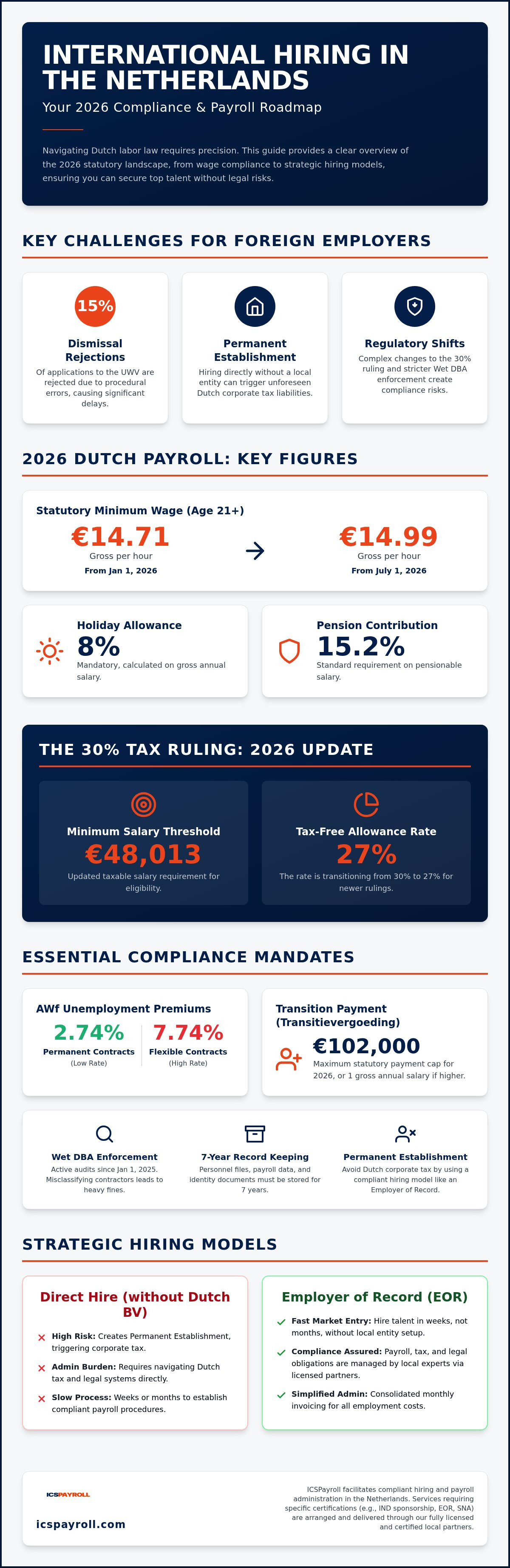
Approximately 15% of dismissal applications submitted to the Dutch Employee Insurance Agency (UWV) are rejected or require significant revision due to procedural errors. For international firms, these administrative hurdles represent more than just paperwork; they are significant legal risks that can stall expansion and trigger unforeseen liabilities. You likely recognize that the Dutch labor market offers exceptional talent, yet the fear of permanent establishment risks and the complexities of the 30% ruling changes often create a barrier to entry.
This guide ensures you master international hiring Netherlands compliance by providing a clear roadmap through the 2026 statutory landscape. You'll learn how to navigate the new EUR 48,013 salary threshold for the 30% ruling and the specific 2026 minimum hourly wage requirements of EUR 14.71. We provide a comprehensive breakdown of the mandatory 8% holiday allowance, pension obligations, and the latest enforcement rules for Wet DBA. By the end of this article, you'll understand how to secure top talent and manage Dutch payroll with clinical precision, moving from recruitment to a compliant start date in weeks rather than months.
Key Takeaways
- Identify the 2026 regulatory shifts to mitigate permanent establishment risks and maintain strict international hiring Netherlands compliance.
- Ensure wage accuracy by applying the 2026 statutory minimum of EUR 14.71 per hour and the mandatory 8 percent holiday allowance.
- Apply for the 30 percent ruling using the updated EUR 48,013 salary threshold and understand the impact of the 27 percent tax free rate transition.
- Accelerate market entry by using an Employer of Record model to hire talent in weeks without the delays of direct local entity incorporation.
- Simplify complex administrative processes through consolidated monthly invoicing and expert payroll support arranged via licensed partners.
Navigating the Dutch Regulatory Landscape for International Hiring
The Dutch labor market in 2026 is defined by a shift toward stricter enforcement and administrative transparency. Foreign entities must recognize that the Belastingdienst (Dutch Tax Administration) has moved past the previous moratorium on enforcement. Since January 1, 2025, authorities are actively auditing employment relationships to ensure correct classification. For companies managing international hiring Netherlands compliance, this means the reality of the work now outweighs the text of a contract. Government focus has shifted from contractual agreements to the daily operational reality of the working relationship.
Failure to comply results in immediate financial penalties and retroactive premium collections. The Belastingdienst monitors wage tax, national insurance contributions, and employee insurance premiums with increased scrutiny. Administrative precision is the only defense against automated auditing systems. These systems identify discrepancies in wage tax filings almost instantly, triggering inquiries that can consume months of management time. Without a local Dutch BV, foreign employers often struggle to interface with these systems. Local expertise is a necessity rather than an option to avoid these administrative traps.
The 2026 Compliance Audit for Foreign Employers
To maintain a secure standing, employers should consult the Chamber of Commerce (KVK) for the latest commercial and labor standards. A critical administrative pillar is the seven year record keeping requirement. You must store all personnel files, payroll data, and identity documents for this duration to satisfy potential audits. Effective record keeping isn't just a best practice; it's a legal mandate that protects your business during retroactive inspections. The Wet DBA requires a clear distinction between employees and independent contractors. Misclassification in 2026 triggers heavy fines and the forced payment of social security premiums for workers who are deemed disguised employees.
Avoiding Permanent Establishment Risk
Hiring talent directly without a local legal entity can inadvertently create a Permanent Establishment. This status forces your foreign company into the Dutch corporate tax net, creating complex reporting duties and dual taxation risks. It effectively treats your presence as a local branch, regardless of whether you've formally incorporated. You can mitigate this by utilizing structured hiring models that isolate your core business from local tax liabilities. For a step by step review of your current status, refer to the Dutch Employment Compliance Checklist. This audit ensures you access Dutch talent while protecting your global corporate structure from unnecessary regulatory exposure.
Essential Pillars of Dutch Labor Law and Wage Compliance
Dutch wage standards are rigorous and require precise calculation to ensure international hiring Netherlands compliance. As of January 1, 2026, the statutory minimum wage is set at EUR 14.71 gross per hour for employees aged 21 and older. This rate increases to EUR 14.99 gross per hour on July 1, 2026. Employers must also factor in the mandatory 8 percent holiday allowance, which is calculated on the total gross annual salary. Most companies choose to pay this as a lump sum in May, though monthly accrual is also permissible if clearly documented in the employment contract.
Beyond base salary, pension contributions represent a significant portion of the total cost of employment. In 2026, the standard pension contribution requirement is 15.2 percent of the pensionable salary. You must also account for the statutory transition payment (transitievergoeding) if a contract is terminated. The maximum transition payment for 2026 is capped at EUR 102,000, or one gross annual salary if the employee earns more than this amount. Precise budgeting for these statutory costs prevents the "surprise expenses" that often derail international expansion plans. If you need a detailed breakdown of these figures for a specific role, our team provides Dutch payroll administration services that include comprehensive cost projections.
Statutory Benefits and Social Security Contributions
Employers are responsible for several mandatory premiums that fund the Dutch social security system. For 2026, the AWf (General Unemployment Fund) low rate is 2.74 percent for permanent contracts, while the high rate for flexible contracts is 7.74 percent. You must also pay the Aof (Disability Fund) premium, which ranges from 6.27 percent to 7.63 percent depending on company size, and the Zvw (Health Insurance Act) contribution of 6.10 percent. A unique aspect of Dutch law is the sickness risk coverage; employers must pay at least 70 percent of an ill employee's salary for up to two years. Detailed rules for paternity and parental leave can be found on the official Rijksoverheid portal.
Contractual Requirements and Ketenregeling
The "Ketenregeling" or chain rule limits the use of temporary contracts. An employee is automatically entitled to a permanent contract after three consecutive fixed term contracts or after 36 months of service. You must also provide an employee handbook to define workplace policies and ensure compliance with the 2026 non compete reforms. These reforms limit non compete clauses to 12 months and require employers to pay 50 percent of the monthly salary for each month the clause is enforced. Probation periods are strictly regulated; they cannot exceed two months for permanent roles or one month for fixed term contracts between six months and two years.
Managing Migrant Visas and the 30 Percent Tax Ruling
Effective international hiring Netherlands compliance relies heavily on leveraging tax incentives while meeting strict income criteria. The 30 percent ruling remains the primary fiscal instrument for attracting global talent to the Dutch market. For 2026, the standard taxable salary threshold is EUR 48,013. This figure represents the minimum taxable income required after the tax free allowance has been applied. For employees under 30 with a qualifying Master's degree, a reduced taxable salary threshold of EUR 36,497 applies. It's essential to note that the 30 percent ruling benefit is capped; for 2026, it only applies to salaries up to EUR 262,000.
Significant legislative changes have altered the landscape of this tax benefit. The partial non resident status was officially abolished on January 1, 2025. A transitional rule allows employees who were using this status on December 31, 2023, to continue benefiting until December 31, 2026. New arrivals in 2026 no longer have access to this specific advantage. Additionally, employers must prepare for the transition to a 27 percent tax free rate. While the 30 percent rate remains for existing rulings, the allowance will decrease to 27 percent starting January 1, 2027, for newer applications. Maintaining administrative precision during these transitions is vital for long term fiscal security.
Expedited Highly Skilled Migrant Visa Processing
Securing work authorization for non-Schengen staff requires precise coordination with the Immigration and Naturalisation Service (IND). While ICSPayroll is not a direct IND recognized sponsor, these applications are arranged via licensed partners to ensure speed and legality. We target an expedited turnaround of approximately three weeks for Highly Skilled Migrant (HSM) visas. This process involves verifying educational credentials and ensuring the proposed salary meets the 2026 HSM thresholds. By managing these logistics through specialized partners, we remove the administrative burden from your internal HR teams.
Assistance with the 30 Percent Ruling Application
Applying for the 30 percent ruling requires a joint submission from both the employer and the employee. This must be filed with the Belastingdienst within four months of the employee’s start date to ensure retroactive application to the first day of employment. If this deadline is missed, the ruling only applies from the first day of the month following the application month. Our team manages the complexities of this process to ensure your international hiring Netherlands compliance remains uncompromised. We provide step by step guidance to verify that the employee lived more than 150 kilometers from the Dutch border for at least 16 out of the 24 months prior to their recruitment.
Strategic Hiring Models: Entity Setup vs. Employer of Record
Incorporating a Dutch BV (Besloten Vennootschap) provides a permanent footprint but requires significant time and capital investment. You must navigate notary requirements, tax registrations, and bank account openings, which often take months to finalize. For businesses that need to move quickly, international hiring Netherlands compliance is often better served through an Employer of Record (EOR) model. This structure allows you to onboard talent in weeks rather than months. The EOR serves as the legal employer of record, managing all statutory duties while your firm retains operational control of the employee's daily tasks. It's particularly effective for testing the Dutch market or securing high priority talent before a local entity is fully established.
The EOR model mitigates the risks of permanent establishment by ensuring that all local tax and labor requirements are met by a compliant Dutch entity. It simplifies the complexities of the Dutch tax system and social security premiums. By outsourcing these functions, you avoid the administrative burden of registering with the Belastingdienst and managing monthly Loonaangifte filings. This arrangement ensures international hiring Netherlands compliance while allowing your HR team to focus on talent development rather than navigating local bureaucracy. It acts as a secure bridge between your global headquarters and the specific demands of the Dutch labor market.
When to Choose a Local Employer of Record
Speed to market is the primary advantage of the EOR approach. You can start operations immediately while a BV registration with the Chamber of Commerce (KVK) is pending or if you prefer to avoid entity setup altogether. This model is ideal for managing small to medium remote teams without the overhead of a local HR department. For a comprehensive comparison of these hiring strategies, read our detailed report on PEO Services in the Netherlands. These services, arranged via licensed partners, provide a secure foundation for your talent acquisition strategy.
The Payroll Factor Pricing Model
International finance departments often struggle with the fragmented nature of Dutch statutory costs. The payroll factor pricing model consolidates social security, pension contributions, and insurance into a single, transparent monthly invoice. This eliminates the need for separate billing for HR administration or digital portal access. You'll receive a predictable cost structure that facilitates accurate forecasting and simplifies global reporting. This transparency ensures there are no surprise costs during the employment lifecycle, as the total cost of employment typically ranges from 1.3 to 1.5 times the gross salary. To see how this model fits your specific hiring needs, you can request a tailored Dutch payroll quotation today.
Accelerating Compliant Hiring with ICSPayroll
Achieving international hiring Netherlands compliance requires a partner that combines technical precision with operational speed. ICSPayroll removes the complexity of local bureaucracy by providing a comprehensive solution for your employment needs. When you provide specific employee details, we deliver a tailored quotation within 24 hours. This rapid response allows your finance and HR departments to make informed decisions without the delays typical of traditional consultancy firms. You gain immediate clarity on statutory costs, including the 2026 minimum hourly wage of EUR 14.71 and the mandatory 8 percent holiday allowance.
Managing a remote workforce in the Netherlands involves more than just payroll processing. Our online portal provides 24/7 access to essential documents, including payslips, employment contracts, and real time holiday balances. This transparency benefits both the employer and the employee, fostering a professional and compliant working relationship. We also provide ongoing support for sick leave management and reintegration. Under Dutch law, the two year salary payment requirement for ill employees is a significant liability. Our specialists guide you through the mandatory steps of the Gatekeeper Improvement Act to ensure you remain fully compliant while supporting your staff.
Expert Led Compliance and Payroll Administration
Our team handles the full cycle of payroll administration, from monthly Loonaangifte filings with the Belastingdienst to the calculation of employer premiums like AWf and Aof. You receive direct support from Dutch payroll specialists who understand the nuances of the 2026 labor law reforms. This includes ensuring all contracts adhere to the latest non compete clause restrictions and the EUR 102,000 transition payment cap. By centralizing these functions, we provide a stabilizing force for your business as you enter the Dutch market. We act as the bridge between your corporate goals and the meticulous requirements of Dutch legal standards.
Getting Started: Your First Hire in the Netherlands
Starting your operations doesn't have to take months. We can provide a draft service agreement and an employment contract within days of your initial inquiry. ICSPayroll, through services arranged via licensed partners, employs your staff so you can focus entirely on your core business activities. This model ensures that every aspect of the employment relationship, from the 30 percent ruling application to the HSM visa process, is managed with clinical precision. Whether you are hiring a single specialist or scaling a remote team, we offer the security and reliability needed for successful international hiring Netherlands compliance. Contact us today for a comprehensive compliance audit or a tailored quotation to begin your journey in the Netherlands.
Securing Your Dutch Expansion for 2026
The Dutch labor market rewards companies that prioritize administrative precision and legal foresight. By mastering the 2026 statutory requirements, from the EUR 14.71 minimum hourly wage to the updated 30 percent ruling thresholds, you protect your business from the risks of permanent establishment and retroactive tax penalties. Transitioning your focus from entity incorporation to an efficient Employer of Record model allows you to secure top tier talent without the months of delay associated with a Dutch BV.
Maintaining international hiring Netherlands compliance is a strategic advantage that fosters long term stability. Our team provides the local expertise needed to navigate these complexities with clinical precision. We offer a consolidated monthly invoice for all employment costs and manage HSM visa processing via licensed partners in approximately three weeks. It's time to move forward with the confidence that your payroll and tax filings meet every official Dutch standard.
Hire in the Netherlands with confidence: Request a quotation within 24 hours. We look forward to helping you build a compliant and successful team.
Frequently Asked Questions
How quickly can I hire an employee in the Netherlands without a local entity?
You can hire an employee in weeks by using an Employer of Record (EOR) model rather than waiting months for local entity incorporation. This approach ensures international hiring Netherlands compliance while you bypass the need for a Dutch BV. The EOR acts as the legal employer, managing all payroll and statutory duties. This allows you to start operations almost immediately once employee details are finalized and contracts are signed.
What is the minimum hourly wage in the Netherlands for 2026?
The statutory minimum wage for 2026 is set at EUR 14.71 gross per hour as of January 1. This rate is scheduled to increase to EUR 14.99 gross per hour on July 1, 2026. These figures apply to all employees aged 21 and older. You must also calculate the mandatory 8 percent holiday allowance on top of this base hourly rate to meet Dutch wage standards.
How does the 30 percent ruling salary threshold work in 2026?
To qualify for the 30 percent ruling in 2026, the standard taxable salary threshold is EUR 48,013 after the allowance is applied. Employees under 30 with a Master's degree have a lower threshold of EUR 36,497. The benefit is capped at a salary of EUR 262,000. Note that partial non resident status has been abolished, though transitional rules apply for those who held the status before 2024. Details are available at Belastingdienst.nl.
Can I hire non-EU citizens for my Dutch team?
You can hire non-EU citizens by utilizing the Highly Skilled Migrant (HSM) visa program. These applications are arranged via licensed partners who hold the necessary IND sponsorship status. The candidate must meet specific salary criteria and be recruited from abroad. This model provides a secure path for bringing global talent into your Dutch operations without the administrative burden of obtaining your own sponsorship license.
What are the mandatory employer contributions for Dutch social security?
Employers are responsible for several mandatory premiums, including the AWf (Unemployment Fund), Aof (Disability Fund), and Zvw (Health Insurance Act). For 2026, the Zvw contribution is 6.10 percent on income up to EUR 79,409. AWf rates vary between 2.74 percent for permanent contracts and 7.74 percent for flexible ones. These contributions fund the robust Dutch social security system and must be filed monthly via the Belastingdienst.
Is a written employment contract required by Dutch law?
While an oral agreement is technically valid, a written contract is essential for international hiring Netherlands compliance. Specific clauses, such as probation periods and non-compete agreements, are legally void unless documented in writing. EU transparency directives also require employers to provide written details of essential working conditions within one week of the start date. Maintaining written records for seven years is a statutory requirement for all payroll data.
How long does the Highly Skilled Migrant visa process take?
The Highly Skilled Migrant visa process typically takes approximately three weeks when arranged via licensed partners. This expedited timeline is much faster than the months required for standard work permits. The process includes the initial IND application and the collection of the visa at a Dutch embassy abroad. Providing complete documentation, such as educational credentials and a valid passport, is critical for maintaining this rapid turnaround. More information is on the IND website.
What is the maximum transition allowance for 2026?
The maximum statutory transition allowance for 2026 is capped at EUR 102,000. If an employee's annual gross salary exceeds this amount, the cap is adjusted to equal one gross annual salary. This payment is mandatory for most contract terminations, including the non-renewal of fixed term contracts. Accurate calculation of this liability is vital for your long term financial planning and compliance with Dutch labor law.

Article by
Joost Hubregtse
Joost Hubregtse is Director of ICS Staffing & Payroll B.V., the wholly owned subsidiary of Intercompany Solutions behind ICS Payroll. He is responsible for Employer of Record and Dutch payroll services: employment contracts, wage tax and social security filings, holiday allowance, pension, sick leave and CAO compliance, with onboarding possible within 48 hours.
Frequently Asked Questions
You can hire an employee in weeks by using an Employer of Record (EOR) model rather than waiting months for local entity incorporation. This approach ensures international hiring Netherlands compliance while you bypass the need for a Dutch BV. The EOR acts as the legal employer, managing all payroll and statutory duties. This allows you to start operations almost immediately once employee details are finalized and contracts are signed.
The statutory minimum wage for 2026 is set at EUR 14.71 gross per hour as of January 1. This rate is scheduled to increase to EUR 14.99 gross per hour on July 1, 2026. These figures apply to all employees aged 21 and older. You must also calculate the mandatory 8 percent holiday allowance on top of this base hourly rate to meet Dutch wage standards.
To qualify for the 30 percent ruling in 2026, the standard taxable salary threshold is EUR 48,013 after the allowance is applied. Employees under 30 with a Master's degree have a lower threshold of EUR 36,497. The benefit is capped at a salary of EUR 262,000. Note that partial non resident status has been abolished, though transitional rules apply for those who held the status before 2024. Details are available at Belastingdienst.nl.
You can hire non-EU citizens by utilizing the Highly Skilled Migrant (HSM) visa program. These applications are arranged via licensed partners who hold the necessary IND sponsorship status. The candidate must meet specific salary criteria and be recruited from abroad. This model provides a secure path for bringing global talent into your Dutch operations without the administrative burden of obtaining your own sponsorship license.
Employers are responsible for several mandatory premiums, including the AWf (Unemployment Fund), Aof (Disability Fund), and Zvw (Health Insurance Act). For 2026, the Zvw contribution is 6.10 percent on income up to EUR 79,409. AWf rates vary between 2.74 percent for permanent contracts and 7.74 percent for flexible ones. These contributions fund the robust Dutch social security system and must be filed monthly via the Belastingdienst.
While an oral agreement is technically valid, a written contract is essential for international hiring Netherlands compliance. Specific clauses, such as probation periods and non-compete agreements, are legally void unless documented in writing. EU transparency directives also require employers to provide written details of essential working conditions within one week of the start date. Maintaining written records for seven years is a statutory requirement for all payroll data.
The Highly Skilled Migrant visa process typically takes approximately three weeks when arranged via licensed partners. This expedited timeline is much faster than the months required for standard work permits. The process includes the initial IND application and the collection of the visa at a Dutch embassy abroad. Providing complete documentation, such as educational credentials and a valid passport, is critical for maintaining this rapid turnaround. More information is on the IND website.
The maximum statutory transition allowance for 2026 is capped at EUR 102,000. If an employee's annual gross salary exceeds this amount, the cap is adjusted to equal one gross annual salary. This payment is mandatory for most contract terminations, including the non-renewal of fixed term contracts. Accurate calculation of this liability is vital for your long term financial planning and compliance with Dutch labor law.