
Dutch Employment Compliance Checklist: The 2026 Essential Audit for Foreign Employers
By Joost Hubregtse, Director, ICS Staffing & Payroll
All blog posts are reviewed and fact checked by our labour law lawyer Zishan Hussain and our director. Editorial standards
A single administrative oversight in Dutch payroll can trigger fines exceeding tens of thousands of Euros from the Belastingdienst. Most foreign employers recognize that expanding into the Netherlands offers incredible talent opportunities, yet the complexity of the 30% ruling and the two-year sick pay obligation remains a constant source of anxiety. This 2026 dutch employment compliance checklist provides the authoritative framework you need to secure a 100% compliant hiring process and eliminate legal uncertainty.
You will master every essential requirement, from the 2026 salary threshold of €48,013 for the 30% ruling to the mandatory 8% holiday allowance. We examine the specific steps for managing "Ketenregeling" contract limits and the latest enforcement of Wet DBA regarding self-employed contractors. Following this methodical audit allows you to remove the administrative burden and focus on your core business growth with total peace of mind.
Key Takeaways
- Identify the most efficient legal vehicle for your expansion by comparing a Dutch BV to an Employer of Record (EOR) model to mitigate Permanent Establishment risks.
- Use our comprehensive dutch employment compliance checklist to ensure every contract includes mandatory clauses and follows 2026 statutory probation period rules.
- Stay aligned with 2026 financial benchmarks, including the €14.71 minimum hourly wage and the €48,013 salary threshold for 30% ruling applications.
- Protect your organization from financial exposure by mastering the two-year sick pay obligation and completing mandatory Risk Assessment and Evaluation (RI&E) protocols.
- Learn how consolidating payroll and tax filings through a local partner can eliminate administrative burdens and prevent heavy penalties from the Belastingdienst.
Pre-Hiring Audit: Establishing Your Legal Footprint in the Netherlands
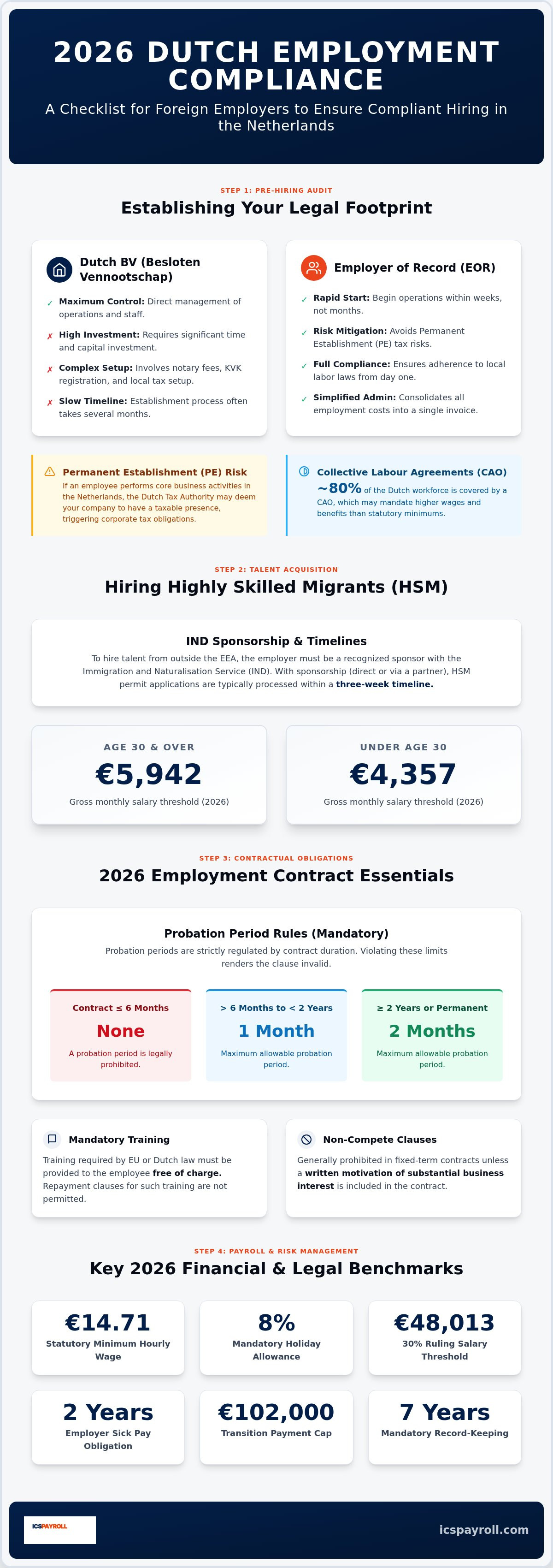
Every successful expansion begins with a clear legal foundation. Your first task on a Dutch employment compliance checklist is to determine how your business will interact with the Dutch Tax Authority. Foreign entities often face significant Permanent Establishment (PE) risks when hiring local staff. If an employee performs core business activities or has the authority to conclude contracts from a home office in the Netherlands, the Belastingdienst may deem your company to have a taxable presence. This triggers corporate tax obligations and complex reporting requirements that many international firms aren't prepared to manage.
Entity Setup vs. EOR Solutions
Establishing a local Dutch BV provides maximum control but requires a significant investment of time and capital. The process involves notary fees, Chamber of Commerce (KVK) registration, and setting up local tax numbers, which often takes several months. In contrast, an Employer of Record (EOR) solution allows you to begin operations in weeks. By utilizing an EOR model, arranged through licensed partners, you bypass the need for immediate incorporation. All employment costs are consolidated into a single monthly invoice. This approach mitigates PE risk while ensuring full compliance with local labor laws from day one. You must also verify if your sector falls under a Collective Labour Agreement (CAO). These agreements cover approximately 80% of the Dutch workforce and often mandate higher wages or better benefits than statutory minimums.
Highly Skilled Migrant (HSM) Preparedness
Hiring talent from outside the European Economic Area (EEA) is a primary driver for many international companies and a critical component of a Dutch employment compliance checklist. To hire these individuals, the employer must be a recognized sponsor with the Immigration and Naturalisation Service (IND). While ICSPayroll is not an IND sponsor directly, we arrange these services via licensed partners to facilitate rapid onboarding. For recognized sponsors, the IND typically processes HSM permit applications within a three-week timeline. You must ensure the candidate meets the 2026 salary thresholds, which are €5,942 gross per month for those aged 30 and over, or €4,357 for those under 30. Preparing the necessary documentation, such as legalized birth certificates and employment contracts, is a vital step to avoid delays in the visa process.
The 2026 Dutch Employment Contract Checklist: Mandatory Clauses
The contract is the most critical document in your dutch employment compliance checklist. Since the implementation of the EU Transparent Terms Directive, Dutch labor law requires employers to provide comprehensive information about employment conditions within one week of the start date. Failure to include specific mandatory clauses can lead to significant legal liability or render certain provisions void. You must ensure that every agreement reflects the most recent 2026 legal standards to avoid disputes with the Belastingdienst or labor courts.
Probation periods are strictly regulated based on contract duration (business.gov.nl). For contracts of six months or less, a probation period is legally prohibited. If the contract lasts between six months and two years, the maximum allowable probation is one month. Permanent contracts or fixed-term agreements of two years or longer permit a maximum of two months. Violating these limits means the probation clause is automatically invalid. You don't want to discover a clause is unenforceable during a difficult termination process.
Employers must also account for mandatory training requirements. Under current law, any training required by EU or national legislation must be provided free of charge. You can't require employees to pay for this training or include a repayment clause. Additionally, non-compete clauses are generally prohibited in fixed-term contracts unless you provide a written motivation of substantial business interest within the contract itself. While reforms to non-compete clauses are currently under legislative review, the requirement for a written justification in fixed-term roles remains a strict necessity for enforcement (business.gov.nl.
Contract Duration and the Ketenregeling
The "Ketenregeling" (chain rule) prevents the endless use of temporary contracts. An employee automatically transitions to a permanent contract after three consecutive fixed-term agreements or after 36 months of temporary employment government.nl). A gap of more than six months between contracts resets this chain. Notice periods must also be clearly defined; while employees typically have a one-month notice period, the employer's notice period often scales with the employee's length of service. If you're unsure if your current templates align with these rules, our Dutch payroll administration experts can help verify your documentation.
Mandatory Work Pattern Disclosures
Transparency regarding work schedules is now a statutory requirement. Contracts must specify the work location and whether the work pattern is predictable or unpredictable. For unpredictable schedules, you must define the reference days and hours when the employee can be required to work. Employees who've been with a company for at least 26 weeks have the right to request more predictable employment conditions. You're legally required to respond to such requests in writing within one month (business.gov.nl.
Statutory Payroll & Tax Compliance: 2026 Financial Benchmarks
Financial precision is the cornerstone of a successful expansion into the Netherlands. Your dutch employment compliance checklist must prioritize the 2026 statutory benchmarks to ensure total alignment with the Belastingdienst. As of January 1, 2026, the statutory minimum hourly wage is €14.71 for employees aged 21 and over. This rate is scheduled to increase to €14.99 on July 1, 2026. On top of the base salary, employers are legally required to pay a holiday allowance (vakantiegeld) of at least 8% of the employee's gross annual salary. This is typically paid as a lump sum in May, though it's possible to distribute it monthly if specified in the contract.
Managing the timing and accuracy of "Loonaangifte" (wage tax return) filings is essential. The Dutch Tax Authority enforces strict monthly or four-weekly deadlines for these returns. Late filings or incorrect payments often result in significant penalties. You're also legally required to maintain all payroll and business records for a mandatory retention period of at least seven years. This administrative burden is a primary reason why many foreign firms choose to consolidate their operations through a local partner.
Managing the 30% Tax Ruling
The 30% ruling remains a powerful tool for attracting international talent, but the eligibility criteria and rates have become more restrictive. For 2026, the minimum taxable salary threshold is €48,013 for standard applicants. For employees under 30 with a qualifying master's degree, the threshold is €36,497. It's vital to recognize that for rulings issued after 2024, the tax-free allowance rate is scheduled to be 27% rather than the historical 30%. Furthermore, the partial non-resident status was abolished on January 1, 2025. While a transitional arrangement exists until the end of 2026 for those using the status on December 31, 2023, new hires won't benefit from this tax exemption on savings and investments. Our 30% ruling application service, facilitated via our licensed partners, ensures that these complex applications are handled with technical precision.
Employer Premiums and Social Security
Budgeting for a Dutch employee requires accounting for various social security premiums. For 2026, the low AWf (unemployment) contribution for permanent contracts is 2.74%, while flexible or temporary contracts trigger the high rate of 7.74%. Small employers pay a differentiated Aof (disability) premium of 6.27%, whereas medium and large employers pay 7.63%. Additionally, the employer's income-related contribution to the healthcare insurance (Zvw) is 6.10% on income up to €79,409. Beyond these statutory premiums, you should budget for a standard pension scheme contribution of approximately 15.2% to remain competitive in the Dutch labor market.
Social Security and Risk Management: Protecting Your Dutch Workforce
Beyond tax and salary benchmarks, a comprehensive dutch employment compliance checklist must address the significant social security obligations and operational risks inherent in the Dutch market. The Netherlands maintains some of the most robust worker protections in Europe. Foreign employers often find the financial scale of these obligations surprising. Failure to prepare for long-term sickness or workplace safety audits can result in liabilities that far exceed standard payroll costs. You must implement these protections from the first day of employment to secure your investment in the region.
The two-year sick pay obligation is perhaps the most significant financial risk for any employer. In the Netherlands, you're legally required to pay at least 70% of an employee's salary for up to 104 weeks of illness. For most professional roles, this is often topped up to 100% in the first year via the employment contract. Additionally, every employer with staff must conduct a Risk Assessment and Evaluation (RI&E) for the workspace. This document identifies health and safety risks and includes a plan of approach to mitigate them (business.gov.nl). If an employee is terminated, you're also liable for the statutory transition allowance (transitievergoeding). For 2026, this payment is capped at €102,000, or one annual salary if the employee's yearly earnings exceed that amount.
Sick Leave and Reintegration Guidance
Managing illness requires strict adherence to the Gatekeeper Improvement Act (Wet Verbetering Poortwachter). This law mandates a specific timeline for reintegration efforts to prevent long-term disability. You must register sick leave on the first day through a secure company portal. Within six weeks, a problem analysis must be conducted by a certified occupational health service (Arbodienst). You're required to collaborate with the employee to create a reintegration plan by week eight. Managing these complex obligations requires local expertise. Our Employer of Record solutions, arranged through licensed partners, ensure your workforce is protected while you remain fully compliant.
Pension and Benefit Administration
Enrollment in a compliant pension scheme is a standard expectation in the Dutch labor market. While some sectors have mandatory industry-wide funds, others allow for private company schemes. You should provide every hire with a detailed employee handbook that outlines local HR policies, including holiday entitlement and the mandatory 8% holiday allowance. Finally, Dutch law requires you to maintain a seven-year record-keeping standard for all personnel and payroll data (belastingdienst.nl). This includes copies of identification documents, contracts, and salary statements, which must be readily available for audit by the Tax Authority or the Labor Inspectorate.
Streamlining Compliance: Why a Local EOR Partner is the Strategic Choice
Completing a dutch employment compliance checklist is a rigorous administrative undertaking. For many foreign employers, managing separate filings for social security, pension, and wage tax returns is not a sustainable long-term strategy. An Employer of Record (EOR) solution, arranged via licensed partners, serves as a comprehensive bridge. It consolidates all employment costs into one clear monthly invoice. This model removes the need for your business to register directly with the Belastingdienst or the KVK before hiring.
Navigating the shifting landscape of Dutch labor law requires local vigilance. While the original VBAR legislation was scrapped in March 2026, the legal presumption of an employment contract for workers earning below a specific hourly rate remains a critical compliance risk. Engaging a local partner provides the expertise needed to manage these Wet DBA enforcement risks effectively. You gain peace of mind knowing that every administrative detail is handled by specialists who understand the 2026 regulatory environment.
The Payroll Factor Pricing Model
Our payroll factor pricing model simplifies financial planning. We convert the gross salary of your employee into a transparent, all-inclusive invoice. This factor covers mandatory pension contributions, the two-year sickness risk, and all HR administration costs. You receive a predictable cost structure without hidden fees. We provide tailored quotations within 24 hours of your inquiry to facilitate rapid decision-making. This transparency is essential for maintaining a 100% compliant dutch employment compliance checklist while managing international budgets.
Market Entry in Weeks Not Months
Speed is a significant competitive advantage. While establishing a Dutch BV can take several months, an EOR model allows you to onboard talent in as little as three weeks. This is especially beneficial when navigating Highly Skilled Migrant (HSM) visa processing, which we arrange via licensed partners. You can begin operations while your local entity is still in formation. Service agreements are typically ready within days of our first contact. This ensures your hiring process remains compliant from the first day of employment. Employees gain access to a dedicated online portal to view payslips, contracts, and real-time holiday balances.
Securing Your Dutch Expansion for 2026
Managing the complexities of Dutch labor law requires precision and local insight. By following this 2026 dutch employment compliance checklist, your organization can effectively mitigate the financial risks associated with the two-year sick pay obligation and ensure all contracts meet the latest EU Transparent Terms Directive standards. Success in the Netherlands depends on balancing speed with strict adherence to statutory benchmarks, such as the €48,013 salary threshold for the 30% ruling.
Partnering with an Employer of Record allows you to bypass the lengthy process of local entity incorporation while maintaining total compliance. You benefit from consolidated invoicing and expert oversight that removes the administrative burden from your internal teams. With expedited 3-week HSM visa processing and one clear monthly invoice with no surprises, you can focus on scaling your business rather than navigating bureaucracy.
Under the guidance of Payroll Director Joost Hubregtse, we provide the stability you need to thrive in a new market. Hire in the Netherlands with confidence; get your 24-hour quote today. Your international growth is within reach.
Frequently Asked Questions
Can I hire an employee in the Netherlands without a local legal entity?
Yes, you can hire without a local entity by utilizing an Employer of Record (EOR). The EOR, arranged via licensed partners, handles all payroll and legal duties while the employee works for you. This is a vital component of a dutch employment compliance checklist for firms wanting to avoid the complexities of establishing a Dutch BV. It effectively mitigates Permanent Establishment risks while ensuring full compliance with local tax laws.
What is the minimum wage in the Netherlands for 2026?
As of January 1, 2026, the statutory minimum hourly wage is €14.71 for employees aged 21 and older. This rate increases to €14.99 on July 1, 2026. These figures are set by the Dutch government and apply to all sectors unless a Collective Labour Agreement (CAO) mandates a higher rate. You must ensure your payroll system reflects these benchmarks to avoid penalties from the Belastingdienst.
How does the 30% ruling work for international employees in 2026?
For 2026, the 30% ruling requires a minimum taxable salary of €48,013 for standard applicants. Employees under 30 with a master's degree must earn at least €36,497. For rulings issued after 2024, the tax-free allowance rate is 27%. The partial non-resident status was abolished in 2025; however, employees using it on December 31, 2023, can continue until the end of 2026. This benefit is capped at a salary of €262,000.
What are the mandatory holiday allowance requirements in the Netherlands?
The mandatory holiday allowance (vakantiegeld) is 8% of the employee's gross annual salary. Most employers pay this as a lump sum in May. You can find detailed rules for this calculation on belastingdienst.nl. It's a non-negotiable statutory requirement. If you don't include this in your financial planning, you risk significant legal disputes and administrative fines during a labor audit.
How long is the probation period for a Dutch employment contract?
Probation periods are strictly capped based on contract length. You can't include a probation period for contracts of six months or less. For contracts between six months and two years, the maximum is one month. Permanent contracts or those lasting two years or more allow for a maximum of two months. If you exceed these statutory limits, the entire probation clause becomes legally invalid, meaning you can't terminate the employee without notice.
What is the ketenregeling and how does it affect contract renewals?
The "Ketenregeling" is a chain rule that limits temporary employment. An employee is entitled to a permanent contract after three consecutive fixed-term agreements or after 36 months of service. A gap of more than six months between contracts resets this chain. Monitoring these contract renewals is a key part of any dutch employment compliance checklist to prevent employees from automatically gaining permanent status without your explicit consent.
What are the employer obligations for sick leave in the Netherlands?
Employers must pay at least 70% of an employee's gross salary for up to two years (104 weeks) of sickness. You're also responsible for following the Gatekeeper Improvement Act, which mandates specific reintegration steps. This includes hiring an occupational health service (Arbodienst) to assess the employee's ability to work. Failure to meet these obligations can lead to the UWV imposing a third year of mandatory salary payments.
How quickly can I start hiring in the Netherlands using an EOR?
You can begin hiring in as little as two to three weeks by using an Employer of Record. While forming a Dutch BV often takes months, our EOR services, arranged via licensed partners, provide a much faster route. For international talent, the expedited HSM visa processing through the IND typically takes about three weeks. This speed allows you to secure top talent before your competitors do.

Article by
Joost Hubregtse
Joost Hubregtse is Director of ICS Staffing & Payroll B.V., the wholly owned subsidiary of Intercompany Solutions behind ICS Payroll. He is responsible for Employer of Record and Dutch payroll services: employment contracts, wage tax and social security filings, holiday allowance, pension, sick leave and CAO compliance, with onboarding possible within 48 hours.
Frequently Asked Questions
Yes, you can hire without a local entity by utilizing an Employer of Record (EOR). The EOR, arranged via licensed partners, handles all payroll and legal duties while the employee works for you. This is a vital component of a dutch employment compliance checklist for firms wanting to avoid the complexities of establishing a Dutch BV. It effectively mitigates Permanent Establishment risks while ensuring full compliance with local tax laws.
As of January 1, 2026, the statutory minimum hourly wage is €14.71 for employees aged 21 and older. This rate increases to €14.99 on July 1, 2026. These figures are set by the Dutch government and apply to all sectors unless a Collective Labour Agreement (CAO) mandates a higher rate. You must ensure your payroll system reflects these benchmarks to avoid penalties from the Belastingdienst.
For 2026, the 30% ruling requires a minimum taxable salary of €48,013 for standard applicants. Employees under 30 with a master's degree must earn at least €36,497. For rulings issued after 2024, the tax-free allowance rate is 27%. The partial non-resident status was abolished in 2025; however, employees using it on December 31, 2023, can continue until the end of 2026. This benefit is capped at a salary of €262,000.
The mandatory holiday allowance (vakantiegeld) is 8% of the employee's gross annual salary. Most employers pay this as a lump sum in May. You can find detailed rules for this calculation on belastingdienst.nl. It's a non-negotiable statutory requirement. If you don't include this in your financial planning, you risk significant legal disputes and administrative fines during a labor audit.
Probation periods are strictly capped based on contract length. You can't include a probation period for contracts of six months or less. For contracts between six months and two years, the maximum is one month. Permanent contracts or those lasting two years or more allow for a maximum of two months. If you exceed these statutory limits, the entire probation clause becomes legally invalid, meaning you can't terminate the employee without notice.
The "Ketenregeling" is a chain rule that limits temporary employment. An employee is entitled to a permanent contract after three consecutive fixed-term agreements or after 36 months of service. A gap of more than six months between contracts resets this chain. Monitoring these contract renewals is a key part of any dutch employment compliance checklist to prevent employees from automatically gaining permanent status without your explicit consent.
Employers must pay at least 70% of an employee's gross salary for up to two years (104 weeks) of sickness. You're also responsible for following the Gatekeeper Improvement Act, which mandates specific reintegration steps. This includes hiring an occupational health service (Arbodienst) to assess the employee's ability to work. Failure to meet these obligations can lead to the UWV imposing a third year of mandatory salary payments.
You can begin hiring in as little as two to three weeks by using an Employer of Record. While forming a Dutch BV often takes months, our EOR services, arranged via licensed partners, provide a much faster route. For international talent, the expedited HSM visa processing through the IND typically takes about three weeks. This speed allows you to secure top talent before your competitors do.