Dutch Payroll Calendar and Deadlines: Filing Reference
By Joost Hubregtse, Director, ICS Staffing & Payroll
All blog posts are reviewed and fact checked by our labour law lawyer Zishan Hussain and our director. Editorial standards
A missed payroll deadline is a compliance failure, not just a calendar inconvenience. In the Netherlands, payroll tax returns are generally due by the last day of the following month. Deadlines can vary around weekends and public holidays, so check the applicable filing notice.
Filing dates, salary payments and annual employee documents follow different schedules. The annual wage statement for the 2025 tax year, for example, is due to each employee by 1 February 2026.
This reference outlines the key dates, explains how weekends and public holidays affect deadlines, and shows how to track changes through your payroll notice and the official 2026 date table.
By Joost Hubregtse, Payroll Director.
Joost Hubregtse is Payroll Director at ICSPayroll, the Dutch payroll and EOR specialist of Intercompany Solutions. A career payroll specialist and former Head of Payroll, he oversees wage tax filings, 30% ruling applications, and employment compliance for international employers.
Reviewed by Joost Hubregtse, Payroll Director, on 10 November 2026.
Key Takeaways
- Build your payroll calendar around the return period in your Dutch Tax Administration notice, whether it is monthly or every four weeks.
- If a filing deadline falls on a weekend or public holiday, the next working day generally applies.
- Use the official 2026 date table and your tax notice to track filing dates and changes; Dutch payroll tax returns have no extension option.
- Submit a nil return for a period with no wages instead of skipping the filing.
- Provide each employee with their 2025 annual wage statement by 1 February 2026.
How do I stay up to date with Dutch payroll changes?
A payroll tax return reports wages and payroll taxes for a specified return period. In the Netherlands, employers generally file monthly, and filing and payment are due by the last day of the following month, according to the Belastingdienst. Deadlines can vary by return period, so check the applicable payroll tax calendar. A reference to the Dutch payroll calendar and deadlines helps separate these tax obligations from salary payment dates.
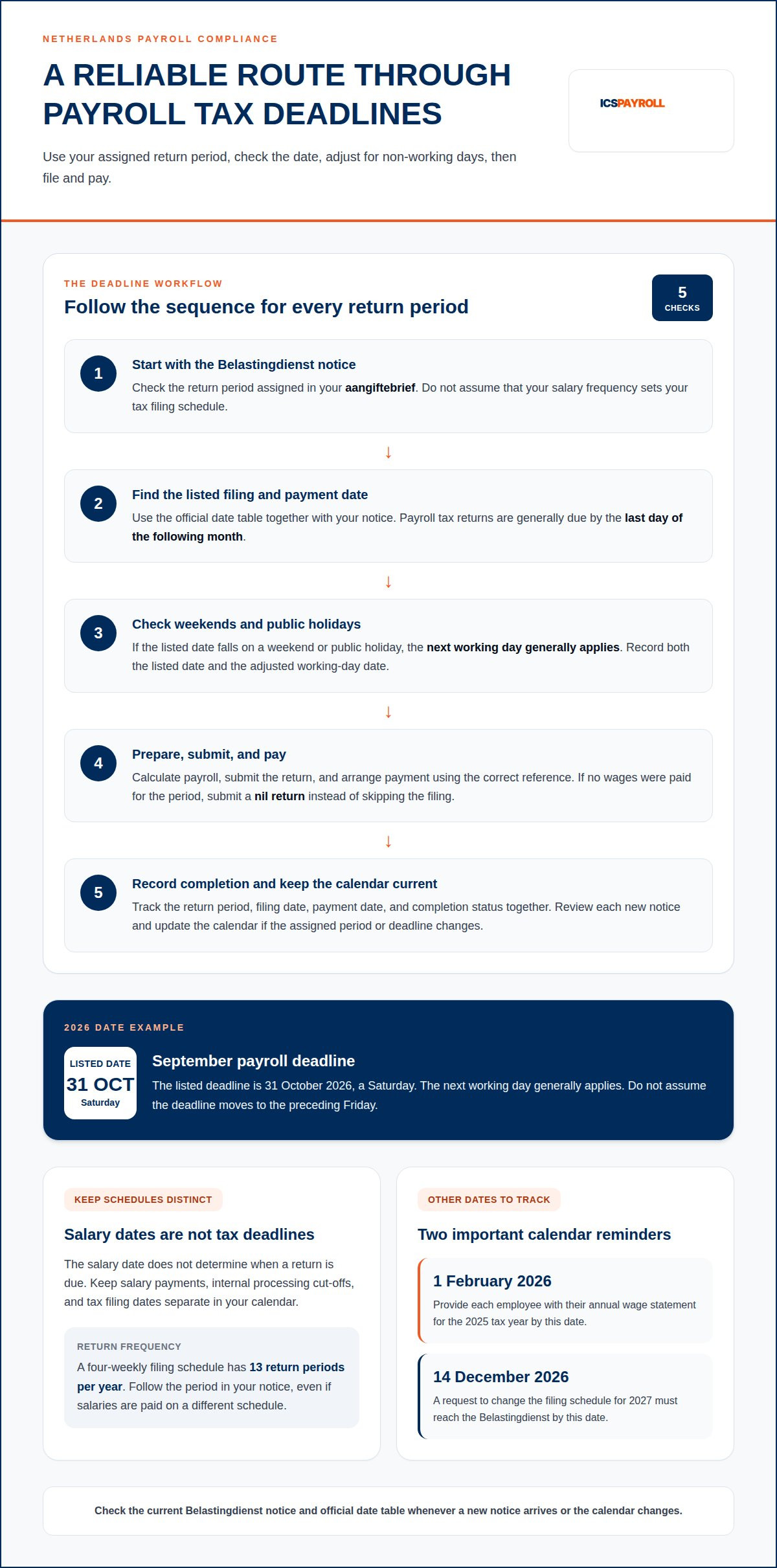
The filing deadline is the final date to submit a return and pay the amount due. Treat filing and payment as connected tasks: calculate payroll, submit the return, then arrange payment using the correct reference. Even if no wages were paid, submit a nil return rather than skipping the filing. Record the return period, filing date, payment date and completion status together.
A payroll cycle is the interval used to calculate and pay employee salaries. Monthly pay is common in the Netherlands, while some sectors use weekly or four-weekly cycles. Employment agreements or collective labour agreements should set out the payroll period and payment date. Keep these dates separate from tax deadlines: the salary date does not determine when a return is due.
A four-weekly payroll cycle covers 13 return periods per year when the employer follows a four-weekly filing schedule. Check the return period in the Belastingdienst aangiftebrief, rather than assuming salary frequency sets the tax filing period. A business paying every four weeks may still need to follow the period assigned in its notice. Weekly payroll also needs a clear schedule for collecting hours and changes.
Employee changes include a new hire, departure, salary adjustment or updated personal details. Send each update and its supporting payroll information by the processing cut-off agreed for your schedule, leaving time to calculate salaries and prepare the return. Dutch rules do not set one universal deadline for sending information to a payroll provider. The practical cut-off depends on the processing arrangement and pay date.
To track changes, keep the current aangiftebrief and official 2026 payroll tax return date table with your calendar. Compare each assigned period against the table, then record any revised deadline or return frequency. For a 2027 change, the request must reach the Belastingdienst by 14 December 2026. Review the Dutch payroll calendar and deadlines whenever a new notice arrives, and update the calendar when the assigned period changes.
For a reliable process, review the Dutch payroll calendar and deadlines alongside internal payroll cut-offs whenever the schedule changes. Assign responsibility for reviewing Belastingdienst notices and recording updates. This helps distinguish the employer’s filing schedule from operational dates for salary processing, employee changes and payment preparation throughout the year.
Deadline changes for weekends and public holidays
A deadline adjustment moves a filing date that falls on a weekend or public holiday to the next working day. In the Netherlands, the next working day generally applies to payroll tax deadlines, according to the Belastingdienst. This adjustment changes the date for filing and payment, not the return period. Keep the listed date and the adjusted working day visible in your calendar.
The 2026 calendar shows why this distinction matters. A payroll deadline may fall on a weekend, so check the applicable date before scheduling filing and payment. The listed deadline for September payroll is 31 October 2026, a Saturday. The next working day generally applies in each case. Do not assume the deadline moves to the preceding Friday. Record the applicable working-day date so payroll processing and payment are scheduled against it.
For each filing period, use this sequence:
- Find the listed deadline for the return period in the Belastingdienst notice and official date table.
- Check whether that date falls on a Saturday, Sunday or public holiday.
- Record the next working day as the adjusted date when the general rule applies.
- Schedule filing and payment against that date, then retain evidence of completion.
A public holiday can affect normal working-day calculations. Because holidays fall on different dates each year, review the calendar annually instead of copying dates from the previous year. Keep internal payroll cut-offs separate from tax deadlines. Plan salary payments and payroll information processing around holidays, even if the filing date moves to the next working day.
Holiday allowance is additional pay for employees, and its statutory minimum is 8% of gross salary, according to Business.gov.nl. Employers typically pay it as a lump sum in May. Include the allowance in payroll calculations and coordinate its processing with the May salary schedule. The date employees receive holiday allowance is separate from the payroll tax filing deadline. A holiday-related deadline adjustment does not itself set or move the salary date.
For payroll processed around a public holiday, check that salaries, holiday allowance, wage tax and applicable pension deductions are recorded correctly. A holiday may affect when information is processed, but it does not remove the requirement to report wages for the relevant period.
For a compliant calendar, keep the holiday list beside the return table and assign responsibility for updating dates each year. Payroll deadline planning support can help coordinate filing and payment steps.
Official 2026 payroll tax return date table
The official 2026 payroll tax return date table lists the filing and payment deadline for each return period. Employers must follow both the table and the return period in their Belastingdienst aangiftebrief. The dates below pair each payroll month with its listed deadline.
| Payroll period | Listed deadline |
|---|---|
| January 2026 | 28 February 2026 |
| February 2026 | 31 March 2026 |
| March 2026 | 30 April 2026 |
| April 2026 | 31 May 2026 |
| May 2026 | 30 June 2026 |
| June 2026 | 31 July 2026 |
| July 2026 | 31 August 2026 |
| August 2026 | 30 September 2026 |
| September 2026 | 31 October 2026 |
| October 2026 | 30 November 2026 |
| November 2026 | 31 December 2026 |
| December 2026 | 31 January 2027 |
A return period is the span of payroll activity reported in one filing. Use the assigned period, not the date salary happens to reach employees. The table gives listed dates; weekend and public-holiday adjustments are covered separately. For example, 31 May 2026 falls on a Sunday, and 31 October 2026 falls on a Saturday.
An income tax return reports an individual’s taxable income for a tax year. The Dutch income tax return for 2025 is due by 1 May 2026. This date is separate from monthly wage tax returns. Do not use the payroll tax table to plan an employee’s annual income tax filing.
A corporate income tax return reports a company’s taxable profits. It is due within five months after the financial year; for a calendar year, the stated deadline is 1 June. This is a separate obligation from payroll tax returns, even when the same business manages both filing calendars.
An extension changes the filing deadline for a particular type of return. Dutch payroll tax returns cannot be extended, so plan preparation around the assigned deadline. Do not assume this rule also determines whether an individual income tax return can be extended. The deadline and process depend on the type of return.
A return-period change request asks the Belastingdienst to change the payroll filing frequency for a future year. For a change covering 2027, the request must be received by 14 December 2026. Record that date separately from the monthly filing deadlines, then update the calendar if the assigned period changes. A clear calendar keeps wage tax filing, payment and other tax returns distinct.
Annual wage statement deadline
An annual wage statement, or jaaropgave, summarizes an employee’s wage information for a tax year. In the Netherlands, the statement for the 2025 tax year is due to each employee by 1 February 2026. Treat it as a separate year-end deliverable, not as a replacement for monthly payroll tax returns.
For year-end reporting, provide the 2025 statement by 1 February 2026. Payroll tax returns remain linked to their return periods: the December 2026 return is due by 31 January 2027. Record corrections against the payroll period they affect and retain the supporting information with the relevant payroll records.
Accuracy starts with reconciling annual statements against the payroll data recorded during the year. Before preparing employee statements, compare annual wage totals and wage tax figures with payroll records and filed returns. Investigate discrepancies before issuing statements. For example, check that a salary adjustment recorded during the year is included in the employee’s annual summary.
Use a year-end sequence to keep the work controlled:
- Close the final payroll period for the tax year and confirm that the related payroll data is complete.
- Review employee-level wage and wage tax records against the returns filed for the year.
- Resolve identified differences in the payroll record and relevant filing workflow.
- Prepare each employee’s jaaropgave and schedule delivery by the applicable deadline.
- Keep the final statement and the records supporting its figures together.
Corrections need a clear audit trail: a record of what changed and why. Note the affected employee, relevant payroll period, corrected information and supporting document. This distinguishes a correction to historical payroll data from a change to a later salary run. Link each correction to the return period it concerns, rather than treating the annual statement deadline as the only year-end date.
Retention is part of the year-end control process. Keeping payroll records organised supports year-end reviews and later retrieval. Preserve the final annual statements, payroll calculations, filed return details and correction records within that retention period. Consistent naming by tax year and employee makes retrieval more reliable when a later payroll review raises a question.
Contracts and payroll records should also agree on the salary arrangements used in annual calculations. If a contract records a salary change, confirm that payroll reflects it for the applicable period before preparing the statement. This helps prevent mismatches between the employee’s documented terms and the annual figures.
Use a separate annual task in the payroll calendar for statement preparation, review and delivery. Set it after the year’s payroll records have been reconciled, while leaving enough processing time before 1 February 2026. This keeps the employee statement deadline distinct from the final monthly return and any corrections that need to be handled.
Dutch payroll compliance
Dutch payroll compliance combines accurate wage processing, timely tax administration and complete employee records. A practical control is to reconcile every salary run against its payslips, return data and payment records.
Payroll Filing and Payment Compliance
Payroll filing and payment compliance means reporting wages and paying the related payroll taxes for each assigned return period. Dutch employers withhold wage tax and social premiums monthly, and the payroll tax return is due by the last day of the following month.
Follow the same sequence for every payroll run: collect employee changes, calculate salaries and deductions, review totals, submit the return and arrange payment. Keep the return confirmation and payment evidence with your payroll records. If no wages were paid during a period, submit a nil return instead of skipping the filing.
Each employee must receive a payslip with each payment. It should show gross salary, net salary, and deductions such as wage tax, social security contributions and pension premiums. From January 2026, the statutory hourly minimum wage for employees aged 21 and over is €14.71. The rate changes to €14.99 from 1 July 2026, so the applicable rate must match the payroll period.
Employment contracts or collective labour agreements should state the payroll period and payment date. Keep these terms aligned with the processing calendar, and record changes when salary arrangements or employee details change. Keep Dutch payroll records organized and accessible so reported amounts can be traced to their source. Store calculations, filed returns, payslips and payment evidence so each reported amount can be traced to its source.
Late Filing and Payment Penalties
A late-filing or late-payment penalty is a charge imposed for failing to meet a payroll tax obligation on time. The Dutch payroll tax default penalty starts at €68. This is a starting amount, not a combined estimate of every possible charge.
Filing and payment are separate actions, so completing one does not complete the other. Submitting a return on time does not settle the amount due, and paying does not replace the required return. Keep separate records for both tasks, including the return period, submission confirmation and payment reference.
Interest and penalties are distinct. A penalty figure does not establish an interest rate or total charge. For an outstanding balance, use the amount stated in the relevant Belastingdienst assessment. If a deadline is approaching, prioritize submitting the return and arranging payment by the applicable date, then retain evidence of both steps.
For structured payroll processing and administration, request Dutch payroll compliance support.
ICSPayroll: Dutch Payroll Administration
ICSPayroll provides Dutch Payroll Administration for companies managing employee pay, payroll tax returns and annual wage statements in the Netherlands. Its payroll administration can coordinate filing periods, payment deadlines and employee records as part of ongoing payroll management.
For companies hiring in the Netherlands, ICSPayroll also offers Employer of Record (EOR). International employers seeking Dutch tax advantages for eligible employees can use its 30% Ruling Application service. These services address different needs: payroll administration supports recurring payroll operations, EOR supports employment in the Netherlands, and the application service concerns the 30% ruling.
For support with Dutch payroll administration or employment in the Netherlands, contact ICSPayroll to discuss your requirements.
Make payroll planning part of your operating rhythm
A calendar is useful when its dates are tied to clear ownership and routine decisions. Assign responsibility for payroll inputs, review, filing and payment, then build those tasks into monthly operations. This turns the Dutch payroll calendar and deadlines into a working process that supports consistent administration as your team changes.
Review the process whenever your workforce, pay arrangements or reporting needs change. A new employee, salary adjustment or different payroll structure can affect the information needed for accurate processing. Keeping the calendar and internal responsibilities aligned helps your business respond methodically instead of relying on last-minute reminders.
ICSPayroll supports companies with Dutch Payroll Administration, Employer of Record (EOR) services and 30% Ruling Applications. If you want to discuss the right support for your Netherlands payroll requirements, contact ICSPayroll. A clear next step can help you put a dependable payroll process in place.
Frequently Asked Questions
How often do I need to file a payroll tax return?
Dutch payroll tax returns are generally filed monthly, although some employers have a four-weekly filing period. Your assigned period determines how often you submit, so align payroll reporting with the period stated in your Belastingdienst notice. A monthly salary schedule, for example, does not by itself mean that your tax return period is monthly. Use the notice to distinguish payroll frequency from the official filing schedule.
What are the Dutch payroll tax filing and payment deadlines in 2026?
For monthly returns, the listed deadline is generally the last day of the month after the payroll period, with the December 2026 return due by 31 January 2027. Examples include 28 February 2026 for January payroll and 30 April 2026 for March payroll. The 2026 date table gives the listed dates for each month. Keep filing and payment tracked as separate tasks, even when they share a deadline.
How often must Dutch employers file payroll tax returns: monthly or every four weeks?
It depends on the return period assigned to the employer. Dutch payroll tax returns are generally filed monthly or every four weeks, and a four-weekly filing cycle has 13 return periods per year. Check the Belastingdienst aangiftebrief rather than assuming that a company’s salary frequency sets its tax return frequency. This distinction matters when payroll dates cross calendar months or the end of the financial year.
When are Dutch payroll tax returns and payments due after each payroll period?
For a monthly return period, filing and payment are generally due by the last day of the following month. For example, February 2026 payroll has a listed deadline of 31 March 2026. Use the deadline associated with the assigned return period, not the date the salary was paid. A nil return is also required for a period with no wages, so include inactive periods in the filing workflow.
What are the Dutch deadlines for paying employee salaries?
There is no single salary payment date that applies to every Dutch employer. The employment contract or applicable collective labour agreement should state the payroll period and payment date. Some employers schedule salary around the 25th or 26th, but that is a common practice rather than a universal deadline. For example, if a contract specifies a monthly payment date, plan payroll processing to meet that agreed date.
How do Dutch public holidays and weekends affect payroll deadlines?
If a payroll tax deadline falls on a weekend or public holiday, the next working day generally applies. For example, the listed 31 May 2026 deadline falls on a Sunday, while 31 October 2026 falls on a Saturday. Record the adjusted working-day deadline in your schedule, but keep the original listed date for reference. Salary payment dates are separate and should still follow the employment terms.
When must Dutch employers issue annual salary statements and provide payslips?
The annual wage statement for the 2025 tax year is due to each employee by 1 February 2026. Separately, employers must provide a payslip with each employee payment. For example, an employee paid monthly should receive a payslip for each monthly payment, as well as the annual statement. Keep both documents distinguishable in employee records, since one records a specific payment and the other summarizes the tax year.
How can employers check their assigned Dutch payroll tax filing frequency and deadlines?
Use the Belastingdienst aangiftebrief to identify the assigned return period, then compare its dates with the official 2026 payroll tax return date table. Keep both references together in the payroll calendar. If planning to change the return period for 2027, the request must reach the Belastingdienst by 14 December 2026. Record the request and update the calendar when the assigned period changes, rather than relying on an older schedule.

Article by
Joost Hubregtse
Joost Hubregtse is Director of ICS Staffing & Payroll B.V., the wholly owned subsidiary of Intercompany Solutions behind ICS Payroll. He is responsible for Employer of Record and Dutch payroll services: employment contracts, wage tax and social security filings, holiday allowance, pension, sick leave and CAO compliance, with onboarding possible within 48 hours.
Frequently Asked Questions
Dutch payroll tax returns are generally filed monthly, although some employers have a four-weekly filing period. Your assigned period determines how often you submit, so align payroll reporting with the period stated in your Belastingdienst notice. A monthly salary schedule, for example, does not by itself mean that your tax return period is monthly. Use the notice to distinguish payroll frequency from the official filing schedule.
For monthly returns, the listed deadline is generally the last day of the month after the payroll period, with the December 2026 return due by 31 January 2027. Examples include 28 February 2026 for January payroll and 30 April 2026 for March payroll. The 2026 date table gives the listed dates for each month. Keep filing and payment tracked as separate tasks, even when they share a deadline.
It depends on the return period assigned to the employer. Dutch payroll tax returns are generally filed monthly or every four weeks, and a four-weekly filing cycle has 13 return periods per year. Check the Belastingdienst aangiftebrief rather than assuming that a company’s salary frequency sets its tax return frequency. This distinction matters when payroll dates cross calendar months or the end of the financial year.
For a monthly return period, filing and payment are generally due by the last day of the following month. For example, February 2026 payroll has a listed deadline of 31 March 2026. Use the deadline associated with the assigned return period, not the date the salary was paid. A nil return is also required for a period with no wages, so include inactive periods in the filing workflow.
There is no single salary payment date that applies to every Dutch employer. The employment contract or applicable collective labour agreement should state the payroll period and payment date. Some employers schedule salary around the 25th or 26th, but that is a common practice rather than a universal deadline. For example, if a contract specifies a monthly payment date, plan payroll processing to meet that agreed date.
If a payroll tax deadline falls on a weekend or public holiday, the next working day generally applies. For example, the listed 31 May 2026 deadline falls on a Sunday, while 31 October 2026 falls on a Saturday. Record the adjusted working-day deadline in your schedule, but keep the original listed date for reference. Salary payment dates are separate and should still follow the employment terms.
The annual wage statement for the 2025 tax year is due to each employee by 1 February 2026. Separately, employers must provide a payslip with each employee payment. For example, an employee paid monthly should receive a payslip for each monthly payment, as well as the annual statement. Keep both documents distinguishable in employee records, since one records a specific payment and the other summarizes the tax year.
Use the Belastingdienst aangiftebrief to identify the assigned return period, then compare its dates with the official 2026 payroll tax return date table. Keep both references together in the payroll calendar. If planning to change the return period for 2027, the request must reach the Belastingdienst by 14 December 2026. Record the request and update the calendar when the assigned period changes, rather than relying on an older schedule.