
Non-competition clauses in the Netherlands: proposed duration limits
By Joost Hubregtse, Director, ICS Staffing & Payroll
All blog posts are reviewed and fact checked by our labour law lawyer Zishan Hussain and our director. Editorial standards
In the Netherlands, there is currently no statutory maximum duration for a non-compete clause. Courts assess each restriction on its facts, so its stated duration alone does not determine whether it is enforceable. Non-competition clause enforceability in the Netherlands also depends on whether the clause meets the applicable legal requirements.
Duration is only one part of the assessment. The clause’s wording, the employment contract and the circumstances of the job matter too. This article explains the current framework and what employers and employees should consider when reviewing a restriction.
It also examines proposed changes to the rules. The bill was sent to the Council of State on 29 June 2026, and parliamentary consideration is expected at the end of 2026, according to the Dutch Senate. Those proposals are not current law.
Key Takeaways
- A Dutch employee must be at least 18 years old for a non-compete clause to be legally valid, and the agreement must be made in writing.
- For a fixed-term contract, the clause needs a written explanation of the legitimate business interest it protects.
- Clear wording matters: the restriction should define the activities and business interests it covers.
- Courts can weigh the employer’s interests against the former employee’s interests and may limit or set aside a clause.
- Assess the clause in the context of the employment relationship, including whether major contract changes affect its justification.
What does a non-compete clause include?
A Dutch non-compete clause restricts an employee’s work after employment ends, usually to protect the employer’s business interests. Its scope and enforceability depend on the written agreement and the circumstances of the employment relationship.
The clause must be agreed in writing, and the employee must agree to it in writing, as described in the Dutch rules on non-compete clauses. It should make clear which work or competing activities are restricted, and for what period after employment. A clause may also define a geographic area or identify the business relationships it protects. These details help both parties understand the practical limits before the employment contract ends.
Age is a separate legal requirement: according to the Government of the Netherlands, an employee must be at least 18 years old for a non-compete clause to be legally valid. A signed clause involving a younger employee does not meet this threshold. Employers should therefore consider age alongside the written agreement, rather than treating a signature as sufficient.
For a fixed-term Dutch employment contract, the employer must explain in writing the legitimate business interest that requires the restriction. The explanation must be specific and reasonable, not a standard statement that merely repeats the clause. It should connect the employee’s role and the employer’s interest to the particular work being restricted. Without the required written justification, the clause may be invalid. In short, the employer must clearly explain the legitimate business interest and why that specific restriction is needed.
Compensation for Restricted Employees
Compensation is payment to an employee for complying with a restriction, but current Dutch law does not provide an automatic right to payment during a non-compete period. That distinction matters when assessing the cost of an existing clause. The proposed reform would require payment of 50% of the employee’s last monthly salary for each month the employer invokes the clause, for up to six months. This is a proposal, not current law.
An employer seeking to enforce a clause may ask a court to order the former employee to comply, potentially subject to a contractual penalty. The court can weigh the employee’s freedom to work against the employer’s interests and may reduce or set aside the restriction. A penalty for breaching the clause is distinct from compensation paid to an employee for complying with it.
Restrictions After Employment Ends
A post-employment restriction applies after the employment relationship ends and generally starts on the employee’s last day. It may limit work for competitors or other activities within the clause’s stated scope. The precise wording matters: a restriction on competing work differs from one limited to specified business relationships.
The start date and wording matter to both parties. The employee needs to know which activities remain restricted after leaving, and the employer must rely on the agreed terms. A court may consider the former employee’s interests and decide that the clause no longer applies or limit its effect. Non-competition clause enforceability in the Netherlands therefore depends on more than the restriction’s end date.
Business-interest justification in permanent contracts
Contract type affects how a non-compete is recorded and assessed. This is particularly important when an employer relies on a written business-interest explanation for a fixed-term employee.
Contract Type and Non-Compete Clauses
For a permanent contract, the employer does not face the same specific written-justification requirement that applies to fixed-term contracts. That does not make the clause automatically enforceable: its wording and impact remain relevant. For fixed-term employment, the Government of the Netherlands’ guidance on non-compete clauses describes the need to explain the business interest in writing. The explanation should connect the restriction to the employee’s actual duties, not rely only on standard wording.
Contractor agreements follow a different legal route from employment contracts. Employment-law rules on non-competes do not automatically apply to a contract for services. A contractor’s restriction must be assessed under the terms and legal framework of that agreement. Before relying on it, establish whether the relationship is employment or contracting, since that classification determines which rules apply.
For example, justifying a restriction for a fixed-term employee who handles sensitive customer pricing raises different questions from restricting a contractor delivering a defined project. The written explanation should show why the particular restriction protects the employer’s business interest in that role. A general reference to confidentiality may not explain why the employee’s future work needs to be restricted. Read the contract provisions together to ensure the justification matches the restriction.
Vague Wording and Contract Interpretation
Contra proferentem is a principle that may guide interpretation when contract wording is ambiguous, particularly if one party drafted it. This matters because unclear terms can lead to disagreement about which conduct the parties agreed to restrict.
For example, “work for a competitor” may leave it unclear whether the restriction applies to every role or only to similar duties. A precise clause identifies the relevant activities and the interest it is intended to protect. Resolve any ambiguity during drafting rather than leaving its meaning to a later dispute. A lawyer can help assess the wording and its legal effect.
Review the agreement as a whole, including definitions and any provisions describing the employee’s responsibilities. If a role changes substantially, the original restriction may no longer align with the work or business interest it was designed to address. Clear drafting helps the parties understand the intended boundary, while the contract type determines which formal justification requirements apply.
Proposed maximum duration of non-competition clauses
Current Dutch law sets no statutory maximum duration for a non-compete; courts assess the agreed period case by case. A Dutch non-compete can be geographically broad only where its defined area is proportionate to the employer’s actual business interest.
Reasonable Duration of Restrictions
Reasonableness involves balancing the time needed to protect a legitimate business interest against the restriction on the former employee’s ability to work. Duration matters because a court can shorten a restriction it considers excessive.
In practice, six months to a year is common, and a one-year period is often considered reasonable. A restriction lasting only a few months may also be reasonable. These are practical reference points, not automatic limits. The employee’s role, the employer’s interests and the written wording all affect the assessment.
Longer periods are not automatically invalid. In a particular case, a court has considered a two-year restriction reasonable, while a three-year clause may be shortened if its effect is excessive. Neither example sets a general rule. They illustrate why duration must be assessed in the context of the specific facts.
The restriction generally starts on the employee’s last day. Over time, the employer’s interest may weaken, while the former employee’s need to work remains. The clause should therefore link its duration to the time needed to protect the specific interest, rather than rely on a standard period without explanation.
Balancing Scope and Duration
Courts assess scope and duration together. A broad restriction lasting longer can limit future work more severely than a narrow one. This matters because the court weighs the employer’s need for protection against the employee’s freedom to work.
Geographical wording should identify the area covered and remain proportionate to the employer’s actual business. A Dutch District Court considered a 35-kilometer geographical range not unreasonable in the case before it. That decision is an example, not a nationwide distance limit. The business’s market and the employee’s role affect whether the same range fits another clause.
A restriction on competing work is different from a solicitation clause, which focuses on business relationships. A clause covering every competitor across a wide area may reach further than one limited to specific activities or customers. Clear wording defines what the former employee may do after termination and gives a court concrete terms to assess.
The proposed reform would set a 12-month maximum and require geographic scope. The bill was sent to the Council of State on 29 June 2026, with parliamentary consideration expected at the end of 2026. These are proposed changes, not current law. Until legislation passes and enters into force, duration and geographical reach remain subject to case-by-case assessment.
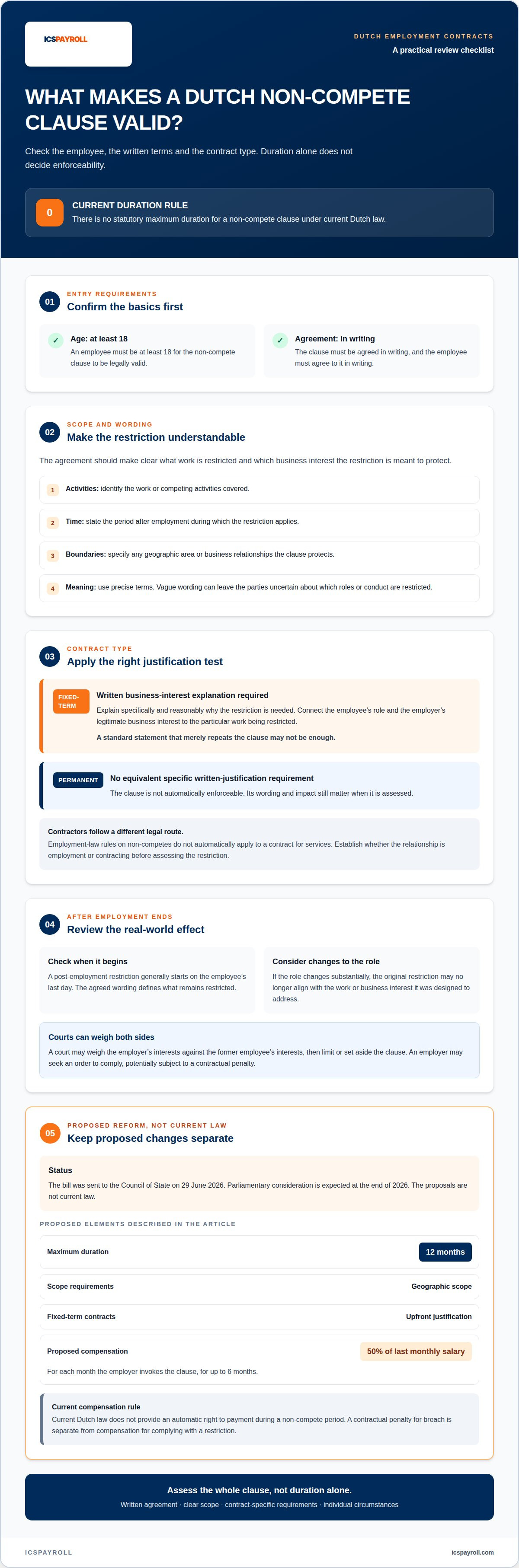
Proposed reforms to non-compete rules
The proposed Dutch reform would amend Article 653 of Book 7 of the Civil Code. It would introduce a maximum period, define additional requirements for invoking a clause, and change how employers compensate restricted employees.
The bill was sent to the Council of State on 29 June 2026, and parliamentary consideration is expected at the end of 2026. It is not current law. Until any legislation passes and enters into force, the existing approach remains: Dutch law sets no statutory maximum duration, and courts assess restrictions case by case. The proposal may still change during parliamentary consideration.
If enacted as proposed, a non-compete could apply for no longer than 12 months after the employment agreement ends. Employers would also need to state the geographic area covered and provide written reasons for that area. This would make the clause’s position and reach more explicit. A nationwide restriction, for example, would need a stated geographic scope and written justification, rather than relying on broad wording alone.
The proposal would also change when an employer must decide whether to invoke a restriction. The employer would have to notify the employee at least one month before the contract ends. If the employer missed that deadline, the clause could not be enforced under the proposed rules. An agreed clause would therefore not automatically prevent the former employee from taking a new position: the employer would need to invoke it on time.
For each month the restriction is invoked, the proposed compensation would equal 50% of the employee’s last monthly salary, for a maximum of six months. A six-month restriction would therefore mean compensation equal to three months’ salary. The proposal would make timely payment a condition of enforcement. If an employer fails to pay on time, it could not enforce the clause for that period.
The proposed changes also address fixed-term contracts. Employers would need to provide an upfront written explanation of the business interest, while current rules already require written justification for a non-compete in a fixed-term contract. The proposal would extend this requirement to permanent contracts and, as described in the proposal, to relationship and solicitation clauses. Under the proposed transitional rules, existing clauses could remain valid despite not meeting the new formal requirements, but would apply only if invoked.
For employers, the proposed framework would make the timing of a decision, geographic scope and compensation central compliance considerations. For employees, it would clarify when a restriction applies and what payment accompanies it. Penalties or damages for breach are separate from the proposed compensation, which would be payment for the restricted period. The proposed rules are not yet in force, so distinguish them from current contract requirements.
Requirements for a valid Dutch non-compete clause
Article 7:653 of the Dutch Civil Code provides the statutory framework for employee non-compete clauses. Its requirements concern the agreement, the contract type, and the effect on both parties. A clause’s presence in an employment contract does not, by itself, establish that every provision can be enforced.
Start with the form of agreement. The clause must be in writing, and the employee must agree to it in writing. The text should identify the restricted work and the employer’s business interest clearly enough to show what the parties agreed. For example, a restriction on work for direct competitors is more specific than a prohibition on all work in the same industry. The employee must also be at least 18 years old, as noted in the earlier section.
Contract type changes the required justification. Since 1 January 2015, a non-compete in a fixed-term employment contract has been allowed only when necessary to protect a legitimate business interest. The contract must contain a specific, written explanation of that interest. The reasons should connect the employee’s position and access to information with the restriction. A generic statement that every employee has access to confidential material may not explain why this particular clause is needed.
The geographic reach and restricted activities should match the employer’s actual interests. A clause covering an entire market when the employee serves only a limited area may be difficult to justify. A narrow restriction on specific competing activities also has a different effect from a broad ban on working for any competitor. Clear terms help a court decide whether the restriction goes beyond the stated business reason.
Article 7:653 gives courts power to moderate a non-compete. An employee may ask a court to set aside all or part of a restriction if its impact outweighs the employer’s interest. A court can also refuse enforcement when the employment ended because of the employer’s seriously reproachable acts or omissions. These outcomes depend on the clause and the circumstances, not merely on whether a breach is alleged.
Before relying on a clause, review the signed wording, the employee’s role, the stated reasons and any changes to the employment relationship. A relationship clause may also need to be revisited after major changes to the contract. If a particular restriction is disputed, a lawyer can assess its wording and the evidence supporting the employer’s interest. This helps distinguish the existence of a written clause from whether it is proportionate and enforceable under Dutch employment law.
ICSPayroll
ICSPayroll helps international companies employ staff in the Netherlands and manage the related payroll responsibilities. Its Employer of Record (EOR) and Dutch Payroll Administration services support the employment and payroll arrangements for a hire. The employer remains responsible for deciding the contract terms and any non-compete clause.
This can be useful when a company is establishing Dutch employment arrangements and needs practical support with local payroll administration. ICSPayroll can also manage 30% Ruling Applications for eligible international employees, a separate process from assessing whether a restrictive clause is enforceable. For advice on interpreting or challenging a specific clause, consult a Dutch employment lawyer.
Contact ICSPayroll to discuss Dutch employment and payroll support for your Netherlands-based hires.
Build a clear process for future employment decisions
Use each hiring or contract review to clarify responsibilities before a disagreement arises. Record why a restriction is being considered, who approves its wording and how changes to the role will be handled. A consistent internal process helps decision-makers assess the clause against the actual position and business context, rather than relying on standard wording alone.
For international employers, non-competition clause enforceability in the Netherlands is one part of broader employment compliance. Keep contract decisions connected to the practical employment and payroll arrangements supporting each hire. This gives teams a clearer basis for decisions and helps them respond thoughtfully when circumstances change.
ICSPayroll supports employers with Dutch employment and payroll arrangements. Contact ICSPayroll to discuss your Netherlands workforce needs, and take the next step with a clearer operational foundation.
Frequently Asked Questions
Questions relating to this article?
This article explains how Dutch non-compete clauses operate in employment relationships, what can affect their enforceability and how proposed reforms may change the rules. To assess a particular clause, identify the contract type, the restriction’s wording and the employer’s stated business interest. These details provide a clear starting point for discussion.
What formal requirements apply to non-compete clauses in Netherlands employment contracts?
The clause must be agreed in writing, and the employee must agree to it in writing. The employee must also be at least 18 years old, according to the Government of the Netherlands. For a fixed-term contract, the written terms must explain the legitimate business interest behind the restriction. As a practical step, keep the clause and any required justification together with the signed employment documentation.
Can a Dutch employer include a non-compete clause in a fixed-term employment contract?
Yes, but the employer must provide a specific written justification explaining why the restriction is necessary to protect a legitimate business interest. For example, the explanation could connect the employee’s access to sensitive customer information with the risk the clause addresses. A general statement that the company wants to protect its business may not explain the need for that particular restriction. Without adequate written reasons, the clause may be invalid.
Can an employer enforce a non-compete clause after dismissing an employee in the Netherlands?
Dismissal does not automatically end a valid non-compete clause. However, Article 7:653(4) of the Dutch Civil Code prevents an employer from invoking it when termination resulted from the employer’s own seriously reproachable acts or omissions. The circumstances of the dismissal therefore matter, alongside the clause’s terms. An employee facing enforcement should distinguish the employer’s reason for dismissal from the separate question of what the signed restriction covers.
When can Dutch courts suspend, limit, or annul a non-compete clause?
A court may set aside all or part of a clause if it unfairly disadvantages the employee compared with the employer’s protected business interest. It may also narrow the restriction, including its scope or duration. The court can consider the employee’s career prospects, the work prohibited and the employer’s actual interests. For example, a broad restriction that reaches beyond the employer’s relevant market may warrant closer scrutiny.
What proposed changes to Dutch non-compete law may affect enforceability?
The proposal would cap restrictions at 12 months, require employers to define geographic scope, and require payment of 50% of the employee’s last monthly salary for each invoked month, for a maximum of six months. It also includes advance notice of invocation and written justification requirements. The bill was sent to the Council of State on 29 June 2026, with parliamentary consideration expected at the end of 2026. These are proposals, not current law.
How can an employee challenge or negotiate a non-compete clause in the Netherlands?
An employee can raise specific concerns with the employer and propose narrower wording, such as limiting the restriction to direct competitors or relevant customer relationships. Before agreeing, clarify how the clause affects the employee’s actual role and future work. If the parties cannot resolve the dispute, the employee may ask a court to set aside all or part of the restriction. A Dutch employment lawyer can assess the clause and the circumstances.

Article by
Joost Hubregtse
Joost Hubregtse is Director of ICS Staffing & Payroll B.V., the wholly owned subsidiary of Intercompany Solutions behind ICS Payroll. He is responsible for Employer of Record and Dutch payroll services: employment contracts, wage tax and social security filings, holiday allowance, pension, sick leave and CAO compliance, with onboarding possible within 48 hours.
Frequently Asked Questions
This article explains how Dutch non-compete clauses operate in employment relationships, what can affect their enforceability and how proposed reforms may change the rules. To assess a particular clause, identify the contract type, the restriction’s wording and the employer’s stated business interest. These details provide a clear starting point for discussion.
The clause must be agreed in writing, and the employee must agree to it in writing. The employee must also be at least 18 years old, according to the Government of the Netherlands. For a fixed-term contract, the written terms must explain the legitimate business interest behind the restriction. As a practical step, keep the clause and any required justification together with the signed employment documentation.
Yes, but the employer must provide a specific written justification explaining why the restriction is necessary to protect a legitimate business interest. For example, the explanation could connect the employee’s access to sensitive customer information with the risk the clause addresses. A general statement that the company wants to protect its business may not explain the need for that particular restriction. Without adequate written reasons, the clause may be invalid.
Dismissal does not automatically end a valid non-compete clause. However, Article 7:653(4) of the Dutch Civil Code prevents an employer from invoking it when termination resulted from the employer’s own seriously reproachable acts or omissions. The circumstances of the dismissal therefore matter, alongside the clause’s terms. An employee facing enforcement should distinguish the employer’s reason for dismissal from the separate question of what the signed restriction covers.
A court may set aside all or part of a clause if it unfairly disadvantages the employee compared with the employer’s protected business interest. It may also narrow the restriction, including its scope or duration. The court can consider the employee’s career prospects, the work prohibited and the employer’s actual interests. For example, a broad restriction that reaches beyond the employer’s relevant market may warrant closer scrutiny.
The proposal would cap restrictions at 12 months, require employers to define geographic scope, and require payment of 50% of the employee’s last monthly salary for each invoked month, for a maximum of six months. It also includes advance notice of invocation and written justification requirements. The bill was sent to the Council of State on 29 June 2026, with parliamentary consideration expected at the end of 2026. These are proposals, not current law.
An employee can raise specific concerns with the employer and propose narrower wording, such as limiting the restriction to direct competitors or relevant customer relationships. Before agreeing, clarify how the clause affects the employee’s actual role and future work. If the parties cannot resolve the dispute, the employee may ask a court to set aside all or part of the restriction. A Dutch employment lawyer can assess the clause and the circumstances.