
2026 Dutch Pension Compliance Guide for Employers
By Joost Hubregtse, Director, ICS Staffing & Payroll
All blog posts are reviewed and fact checked by our labour law lawyer Zishan Hussain and our director. Editorial standards
Approximately 90% of employees in the Netherlands are covered by an occupational pension plan, yet many international firms discover too late that "optional" is rarely an option in the Dutch market. Failing to identify mandatory industry-wide pension fund (BPF) requirements often leads to years of retroactive premium claims that jeopardize financial forecasts. Understanding your Dutch pension obligations for employers is now a critical priority as the country implements the New Pension Act (Wet toekomst pensioenen), which fundamentally changes how contributions are structured and reported.
We recognize the difficulty of calculating the total cost of employment when faced with shifting legislation and sector-specific mandates. You deserve a clear, predictable path to compliance that removes administrative burdens while protecting your business from legal risks. This guide provides a detailed roadmap for 2026, covering the €137,800 pensionable salary cap and the transition to flat-rate contribution models. We will also demonstrate how a consolidated 15.2% payroll factor allows you to manage these obligations through licensed partners. This ensures your Dutch expansion is both secure and efficient without the need for a local entity.
Key Takeaways
- Identify how the Dutch three-pillar system functions and your specific responsibilities regarding Pillar 2 supplementary schemes.
- Navigate your dutch pension obligations for employers by determining if your business activities fall under a compulsory industry-wide pension fund (BPF).
- Budget accurately for 2026 using a consolidated 15.2% pension contribution rate while preparing for the full transition to the New Pension Act.
- Mitigate the risk of retroactive payments and legal penalties by adhering to the mandatory seven-year record-keeping requirement for all payroll and pension data.
- Discover how to manage complex registrations and filings through licensed partners to ensure your Dutch hiring remains fully compliant without a local entity.
Understanding the Three Pillars of the Dutch Pension System
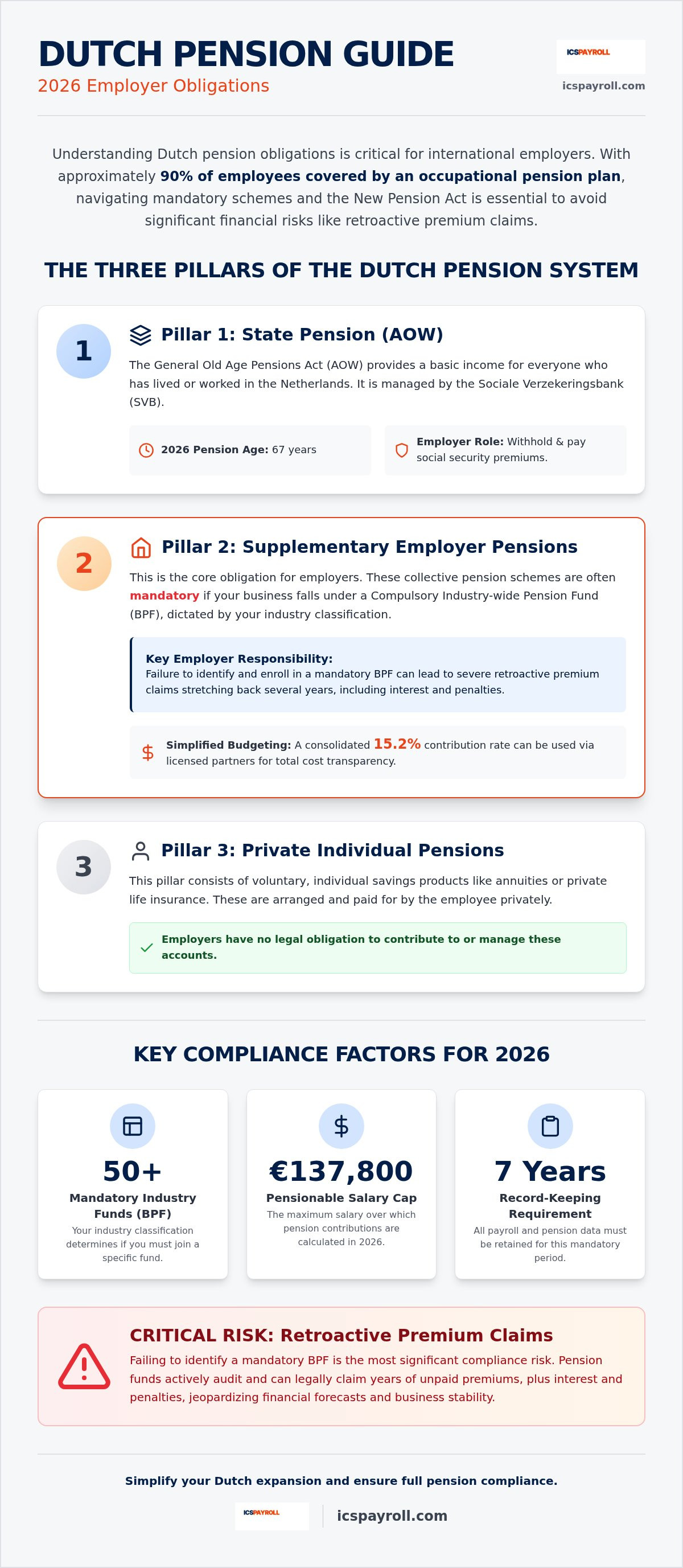
The Dutch retirement framework is built upon three distinct layers. This structure, known as the Three Pillars of the Dutch Pension System, ensures that retirees receive income from the state, their former employers, and their own private savings. While all three layers are essential for the individual, your primary concern as an international business lies in the second pillar. This is where the majority of legal risks and financial commitments reside. Understanding how these layers interact is the first step toward maintaining full compliance.
The General Old Age Pensions Act (AOW)
Pillar 1 is the state pension, known as the AOW. It provides a basic income floor for everyone who has lived or worked in the Netherlands. The Sociale Verzekeringsbank (SVB) manages this system, which is funded through mandatory social security contributions deducted from employee wages. In 2026, the state pension age is set at 67. You can find the latest eligibility criteria and official age thresholds on the svb.nl website. While you don't manage these funds directly, you're responsible for ensuring the correct social security premiums are withheld and paid during your monthly payroll cycle.
Supplementary Employer Pensions (Pillar 2)
The second pillar represents the core of dutch pension obligations for employers. These are collective pension schemes organized at the industry or company level. Unlike many other jurisdictions, participation is often mandatory rather than a benefit choice. If your business activities fall within the scope of a Compulsory Industry-wide Pension Fund (Bedrijfstakpensioenfonds or BPF), you're legally required to enroll your staff and pay premiums.
Collective Labour Agreements (CAOs) often dictate these requirements with clinical precision. Even if no specific CAO applies to your business, you might still face a BPF mandate based on your industry classification. This is a significant compliance area. Failing to register can result in expensive retroactive premium demands that stretch back several years. For many international firms, these costs are managed through a consolidated payroll factor. ICSPayroll facilitates these schemes via licensed partners, using a fixed contribution rate of 15.2% of the gross salary to provide total cost transparency.
Pillar 3 and the Employer's Scope
The third pillar consists of voluntary individual savings, such as tax-efficient annuities or private life insurance policies. Employers have no legal obligation to contribute to or manage these accounts. Consequently, your compliance strategy should focus almost exclusively on Pillar 2. Successfully managing dutch pension obligations for employers requires a precise understanding of your industry classification to determine which pension fund applies to your workforce. It's a technical process that demands local expertise to avoid the pitfalls of the New Pension Act transition.
When is a Pension Scheme Mandatory for Employers?
In the Netherlands, the question of whether to offer a pension is rarely left to the employer's discretion. Most companies are legally bound to participate in a specific scheme based on their industry sector. Understanding dutch pension obligations for employers starts with identifying your company's "scope." If your core business activities align with a sector that has a compulsory fund, enrollment is mandatory by law. This applies even if your company is based abroad but employs staff residing in the Netherlands.
Mandatory Sector Funds (BPF)
There are over 50 mandatory industry-wide pension funds, known as Bedrijfstakpensioenfondsen (BPF), currently active in the Dutch market. These funds cover specific sectors such as IT, wholesale, engineering, and construction. The legal basis for these mandates is found in the Mandatory Participation in an Industry-wide Pension Fund Act. You can review the statutory BPF regulations on overheid.nl to see how these laws are structured. The fund's board defines the scope of the industry, and if your activities fall within those definitions, you're automatically obligated to join.
The financial risks of failing to identify a BPF mandate are substantial. Pension funds conduct regular audits and have the authority to claim unpaid premiums retroactively for many years. These claims often include interest and administrative penalties. Because these costs can disrupt a company's financial stability, it's vital to address Compliance Risks and Employer's Duty of Care before finalizing any Dutch employment contracts. While exemptions exist, they're difficult to obtain and usually require proving that your existing alternative scheme is actuarially equivalent to the BPF's offering.
Collective Labor Agreements (CAO)
Beyond statutory BPF requirements, Collective Labor Agreements (CAOs) often dictate pension contribution levels and eligibility. Many industries are bound by a "declared binding" (AVV) CAO. This means the Minister of Social Affairs and Employment has made the agreement applicable to every employer in that sector, regardless of whether they participated in the original negotiations. These agreements ensure a level playing field for labor costs across the industry.
For international firms, CAO rules apply to any employee working remotely within the Netherlands. These rules specify exactly how much the employer must contribute and which salary components are pensionable. Managing these variables requires precise administrative oversight. If you're looking for a streamlined way to handle these requirements, you can request a tailored quotation to see how these costs fit into your specific hiring plan. By arranging these services via licensed partners, you ensure that every CAO mandate is satisfied without the complexity of managing local fund registrations yourself.
Calculating Employer Contributions and the 2026 Landscape
Calculating your financial commitment is often the most complex part of expanding into the Netherlands. Unlike jurisdictions where pension is a fixed monthly fee, dutch pension obligations for employers are calculated as a precise percentage of the pensionable salary. For 2026, a standard and compliant employer contribution is set at 15.2% of the gross salary. This figure allows for accurate budgeting and ensures your workforce receives competitive, legally sound retirement benefits from day one.
This percentage isn't just a random number. It represents a carefully balanced contribution that satisfies most sector fund requirements while maintaining your company's competitiveness. By using a consolidated payroll factor, businesses can avoid the volatility of varying premium rates across different sectors. This approach transforms a complex variable into a predictable line item on your monthly invoice.
The New Pension Act (WTP) in 2026
The Future of Pensions Act (Wet toekomst pensioenen) represents the most significant overhaul of the Dutch system in decades. A core change is the abolition of the 'doorsneesystematiek', or the average premium system. Under the old rules, younger employees effectively subsidized the higher accrual rates of older colleagues. The new law mandates a shift to age-independent contribution rates. This means every employee in the same scheme receives the same percentage of their salary as a contribution, regardless of their age.
By October 1, 2026, employers using insurers or Premium Pension Institutions (PPIs) must submit their amended agreements and transition plans to their providers. While the final deadline for all schemes to transition is January 1, 2028, a significant portion of the market already moved to these defined contribution models on January 1, 2026. This shift provides greater transparency through individual pension pots, though it moves the investment risk from the collective fund to the individual employee.
Budgeting for Total Employment Costs
Accurate budgeting requires looking beyond the base salary. You must account for the AOW franchise, which is the portion of the salary excluded from pension accrual because the employee will eventually receive a state pension. For 2026, the minimum AOW franchise is €19,172. Additionally, the maximum salary on which pension can be accrued with tax benefits is capped at €137,800. Contributions above this limit don't enjoy the same tax advantages.
When calculating the total cost of employment (TCO), you must integrate the 15.2% pension contribution with the mandatory 8% holiday allowance and other statutory premiums. Managing these variables individually is a heavy administrative burden. ICSPayroll simplifies this by consolidating these costs into a single invoice. This method ensures all dutch pension obligations for employers are met while allowing you to monitor tax-related deductions via the belastingdienst.nl portal. This streamlined process removes the friction of local compliance, allowing you to focus on your core business growth.
Compliance Risks and the Employer's Duty of Care
Managing dutch pension obligations for employers involves more than just paying premiums. It requires a rigorous adherence to administrative standards and legal transparency. One of the most overlooked requirements is the seven-year record-keeping rule. You must maintain all payroll and pension-related data for at least seven years to satisfy potential audits by the Dutch Tax Authority (Belastingdienst) or specific industry funds. This archive must include proof of registrations, premium calculations, and employee communications.
Specific risks also arise during long-term illness. In the Netherlands, employers are generally responsible for continued wage payments for up to two years of sick leave. During this period, pension accrual and employer contributions typically continue according to the rules of the applicable pension fund or collective agreement. Failing to manage these contributions correctly during an employee's recovery can lead to significant liabilities and disputes with the pension provider.
The Duty of Care (Zorgplicht)
The Dutch legal concept of "Zorgplicht" mandates that you provide clear, timely, and accurate information regarding the pension scheme. You're responsible for informing employees about their choices, such as value transfers from previous employers or survivor pension options. Providing incorrect or incomplete data can result in financial losses for the employee, for which the employer may be held liable. The Netherlands Authority for the Financial Markets (AFM) monitors these conduct standards to ensure fair treatment. You can review these expectations on the afm.nl website.
Administrative Deadlines and Filings
Precision in filing is essential to avoid penalties. You must submit the monthly 'Loonaangifte' (wage tax filing) to the tax authorities by specific deadlines, usually within one month after the end of the period. Simultaneously, this data must be synchronized with pension fund portals to ensure premiums are calculated on the correct pensionable salary. For a deeper look at these technical requirements, see our guide on Dutch Payroll Administration: The 2026 Complete Reference Guide.
Navigating these complexities requires a partner who understands the intersection of labor law and financial regulation. If you want to ensure your operations remain fully compliant without the administrative burden, contact ICSPayroll today to discuss how we arrange these services via our licensed partners.
Simplifying Pension Compliance with a Local EOR Partner
Managing dutch pension obligations for employers doesn't have to involve manual fund registrations or complex legal audits. An Employer of Record (EOR) serves as the legal bridge, assuming the primary responsibility for Dutch labor law compliance. By acting as the local employer on record, the EOR ensures that all sector-specific mandates are identified and fulfilled correctly. This model removes the fear of retroactive payments, as the administrative burden of tracking BPF scope and premium updates is handled by local experts. All pension schemes are arranged via licensed partners to ensure strict adherence to the New Pension Act and other statutory requirements.
This consolidated approach significantly accelerates your market entry. While setting up a local entity and registering for various pension funds can take months, an EOR partner can have your new hire onboarded in weeks. It ensures your business remains a traditionalist regarding legal standards while benefiting from modern, rapid processing technology. This transition from complexity to clarity is essential for international firms that value both speed and administrative precision.
Eliminating Permanent Establishment Risk
One of the most significant advantages is the ability to hire without incorporating a Dutch BV. Establishing a local entity often triggers Permanent Establishment status, leading to complex corporate tax filings and a heavy administrative tail. An EOR allows you to remain compliant with all dutch pension obligations for employers while keeping your operational footprint light. ICSPayroll consolidates these costs into a single monthly invoice. This payroll factor includes the 15.2% pension contribution, the 8% holiday allowance, and transition allowance coverage. For a comprehensive look at this strategy, see our Employer of Record Netherlands: The 2026 Guide to Compliant Hiring.
Expert Support from Joost Hubregtse and ICSPayroll
Our service is led by Joost Hubregtse, Payroll Director, ensuring every calculation reflects the 2026 financial benchmarks. We provide direct human support, moving away from the faceless nature of large scale outsourcing firms. Clients receive tailored quotations within 24 hours, providing immediate clarity on total employment costs. Employees gain access to a secure online portal where they can view their payslips and monitor their pension balances in real time. This transparency builds trust and fulfills your duty of care without requiring you to manage individual employee handbooks or complex HR administration. It's a professional, no-nonsense solution for businesses entering the Dutch market.
Securing Your Dutch Expansion with Confidence
Managing dutch pension obligations for employers requires a meticulous approach to both industry mandates and the evolving 2026 legislative landscape. The transition to the New Pension Act (WTP) and the strict enforcement of sector-specific BPF funds create a complex environment for international firms. Failing to meet these standards invites retroactive claims and legal scrutiny that can disrupt your long-term business goals. However, compliance doesn't have to be a barrier to your growth.
By partnering with local experts to arrange your pension schemes via licensed partners, you gain total transparency and security. Our consolidated 15.2% pension premium provides a predictable cost structure while ensuring full 2026 Dutch compliance for every member of your workforce. We remove the administrative weight of Loonaangifte filings and fund registrations, allowing you to focus on talent acquisition and operational success. Don't let bureaucracy slow your momentum in this high-growth market.
Hire in the Netherlands with confidence: Request a 24-hour quote and secure a compliant path for your Dutch hiring today.
Frequently Asked Questions
Is offering a pension scheme mandatory for all employers in the Netherlands?
Participation is not universally mandatory for every single business, but it's a requirement for the vast majority. Approximately 90% of Dutch employees are covered by a pension scheme because their employer falls under a compulsory industry-wide pension fund (BPF) or a Collective Labour Agreement (CAO). If your business activities align with a sector fund's scope, you must enroll your staff. Failing to do so can result in significant retroactive premium claims.
What is the standard employer pension contribution rate in 2026?
While specific rates are determined by individual sector funds, a consolidated and compliant employer pension contribution is set at 15.2% of the gross salary. This fixed rate allows international businesses to budget with precision while ensuring all legal mandates are satisfied. This percentage is typically integrated into a broader payroll factor that covers other statutory requirements, such as holiday allowance and transition payments, providing a clear total cost of employment.
How does the New Pension Act (WTP) affect my current employees?
The WTP transitions the Dutch system from defined benefit models to a defined contribution model. Your current employees will move to a system featuring individual pension pots and age-independent contribution rates. While the final deadline for this transition is January 1, 2028, many funds moved to the new structure on January 1, 2026. This shift provides employees with more transparency regarding their accrued capital while changing how you calculate monthly contributions.
Can I use my home country's pension scheme for Dutch employees?
Using a foreign pension scheme for staff residing in the Netherlands is generally not permitted. To qualify for Dutch tax advantages, a pension plan must meet strict local criteria set by the Dutch Tax Authority (Belastingdienst). Foreign schemes rarely comply with these specific fiscal requirements. Enrolling employees in a non-compliant plan can result in the contributions being treated as taxable income, creating an unexpected and heavy tax burden for your staff.
What happens if I fail to register my employees with a mandatory sector fund (BPF)?
Non-compliance is one of the most expensive mistakes you can make when managing dutch pension obligations for employers. Mandatory funds have the legal authority to claim unpaid premiums retroactively for many years, often including interest and administrative fines. These audits are common and can occur years after a hire begins. It's vital to identify your specific BPF scope before the first employment contract is signed to avoid these liabilities.
Does the 30% ruling impact pension contribution calculations?
The 30% ruling reduces the taxable wage, but pension contributions are usually calculated on the full gross salary before the tax-free allowance is deducted. However, the exact pensionable salary depends on the specific rules of your applicable pension fund or insurance provider. You must verify whether the tax-free component is included in the pension base to ensure you aren't underfunding the employee's retirement account or violating fund regulations.
How do I determine which sector pension fund applies to my business?
The applicable fund is determined by the specific nature of your business activities in the Netherlands. You must compare your core operations against the statutory definitions of the 50+ mandatory industry-wide funds. If your business performs activities that span multiple sectors, the "main activity" rule generally applies. This technical analysis is essential for compliance, as the wrong classification can lead to rejected filings and potential legal disputes with pension providers.
What is the role of an EOR in managing Dutch pension obligations?
An EOR assumes the legal responsibility for identifying and fulfilling all dutch pension obligations for employers on your behalf. They manage the complex process of fund registration, monthly premium calculations, and Loonaangifte filings via licensed partners. This model allows you to hire in the Netherlands without a local entity while ensuring every employee is enrolled in a compliant, sector-appropriate scheme. It removes the administrative burden and protects you from retroactive financial risks.

Article by
Joost Hubregtse
Joost Hubregtse is Director of ICS Staffing & Payroll B.V., the wholly owned subsidiary of Intercompany Solutions behind ICS Payroll. He is responsible for Employer of Record and Dutch payroll services: employment contracts, wage tax and social security filings, holiday allowance, pension, sick leave and CAO compliance, with onboarding possible within 48 hours.
Frequently Asked Questions
Participation is not universally mandatory for every single business, but it's a requirement for the vast majority. Approximately 90% of Dutch employees are covered by a pension scheme because their employer falls under a compulsory industry-wide pension fund (BPF) or a Collective Labour Agreement (CAO). If your business activities align with a sector fund's scope, you must enroll your staff. Failing to do so can result in significant retroactive premium claims.
While specific rates are determined by individual sector funds, a consolidated and compliant employer pension contribution is set at 15.2% of the gross salary. This fixed rate allows international businesses to budget with precision while ensuring all legal mandates are satisfied. This percentage is typically integrated into a broader payroll factor that covers other statutory requirements, such as holiday allowance and transition payments, providing a clear total cost of employment.
The WTP transitions the Dutch system from defined benefit models to a defined contribution model. Your current employees will move to a system featuring individual pension pots and age-independent contribution rates. While the final deadline for this transition is January 1, 2028, many funds moved to the new structure on January 1, 2026. This shift provides employees with more transparency regarding their accrued capital while changing how you calculate monthly contributions.
Using a foreign pension scheme for staff residing in the Netherlands is generally not permitted. To qualify for Dutch tax advantages, a pension plan must meet strict local criteria set by the Dutch Tax Authority (Belastingdienst). Foreign schemes rarely comply with these specific fiscal requirements. Enrolling employees in a non-compliant plan can result in the contributions being treated as taxable income, creating an unexpected and heavy tax burden for your staff.
Non-compliance is one of the most expensive mistakes you can make when managing dutch pension obligations for employers. Mandatory funds have the legal authority to claim unpaid premiums retroactively for many years, often including interest and administrative fines. These audits are common and can occur years after a hire begins. It's vital to identify your specific BPF scope before the first employment contract is signed to avoid these liabilities.
The 30% ruling reduces the taxable wage, but pension contributions are usually calculated on the full gross salary before the tax-free allowance is deducted. However, the exact pensionable salary depends on the specific rules of your applicable pension fund or insurance provider. You must verify whether the tax-free component is included in the pension base to ensure you aren't underfunding the employee's retirement account or violating fund regulations.
The applicable fund is determined by the specific nature of your business activities in the Netherlands. You must compare your core operations against the statutory definitions of the 50+ mandatory industry-wide funds. If your business performs activities that span multiple sectors, the "main activity" rule generally applies. This technical analysis is essential for compliance, as the wrong classification can lead to rejected filings and potential legal disputes with pension providers.
An EOR assumes the legal responsibility for identifying and fulfilling all dutch pension obligations for employers on your behalf. They manage the complex process of fund registration, monthly premium calculations, and Loonaangifte filings via licensed partners. This model allows you to hire in the Netherlands without a local entity while ensuring every employee is enrolled in a compliant, sector-appropriate scheme. It removes the administrative burden and protects you from retroactive financial risks.