
Dutch Payroll Services for Foreign Companies: 2026 Guide
By Joost Hubregtse, Director, ICS Staffing & Payroll
All blog posts are reviewed and fact checked by our labour law lawyer Zishan Hussain and our director. Editorial standards
Hiring in the Netherlands is a high-stakes legal exercise where a single administrative oversight can trigger two years of mandatory sick pay obligations. You likely recognize that the Dutch market offers immense talent, yet the labyrinth of pension requirements and the risk of permanent establishment can feel like a significant barrier to entry. Navigating the choice between an EOR vs payroll service netherlands is the critical first step in securing your business against local regulatory shifts while ensuring your employees are managed with precision.
This 2026 guide provides the clarity you need to onboard your international team compliantly and efficiently. We will navigate the complexities of the Dutch labor market together, from the €48,013 taxable salary threshold for the 30% ruling to the statutory €14.99 minimum hourly wage. You will learn how to consolidate your monthly costs into a single, transparent payroll factor that includes mandatory 8% holiday allowances and 15.2% pension contributions. This expert guide offers a clear roadmap for compliant hiring that reduces your administrative burden and protects your expansion.
Key Takeaways
- Understand the fundamental differences in EOR vs payroll service netherlands to determine if your business requires a local BV or an external legal employer.
- Identify critical compliance risks, including the two year sick pay obligation and the potential for creating a permanent establishment when hiring directly.
- Learn how to navigate 2026 statutory requirements such as the €48,013 salary threshold for the 30% ruling and mandatory 15.2% pension contributions.
- Discover the advantages of partnering with local Dutch specialists over global EOR providers to ensure direct communication with tax authorities.
- Evaluate potential partners based on their ability to consolidate all employment costs into a transparent monthly invoice via a payroll factor model.
Navigating Dutch Employment Law and Compliance Risks
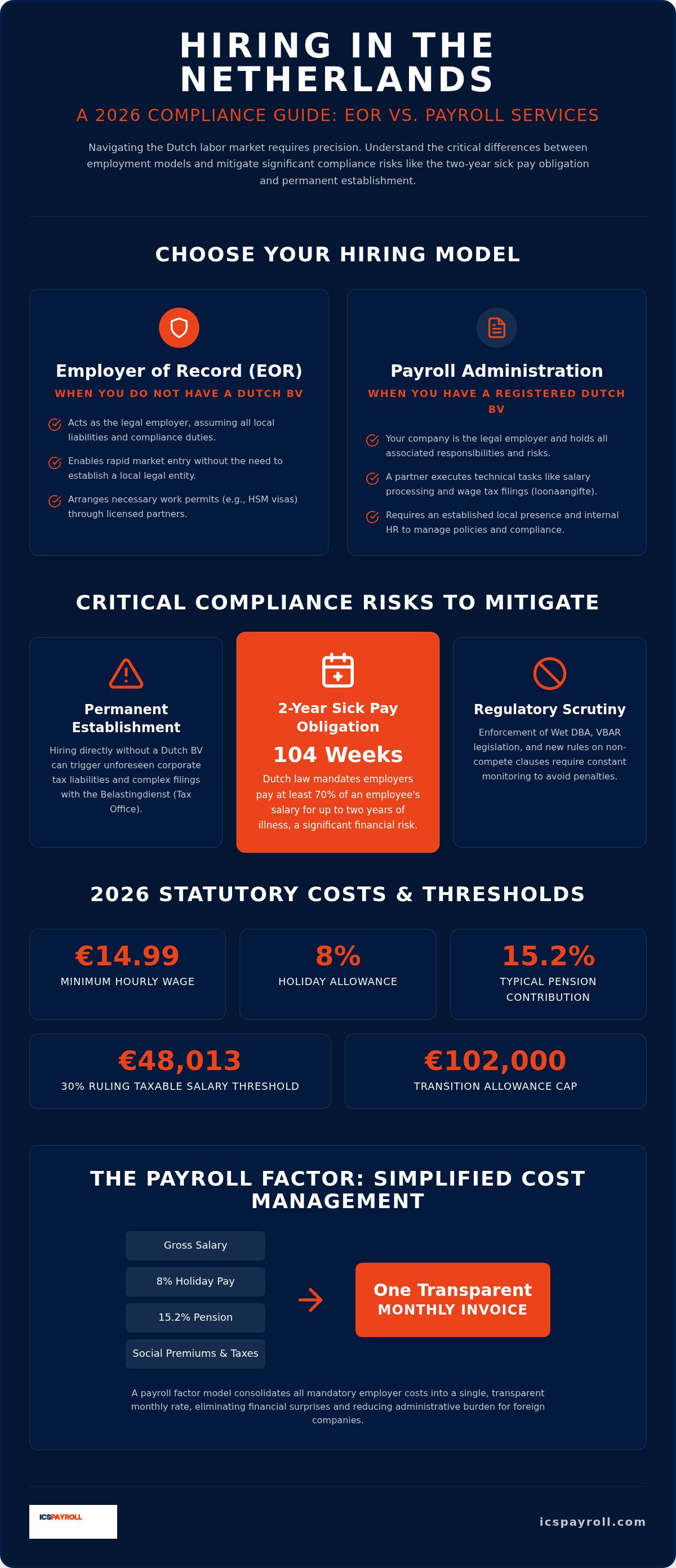
The Dutch labor market operates under highly structured civil codes that prioritize comprehensive employee protection. For any foreign entity, the primary legal hurdle is the risk of creating a Permanent Establishment (PE). Hiring a Dutch resident directly without a local BV often triggers unforeseen corporate tax liabilities and complex filings with the Belastingdienst (Tax Office). This risk makes the decision between an EOR vs payroll service netherlands a foundational business strategy. While a payroll service requires you to hold a local entity, an Employer of Record provides a compliant bridge to the market by assuming all legal employer responsibilities.
Managing Statutory Benefits and Sick Pay Obligations
Dutch employment contracts include mandatory benefits that significantly impact your total cost of employment. Every employee is entitled to a statutory 8% holiday allowance. Additionally, most professional sectors require a 15.2% pension contribution. Perhaps the most significant financial risk for foreign firms is the two year sick pay obligation. Under Dutch law, employers are required to pay at least 70% of an employee's salary for up to 104 weeks if they fall ill. When a contract ends, you must also factor in the Transition Allowance (transitievergoeding). For 2026, this statutory payment is capped at €102,000. Managing these variables requires meticulous coordination with social security funds to avoid administrative penalties.
Regulatory Changes for Foreign Employers in 2026
Compliance in the Netherlands is a moving target. The enforcement of Wet DBA and the introduction of VBAR legislation have intensified the scrutiny on independent contractors. Authorities now actively penalize "false self-employment" to ensure workers receive proper social protections. 2026 also brings significant reforms to non-compete clauses. Employers must now provide a specific "weighty business interest" in writing to justify any post-contractual restrictions. Additionally, new transparency requirements for gender pay gap reporting now affect Dutch payroll administration for larger teams. Understanding What is an Employer of Record helps businesses understand how these shifting legal responsibilities are managed via a local partner. These regulations demand a partner who stays ahead of legislative dates to protect your international operations from litigation.
Choosing Between Dutch Payroll Administration and EOR Services
Selecting the appropriate employment model is a strategic decision that dictates your operational flexibility and legal exposure in the Dutch market. The choice between EOR vs payroll service netherlands typically rests on whether your organization already possesses a local legal entity. Dutch payroll administration is a specialized service for companies that have a registered Dutch BV but require expert support for tax filings and salary processing. In contrast, an Employer of Record (EOR) allows you to hire staff without the administrative burden of incorporation. An Employer of Record in the Netherlands serves as the compliant bridge for foreign companies to hire local talent without the necessity of establishing a local legal entity. Your choice depends on your long-term strategy: temporary market entry versus permanent local presence.
When to Use Payroll Administration (BV Registered)
This model is the standard choice for international businesses that have formally registered with the Kamer van Koophandel (KvK). Once your BV is established, you become the legal employer and assume direct responsibility for Dutch labor law compliance. A payroll administration partner focuses on the technical execution of the monthly loonaangifte (wage tax filing) and the generation of accurate payslips. It's a functional solution for firms that already have established HR policies and are prepared to manage the financial risks associated with employer liabilities directly. You remain responsible for managing sickness risks and ensuring your internal policies align with the latest Dutch civil codes.
When an Employer of Record (EOR) is Required
If your strategy involves rapid market entry or testing the Dutch landscape without a long-term commitment to a BV, an EOR is the necessary path. It's particularly vital when you need to hire non-Schengen staff. In these cases, HSM visas are arranged via licensed partners to ensure your talent has the legal right to work in the Netherlands. The EOR acts as the legal employer, which effectively shields your parent company from direct liability under Dutch labor law. This provides a comprehensive, one-stop solution where contracts, payroll, and statutory benefits are managed by local experts.
When evaluating EOR vs payroll service netherlands, remember that an EOR can often have your team operational in just a few weeks, whereas entity incorporation can take significantly longer. The provider handles everything from the 8% holiday allowance to the 15.2% pension contributions, consolidating these into a single invoice. If you're ready to explore these options for your international team, you can request a tailored quotation to see how these models fit your 2026 budget and expansion goals.
Local Dutch Specialists vs. Global EOR Providers
The choice between a global EOR vs payroll service netherlands often reveals a significant divide in operational depth. Global providers typically operate on an aggregator model, where they outsource the actual employment to local third parties. This creates a fragmented communication chain that often leads to delays and increased overhead. Local specialists offer a direct alternative by managing the relationship with the Belastingdienst and the IND themselves. This directness is particularly vital for compliance with the Poortwachter process (Gatekeeper Act). Local experts understand the specific reintegration steps required by Dutch law to mitigate the financial impact of long term illness and ensure your business meets its statutory obligations without procedural errors.
The Hidden Costs of Global Aggregator Models
Aggregator models frequently hide markups within currency exchange rates and variable management fees. These costs can fluctuate monthly, making budget forecasting difficult for foreign finance departments. Beyond the financial aspect, global entities often lack a granular understanding of Dutch Collective Labor Agreements (CAOs). A CAO can dictate specific wage scales, working hours, and notice periods that override standard statutory minimums. Misapplying these rules leads to legal disputes and backdated payment claims. Urgent HSM visa applications for non EU staff also experience friction in an aggregator model. Local partners ensure these applications are arranged via licensed partners with the necessary speed to secure talent within the typical three week window.
Why Local Expertise is Critical for the 30% Ruling
The 30% ruling remains a primary incentive for attracting international talent, but its administration is becoming increasingly technical. For 2026, the standard taxable salary threshold is exactly €48,013. This figure is the amount required after the tax free allowance is applied. Local tax experts are essential for navigating the transition to the 27% rate for newer rulings issued following recent legislative reforms. Managing this shift requires precise payroll configuration to ensure employees receive the correct net benefit without triggering audits from the tax authorities.
Local specialists also provide critical guidance on the abolition of partial non resident taxpayer status. While a transitional rule allows some employees to benefit until December 31, 2026, new arrivals no longer have access to this specific tax advantage. Accurate reporting to the Belastingdienst is mandatory to avoid retroactive tax liabilities. Relying on a provider with direct local ties ensures these 2026 benchmarks are met with clinical precision, protecting both the employer and the international team member from financial surprises.
How to Evaluate a Dutch Payroll Partner in 2026
Evaluating an EOR vs payroll service netherlands requires a technical audit of operational speed and compliance safeguards. In the current market, a competent partner must facilitate hiring in weeks rather than months. You should prioritize providers that consolidate all employment costs into a single monthly invoice to ensure financial predictability. This consolidation is essential for foreign finance departments that need to manage international budgets without navigating multiple local tax categories. A modern partner also provides a secure online portal for both employers and employees. This digital interface simplifies the management of payslips, expense claims, and contract signatures while maintaining data security standards.
Speed is a critical differentiator for specialized talent. You must confirm that your provider has the expertise to handle expedited HSM visa processing. This procedure typically takes approximately three weeks when managed correctly. Additionally, the partner should demonstrate a clinical approach to the 30% ruling and Dutch pension compliance. They must ensure that the €48,013 taxable salary threshold for 2026 is met and that the 15.2% pension contribution is correctly calculated for every pay cycle.
Auditing Legal Compliance and IND Support
Legal security is the foundation of a successful expansion. You should confirm that the provider uses licensed partners for IND sponsorship and SNA certification. This structure ensures that your international staff are hired legally and that all social security premiums are paid correctly. Your partner must also provide expert guidance on the Ketenregeling (chain rule). Under Dutch law, an employee is entitled to a permanent contract after either three consecutive fixed-term contracts or 36 months of service. Mismanaging this timeline can lead to unintended permanent employment liabilities. Finally, check for a dedicated point of contact who provides direct support for sick-leave management and the statutory reintegration process.
Analyzing the Transparency of Cost Structures
Transparent pricing is vital for maintaining your profit margins. You should identify if the provider uses a consolidated Payroll Factor or a complex list of separate administrative fees. A reliable quote must include the mandatory 8% holiday allowance and the 15.2% pension contribution from the outset. This transparency prevents hidden costs from surfacing later in the employment cycle. You should also inquire about the handling of the transition allowance (transitievergoeding). For 2026, this statutory payment is capped at €102,000. Understanding how these terminal costs are accrued or invoiced is essential for long-term financial planning. If you require a clear breakdown of these variables, you can request a transparent quotation to see how the payroll factor model applies to your specific hiring needs.
ICSPayroll: Streamlined Hiring via the Payroll Factor Model
ICSPayroll simplifies the complexities of the Dutch labor market through a transparent payroll factor model. This approach consolidates all statutory costs and administrative fees into a single, predictable multiplier applied to the gross salary. When evaluating EOR vs payroll service netherlands, many businesses struggle with fluctuating monthly invoices and hidden social premium adjustments. Our model eliminates this ambiguity. One clear monthly invoice covers the mandatory 8% holiday allowance, 15.2% pension contributions, wage taxes, and comprehensive HR administration. This level of financial transparency allows your finance department to forecast international expansion costs with clinical precision.
Speed of execution is a core pillar of our service. You can receive a tailored quotation within 24 hours, ensuring your market entry is not delayed by administrative bottlenecks. Hiring can begin even before a Dutch BV is established, or you can choose to operate without one entirely by utilizing our EOR framework. This flexibility allows you to secure top talent in the Netherlands while we manage the legal and financial heavy lifting. We act as the bridge between your foreign entity and the local regulatory system, providing peace of mind through meticulous compliance management.
Expedited HSM Visas and 30% Ruling Support
Attracting high-skilled migrants requires a partner who understands the urgency of immigration logistics. Expedited HSM visa applications for non-Schengen staff are arranged via licensed partners to ensure your team is operational in approximately three weeks. We also provide full assistance with the 30% ruling application for eligible international hires. This tax advantage is a critical tool for talent retention, provided the employee meets the 2026 taxable salary threshold of €48,013. For a deeper analysis of these requirements, consult The 30% Ruling in the Netherlands: A Comprehensive 2026 Employer Guide. Our experts ensure that every application is processed accurately to maximize the net benefit for your employees.
Comprehensive HR Support and Online Portals
Modern payroll management requires sophisticated digital tools and traditional legal safeguards. Every client and employee receives access to an online portal for the management of payslips, employment contracts, and holiday balances. This centralized system reduces the administrative burden on your internal HR team and provides employees with immediate access to their records. Beyond the digital interface, we provide robust protection against local employment risks. Sickness risk coverage for up to the statutory two year period is included in our service framework. This protects your business from the significant financial liability of long-term employee illness. To understand how these administrative services integrate with your broader strategy, refer to our Dutch Payroll Administration: The 2026 Complete Reference Guide. We provide the technical expertise and human-led support necessary to navigate the Dutch market with confidence.
Securing Your Dutch Market Entry
Choosing between an EOR vs payroll service netherlands is a strategic decision that defines your legal risk and operational speed. Whether you require a local BV for long term presence or an Employer of Record to hire immediately, compliance with 2026 benchmarks is non negotiable. It's essential to ensure your team meets the €48,013 taxable salary threshold for the 30% ruling while managing mandatory 15.2% pension contributions and 8% holiday allowances. Local expertise is the only way to navigate these requirements with clinical precision.
ICSPayroll provides the security you need to expand. Our operational set up takes only weeks, and our transparent payroll factor pricing model consolidates all statutory costs into a single invoice. With full Dutch compliance managed by local experts, you can focus on growth while we handle the administrative burden. Hire in the Netherlands with confidence: Get your tailored quote in 24 hours. We are ready to streamline your international hiring process today.
Frequently Asked Questions
Can I hire employees in the Netherlands without a local legal entity?
Yes, you can hire employees in the Netherlands without establishing a local legal entity by partnering with an Employer of Record (EOR). This model allows the EOR to act as the legal employer, managing all local compliance, tax filings, and payroll duties on your behalf. When evaluating EOR vs payroll service netherlands, remember that an EOR removes the need for a Dutch BV. This approach provides a compliant path for foreign companies to secure local talent quickly.
What are the 2026 salary requirements for the Dutch 30% ruling?
For 2026, the standard annual taxable salary threshold for the 30% ruling is exactly €48,013. If the employee is under 30 years old and holds a qualifying Master's degree, the reduced taxable salary threshold is €36,497. These amounts represent the taxable salary after the tax free allowance has been applied. You should also prepare for the 2027 legislative shift, where the tax free allowance for new rulings will decrease from 30% to 27%.
How long does it take to get a Highly Skilled Migrant (HSM) visa?
Processing a Highly Skilled Migrant (HSM) visa typically takes approximately three weeks. These applications are arranged via licensed partners who hold IND recognized sponsor status. This expedited timeline is essential for securing international talent in a competitive market. The process includes ensuring the employee meets the specific salary criteria and that all documentation is filed correctly with the immigration authorities to avoid delays in the onboarding schedule. It's a highly efficient route for expansion.
What is included in the ICSPayroll payroll factor pricing?
The ICSPayroll payroll factor consolidates all employment costs into one transparent monthly invoice. This factor includes the employee's gross salary, the mandatory 8% holiday allowance, and the 15.2% pension contribution. It also covers employer insurance premiums and all HR administrative fees. By using this consolidated model, businesses avoid the complexity of managing multiple social security funds and can forecast their international staffing budgets with complete financial certainty. It's designed to remove administrative burdens entirely.
What is the Dutch holiday allowance and how is it calculated?
The Dutch holiday allowance is a mandatory payment equal to at least 8% of an employee's gross annual salary. It is a statutory requirement designed to cover vacation costs. Most employers pay this as a lump sum in May or June, though it can be distributed monthly if specified in the employment contract. The calculation is based on the gross salary earned during the previous twelve months, ensuring every worker receives their legal entitlement under Dutch law.
How are sickness and disability risks managed for Dutch employees?
Employers in the Netherlands are responsible for paying at least 70% of an employee's salary for up to two years (104 weeks) in the event of illness. Managing this sick pay obligation requires strict adherence to the Poortwachter process, which focuses on reintegration and medical assessments. Partnering with a specialist ensures these risks are managed within a compliant framework, protecting the company from significant financial liabilities and potential penalties from the employee insurance agency (UWV).
What is the maximum transition allowance (transitievergoeding) in 2026?
The maximum statutory transition payment for 2026 is capped at €102,000. If an employee's gross annual salary exceeds this amount, the cap is adjusted to equal one year of their gross salary. This payment is mandatory for most contract terminations, including the non renewal of fixed term agreements. Accurate calculation is vital to remain compliant with Dutch labor law and to ensure that terminal settlements are processed without legal disputes or unexpected financial surprises.
How quickly can I start hiring staff in the Netherlands with an EOR?
You can typically start hiring staff in the Netherlands within a few weeks when using an EOR service. This timeline is significantly faster than the months required to incorporate a Dutch BV and register with the Tax Office. The EOR vs payroll service netherlands comparison highlights that an EOR provides the most rapid market entry. This speed allows your business to capitalize on immediate opportunities while local experts handle the administrative and legal setup with precision.

Article by
Joost Hubregtse
Joost Hubregtse is Director of ICS Staffing & Payroll B.V., the wholly owned subsidiary of Intercompany Solutions behind ICS Payroll. He is responsible for Employer of Record and Dutch payroll services: employment contracts, wage tax and social security filings, holiday allowance, pension, sick leave and CAO compliance, with onboarding possible within 48 hours.
Frequently Asked Questions
Yes, you can hire employees in the Netherlands without establishing a local legal entity by partnering with an Employer of Record (EOR). This model allows the EOR to act as the legal employer, managing all local compliance, tax filings, and payroll duties on your behalf. When evaluating EOR vs payroll service netherlands, remember that an EOR removes the need for a Dutch BV. This approach provides a compliant path for foreign companies to secure local talent quickly.
For 2026, the standard annual taxable salary threshold for the 30% ruling is exactly €48,013. If the employee is under 30 years old and holds a qualifying Master's degree, the reduced taxable salary threshold is €36,497. These amounts represent the taxable salary after the tax free allowance has been applied. You should also prepare for the 2027 legislative shift, where the tax free allowance for new rulings will decrease from 30% to 27%.
Processing a Highly Skilled Migrant (HSM) visa typically takes approximately three weeks. These applications are arranged via licensed partners who hold IND recognized sponsor status. This expedited timeline is essential for securing international talent in a competitive market. The process includes ensuring the employee meets the specific salary criteria and that all documentation is filed correctly with the immigration authorities to avoid delays in the onboarding schedule. It's a highly efficient route for expansion.
The ICSPayroll payroll factor consolidates all employment costs into one transparent monthly invoice. This factor includes the employee's gross salary, the mandatory 8% holiday allowance, and the 15.2% pension contribution. It also covers employer insurance premiums and all HR administrative fees. By using this consolidated model, businesses avoid the complexity of managing multiple social security funds and can forecast their international staffing budgets with complete financial certainty. It's designed to remove administrative burdens entirely.
The Dutch holiday allowance is a mandatory payment equal to at least 8% of an employee's gross annual salary. It is a statutory requirement designed to cover vacation costs. Most employers pay this as a lump sum in May or June, though it can be distributed monthly if specified in the employment contract. The calculation is based on the gross salary earned during the previous twelve months, ensuring every worker receives their legal entitlement under Dutch law.
Employers in the Netherlands are responsible for paying at least 70% of an employee's salary for up to two years (104 weeks) in the event of illness. Managing this sick pay obligation requires strict adherence to the Poortwachter process, which focuses on reintegration and medical assessments. Partnering with a specialist ensures these risks are managed within a compliant framework, protecting the company from significant financial liabilities and potential penalties from the employee insurance agency (UWV).
The maximum statutory transition payment for 2026 is capped at €102,000. If an employee's gross annual salary exceeds this amount, the cap is adjusted to equal one year of their gross salary. This payment is mandatory for most contract terminations, including the non renewal of fixed term agreements. Accurate calculation is vital to remain compliant with Dutch labor law and to ensure that terminal settlements are processed without legal disputes or unexpected financial surprises.
You can typically start hiring staff in the Netherlands within a few weeks when using an EOR service. This timeline is significantly faster than the months required to incorporate a Dutch BV and register with the Tax Office. The EOR vs payroll service netherlands comparison highlights that an EOR provides the most rapid market entry. This speed allows your business to capitalize on immediate opportunities while local experts handle the administrative and legal setup with precision.