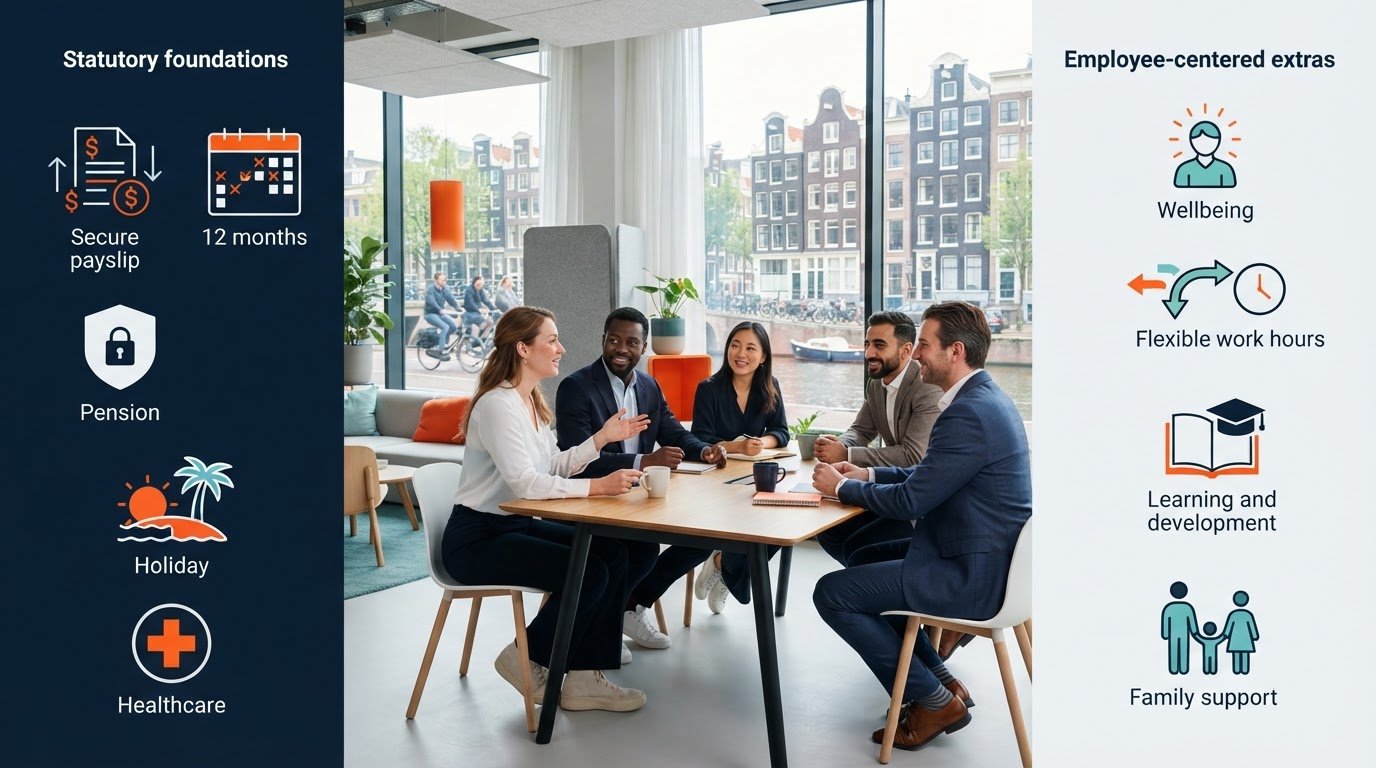
Dutch Employment Contract Law: The 2026 Employer’s Compliance Guide
By Joost Hubregtse, Director, ICS Staffing & Payroll
All blog posts are reviewed and fact checked by our labour law lawyer Zishan Hussain and our director. Editorial standards
By Joost Hubregtse, Payroll Director
Joost Hubregtse is the Payroll Director at ICSPayroll, bringing over 15 years of specialized expertise in Dutch labor law, international tax compliance, and cross border payroll administration. He serves as a leading consultant for foreign entities entering the Dutch market.
Reviewed by Joost Hubregtse on August 24, 2026
Entering the Dutch market without a firm grasp of dutch employment contract law is a legal gamble that most international firms cannot afford to lose. You likely recognize that the Netherlands offers a premier gateway to Europe, yet the prospect of managing 104 weeks of mandatory sick pay or navigating the active enforcement of Wet DBA remains a significant source of anxiety. It's a valid concern; the financial penalties for misclassification or contract errors in 2026 can be severe and immediate.
This definitive guide allows you to master the complexities of local labor regulations with clinical precision. We provide a structured path through the latest statutory requirements, from the July 2026 minimum wage of €14.99 per hour to the €48,013 salary threshold for the 30% tax ruling. You'll gain a clear understanding of the Ketenregeling limits, the seven year record keeping requirement, and the €102,000 transition payment cap. We also preview how to maintain full compliance and secure high skilled migrant visas through licensed partners without the administrative burden of a local BV. By the end of this article, you'll have a functional checklist to ensure your Dutch operations are both efficient and legally sound.
Key Takeaways
- Identify the essential elements of dutch employment contract law to ensure your agreements comply with the 2026 Dutch Civil Code and avoid the legal presumption of employment.
- Navigate the updated 2026 financial thresholds, including the €14.99 minimum hourly wage and the mandatory 8% holiday allowance for all staff.
- Apply the "Ketenregeling" chain rule correctly to manage contract durations and prevent the automatic conversion of fixed-term agreements into indefinite contracts.
- Protect your organization from administrative liabilities by understanding the active enforcement of Wet DBA and the mandatory 104-week sick pay obligations.
- Discover how an Employer of Record, managed via licensed partners, removes the risk of Permanent Establishment while facilitating compliance with the 2026 transition payment cap of €102,000.
Fundamentals of Dutch Employment Law in 2026
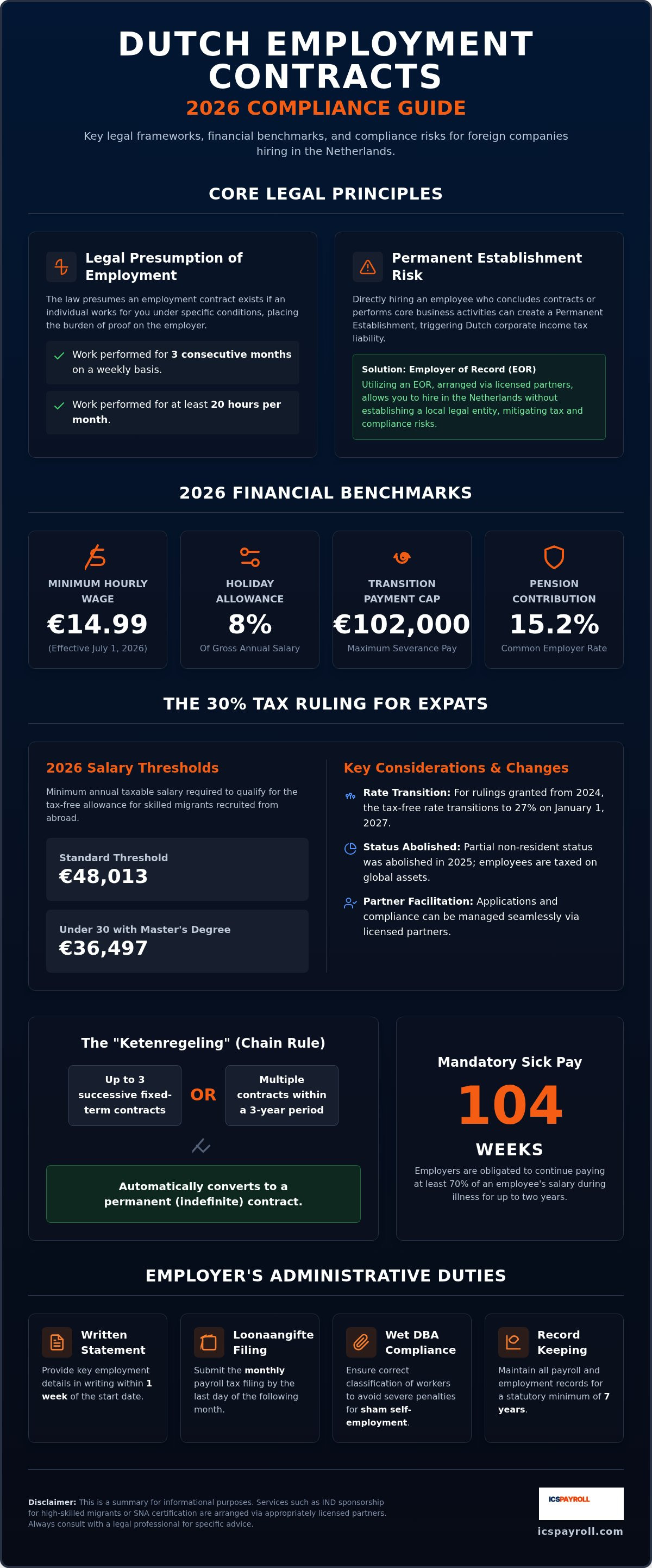
The "Arbeidsovereenkomst" is the legal foundation of the employer-employee relationship in the Netherlands. Under the Dutch legal system, specifically Book 7 of the Civil Code, this relationship is defined by work performed for wages under the employer's authority. A critical aspect of dutch employment contract law is the legal presumption of employment. If an individual performs work for you for three consecutive months on a weekly basis, or for at least 20 hours per month, the law presumes an employment contract exists. This presumption places the burden on the employer to prove the relationship is not one of employment.
Foreign companies must carefully distinguish between a Dutch BV and a Permanent Establishment. Hiring a local employee who has the authority to conclude contracts or performs core business activities can trigger a Permanent Establishment status. This creates a liability for Dutch corporate income tax on profits attributed to those activities. Utilizing an Employer of Record, managed via licensed partners, allows you to hire locally without the need for a formal Dutch entity or the associated tax risks.
The Legal Framework: Civil Code and CAOs
While the Civil Code provides statutory minimums, Collective Labor Agreements (CAOs) often govern specific industries. A CAO is an agreement between employers' organizations and trade unions that sets standards for wages, working hours, and notice periods. You must determine if your company's primary activities fall under a mandatory CAO. If so, these provisions are legally binding and typically override standard statutory law, provided they benefit the employee. You can verify industry requirements via the Chamber of Commerce website.
Written Statement and Filing Requirements
Employers are legally required to provide a written statement of employment details within one week of the employee's start date. This statement must include the job title, work location, and commencement date. Administrative precision is vital for compliance with the Tax Administration. You must adhere to the monthly Loonaangifte (payroll tax filing) deadlines, which are strictly due by the last day of the following month. All payroll records must be maintained for at least seven years to meet statutory record-keeping requirements. Digital signatures and electronic storage are the standard for 2026, provided they meet security and accessibility criteria.
Statutory Benefits and 2026 Financial Benchmarks
Employers must align their compensation structures with the latest statutory updates to remain compliant with dutch employment contract law. As of January 1, 2026, the statutory minimum hourly wage is established at €14.71 gross. This figure increases to €14.99 gross on July 1, 2026. Beyond the base salary, every employee is entitled to a mandatory holiday allowance (vakantiegeld) of at least 8% of their gross annual salary. This is typically paid in May or June. Pension contributions are another vital consideration. While not always legally mandated for all sectors, a common benchmark for employer contributions is 15.2% of the gross salary. This ensures a competitive and compliant benefits package for local talent.
The 30% Tax Ruling Integration
The 30% ruling remains a premier tool for attracting international talent. For 2026, the standard annual taxable salary threshold is €48,013. For employees under 30 with a Master's degree, the threshold is €36,497. To apply this benefit, the employment contract must explicitly state that the employee is recruited from abroad and that both parties agree to the tax-free reimbursement. It's important to note that for rulings granted from 2024 onwards, the tax-free rate will transition to a flat 27% starting January 1, 2027. Partial non-resident status was abolished in 2025, so employees are now subject to Dutch tax on their global assets. These applications can be managed via licensed partners to ensure compliance with 30% facility requirements set by the Tax Administration.
Employer Social Security Contributions
Total employer social security contributions in 2026 generally range between 15% and 20% on top of the gross salary. This includes the mandatory Zvw (health insurance) contribution, which is 6.10% on employee income up to a maximum of €79,409. Employers must also account for the AWf (unemployment fund) and Aof (disability fund) premiums. These contributions are vital for maintaining the social safety net and are calculated based on the specific sector and contract type. Accurate financial planning is the foundation of a stable Dutch operation. If you need assistance calculating the total cost of employment, you can request a tailored quote for your specific hiring needs.
Holiday Leave and Working Hours
Statutory leave in the Netherlands is calculated as four times the number of weekly working hours. For a standard 40-hour work week, this results in a minimum of 20 days per year. Many employers provide "above-statutory" days, often bringing the total to 25 or 30 days. Statutory days expire six months after the year they were earned, whereas above-statutory days have a five-year expiration period. The 2026 Working Hours Act sets strict limits to ensure employee well-being. A shift cannot exceed 12 hours, and the total work week is capped at 60 hours. However, the average over any four-week period must not exceed 55 hours. You must document these hours meticulously to comply with official hourly wage standards and labor regulations.
The Chain Rule (Ketenregeling) and Contract Duration
The "Ketenregeling" is a cornerstone of dutch employment contract law designed to prevent the perpetual use of temporary contracts. Under the current 3:3:6 rule, an employer can offer a maximum of three consecutive fixed-term contracts over a period of three years. If a fourth contract is signed, or if the total duration exceeds 36 months, the agreement automatically converts into a permanent contract. To reset this chain, a gap of more than six months between contracts is required. While legislative discussions regarding the extension of this interruption period are ongoing, the three-year limit remains the active standard for 2026.
Compliance requires strict adherence to notification deadlines. For contracts of six months or longer, you must provide a written "aanzegtermijn" (notice of non-renewal) at least one month before the contract expires. Failure to meet this deadline results in a penalty payment of up to one month's gross salary. Probationary periods are also strictly capped. For fixed-term contracts between six months and two years, the probation period is limited to one month. For indefinite contracts, the limit is two months. Contracts shorter than six months cannot legally include a probation period.
Fixed-Term vs. Permanent Contracts
Starting with a seven-month or 12-month contract is a common strategy for international firms. A seven-month contract is particularly useful because it allows for a one-month probation period, giving both parties time to assess the professional fit. To terminate a fixed-term contract before its scheduled end date, the agreement must include an "interim termination clause." Without this specific clause, neither party can end the contract early unless there is mutual consent or an urgent reason for dismissal. While fixed-term agreements offer initial flexibility, permanent contracts are often necessary to retain high-level talent and are a requirement for employees seeking local financing or mortgages.
Managing the 2026 Non-Compete Reforms
As of 2026, non-compete clauses are subject to significantly higher legal scrutiny. You can no longer include a non-compete clause in a fixed-term contract unless you provide a detailed, written justification of "weighty business interests" within the contract itself. This documentation must prove that the employee's specific role handles sensitive data or proprietary processes that would cause irreparable harm if shared with a competitor. Compliant agreements must now specify a clear geographic radius and a duration limit, which typically should not exceed 12 months. Using an EOR, managed via licensed partners, ensures that these clauses are drafted to meet the latest standards set by the Dutch government.
Termination, Sickness, and Wet DBA Compliance
Terminating an agreement under dutch employment contract law requires a rigorous adherence to procedural standards to avoid costly legal disputes. In the Netherlands, an employer must pay a statutory transition payment (transitievergoeding) for any dismissal initiated at their request, including the non-renewal of a fixed-term contract. For 2026, the transition payment is capped at €102,000, or one gross annual salary if that amount is higher. Beyond dismissal costs, sickness remains a substantial financial liability. Employers are legally obligated to pay at least 70% of an employee's salary for up to 104 weeks (two years) of illness. This obligation is coupled with strict reintegration requirements that begin immediately upon the report of illness.
Sickness and Reintegration Obligations
The Gatekeeper Improvement Act (Wet Verbetering Poortwachter) dictates a precise timeline for managing long-term illness. You must involve a certified company doctor (Arbodienst) within the first six weeks to conduct a formal problem analysis. By week eight, both parties must agree on a reintegration plan. If the Employee Insurance Agency (UWV) determines that your reintegration efforts were insufficient, they can impose a "loonsanctie" (wage sanction). This sanction forces you to continue paying the employee's salary for a third year. Managing these risks requires meticulous documentation and proactive communication with the Arbodienst to ensure all statutory milestones are met.
2026 Enforcement of Labor Status
2026 marks a turning point for labor status enforcement as the Dutch Tax Authority has fully ended the enforcement moratorium on Wet DBA. The focus is now on identifying "disguised employment" where freelancers operate under the same conditions as employees. While parts of the VBAR legislation were scrapped in March 2026, a critical legal presumption of employment is set to take effect on December 31, 2026. This presumption applies to any worker earning below approximately €38 per hour. If you cannot prove genuine entrepreneurship, you face retroactive payroll tax corrections and significant fines. To eliminate these misclassification risks, many international firms choose to outsource their Dutch payroll administration or utilize an EOR model via licensed partners.
Termination via mutual consent remains the most efficient way to end an employment relationship. This process is formalized through a Settlement Agreement (Vaststellingsovereenkomst or VSO). A properly drafted VSO allows the employee to retain their right to Dutch unemployment benefits while protecting the employer from future litigation. It's essential that the VSO respects the statutory notice period, as the employee's unemployment benefits will only commence after this period has lapsed. This approach provides a clean break and avoids the need for prior permission from the UWV or a subdistrict court.
Implementing Compliant Contracts via a Dutch EOR
An Employer of Record (EOR) provides a secure framework for international businesses to engage talent while remaining fully compliant with dutch employment contract law. By acting as the legal employer, the EOR assumes all administrative responsibilities and legal liabilities associated with the "Arbeidsovereenkomst." This arrangement is particularly effective for companies that wish to avoid the complexity of establishing a local Dutch BV. One of the primary benefits is the total elimination of Permanent Establishment risk. Because the EOR is the entity of record, the foreign parent company is protected from being deemed to have a taxable presence in the Netherlands by the Tax Administration.
The operational efficiency of an EOR model allows for the consolidation of all employment costs into a single monthly invoice. This includes gross wages, social security premiums, pension contributions, and the administration of the 30% ruling. For companies needing to relocate talent, HSM visa sponsorship is arranged through licensed partners. This process is highly efficient, with expedited processing typically completed in approximately three weeks. This ensures that your recruitment efforts are not delayed by bureaucratic hurdles or complex visa requirements.
The ICSPayroll Advantage
ICSPayroll offers a streamlined path for rapid market entry. We provide tailored quotations within 24 hours, allowing you to understand the total cost of employment with clinical precision. Once the terms are agreed upon, service agreements and employment contracts are drafted within days. Our model provides full coverage for statutory requirements discussed in previous sections, including the 104-week sickness risk, the 15.2% pension benchmark, and the mandatory 8% holiday allowance. This comprehensive approach removes the administrative burden from your internal teams and places it in the hands of local experts.
Scaling Your Dutch Team in 2026
Scaling your operations in the Netherlands does not require the immediate overhead of a local entity. You can hire staff before or without a Dutch BV, maintaining flexibility as your business grows. Employees gain access to a secure online portal where they can manage holiday balances and view monthly payslips. This digital interface ensures transparency and professional standards for your local team. To begin your expansion with confidence, you can secure your Dutch compliance with ICSPayroll today.
Securing Your Dutch Operations for 2026 and Beyond
Mastering the nuances of dutch employment contract law is a prerequisite for any international firm seeking sustainable growth in the Netherlands. You now have the technical foundation to manage the July 2026 minimum wage of €14.99, the €102,000 transition payment cap, and the rigorous reintegration requirements of the Gatekeeper Improvement Act. These benchmarks ensure your operation remains resilient against the active enforcement of Wet DBA and the complexities of the Ketenregeling.
Strategic expansion doesn't require navigating these administrative burdens alone. By utilizing an Employer of Record model, you transfer legal liability and payroll complexity to a dedicated partner. We provide full 2026 Dutch labor law compliance through a transparent payroll factor pricing model. This includes expedited HSM visa processing in approximately three weeks arranged via our licensed partners.
Hire in the Netherlands with confidence: Get a tailored quote in 24 hours
We look forward to facilitating your successful entry into the Dutch market with speed and precision.
Frequently Asked Questions
What is the minimum hourly wage in the Netherlands for 2026?
The statutory minimum hourly wage for employees aged 21 and over is €14.71 gross as of January 1, 2026. This rate increases to €14.99 gross on July 1, 2026. Employers must ensure all payroll calculations reflect these updates to remain compliant with dutch employment contract law. These figures apply to all sectors unless a more favorable Collective Labor Agreement (CAO) is in place. Ensuring your contracts reflect these benchmarks prevents future legal claims from the labor authorities.
How long can a fixed-term contract last under the Dutch Ketenregeling?
Under the current "Ketenregeling" or chain rule, you can offer up to three consecutive fixed-term contracts over a maximum period of three years. If you exceed three contracts or a total duration of 36 months, the agreement automatically converts into a permanent contract. To reset this sequence, a mandatory interruption of at least six months is required. This rule is a fundamental pillar of dutch employment contract law designed to protect workers from perpetual temporary status and provide job security.
Is the 8% holiday allowance mandatory for all Dutch employment contracts?
Yes, the statutory minimum holiday allowance is 8% of the employee's gross annual salary. This "vakantiegeld" is a mandatory requirement for all employment agreements in the Netherlands. Most employers pay this allowance as a lump sum in May or June, though it can be paid monthly if explicitly agreed upon in the contract. Failure to pay this allowance can lead to significant legal claims and administrative penalties from the Dutch Tax Administration or the Labor Inspectorate.
What are the 2026 salary requirements for the 30% ruling?
For 2026, the standard annual taxable salary threshold to qualify for the 30% ruling is €48,013. Employees under the age of 30 who hold a recognized Master's degree must meet a lower threshold of €36,497. These figures are indexed annually and exclude the tax-free allowance itself. It is essential to verify that the employee was recruited from a distance of more than 150 kilometers from the Dutch border for at least 16 out of 24 months before hiring.
Can I fire an employee in the Netherlands without court involvement?
You can terminate an employment relationship without court involvement through a Settlement Agreement (VSO) based on mutual consent. This is the most common and efficient method for dismissal in the Netherlands. Alternatively, for dismissals based on economic reasons or long-term disability, you must seek prior permission from the Employee Insurance Agency (UWV). Unilateral termination for personal reasons or performance issues generally requires a court order from a subdistrict court judge to ensure the dismissal is legally valid.
What is the maximum transition payment an employer must pay in 2026?
The maximum statutory transition payment (transitievergoeding) for 2026 is capped at €102,000. If an employee's gross annual salary exceeds this amount, the cap is adjusted to equal one full gross annual salary. This payment is mandatory for almost all dismissals initiated by the employer, including the non-renewal of a fixed-term contract. The calculation is based on the employee's monthly salary and the total duration of their employment, including any previous consecutive contracts or years of service within the organization.
How does the 2-year sick pay rule affect foreign employers?
Foreign employers are subject to the same strict 104-week sick pay obligations as local entities. You must pay at least 70% of the employee's last-earned wage for the first two years of illness. Additionally, you are responsible for proactive reintegration efforts under the Gatekeeper Improvement Act. Failure to comply with these reintegration milestones can result in the UWV imposing a wage sanction. This forces you to continue salary payments for a third year while the employee remains unable to work.
Do I need a Dutch legal entity to hire a local employee?
You don't need a local Dutch BV to hire staff in the Netherlands. By utilizing an Employer of Record (EOR) service, arranged via licensed partners, you can engage local talent while the EOR acts as the legal employer. This model handles all local tax, social security, and labor law compliance on your behalf. It also eliminates the risk of creating a Permanent Establishment. You can receive a tailored quotation for these comprehensive services within 24 hours of your request.

Article by
Joost Hubregtse
Joost Hubregtse is Director of ICS Staffing & Payroll B.V., the wholly owned subsidiary of Intercompany Solutions behind ICS Payroll. He is responsible for Employer of Record and Dutch payroll services: employment contracts, wage tax and social security filings, holiday allowance, pension, sick leave and CAO compliance, with onboarding possible within 48 hours.
Frequently Asked Questions
The statutory minimum hourly wage for employees aged 21 and over is €14.71 gross as of January 1, 2026. This rate increases to €14.99 gross on July 1, 2026. Employers must ensure all payroll calculations reflect these updates to remain compliant with dutch employment contract law. These figures apply to all sectors unless a more favorable Collective Labor Agreement (CAO) is in place. Ensuring your contracts reflect these benchmarks prevents future legal claims from the labor authorities.
Under the current "Ketenregeling" or chain rule, you can offer up to three consecutive fixed-term contracts over a maximum period of three years. If you exceed three contracts or a total duration of 36 months, the agreement automatically converts into a permanent contract. To reset this sequence, a mandatory interruption of at least six months is required. This rule is a fundamental pillar of dutch employment contract law designed to protect workers from perpetual temporary status and provide job security.
Yes, the statutory minimum holiday allowance is 8% of the employee's gross annual salary. This "vakantiegeld" is a mandatory requirement for all employment agreements in the Netherlands. Most employers pay this allowance as a lump sum in May or June, though it can be paid monthly if explicitly agreed upon in the contract. Failure to pay this allowance can lead to significant legal claims and administrative penalties from the Dutch Tax Administration or the Labor Inspectorate.
For 2026, the standard annual taxable salary threshold to qualify for the 30% ruling is €48,013. Employees under the age of 30 who hold a recognized Master's degree must meet a lower threshold of €36,497. These figures are indexed annually and exclude the tax-free allowance itself. It is essential to verify that the employee was recruited from a distance of more than 150 kilometers from the Dutch border for at least 16 out of 24 months before hiring.
You can terminate an employment relationship without court involvement through a Settlement Agreement (VSO) based on mutual consent. This is the most common and efficient method for dismissal in the Netherlands. Alternatively, for dismissals based on economic reasons or long-term disability, you must seek prior permission from the Employee Insurance Agency (UWV). Unilateral termination for personal reasons or performance issues generally requires a court order from a subdistrict court judge to ensure the dismissal is legally valid.
The maximum statutory transition payment (transitievergoeding) for 2026 is capped at €102,000. If an employee's gross annual salary exceeds this amount, the cap is adjusted to equal one full gross annual salary. This payment is mandatory for almost all dismissals initiated by the employer, including the non-renewal of a fixed-term contract. The calculation is based on the employee's monthly salary and the total duration of their employment, including any previous consecutive contracts or years of service within the organization.
Foreign employers are subject to the same strict 104-week sick pay obligations as local entities. You must pay at least 70% of the employee's last-earned wage for the first two years of illness. Additionally, you are responsible for proactive reintegration efforts under the Gatekeeper Improvement Act. Failure to comply with these reintegration milestones can result in the UWV imposing a wage sanction. This forces you to continue salary payments for a third year while the employee remains unable to work.
You don't need a local Dutch BV to hire staff in the Netherlands. By utilizing an Employer of Record (EOR) service, arranged via licensed partners, you can engage local talent while the EOR acts as the legal employer. This model handles all local tax, social security, and labor law compliance on your behalf. It also eliminates the risk of creating a Permanent Establishment. You can receive a tailored quotation for these comprehensive services within 24 hours of your request.