
Termination of Employment Contract in the Netherlands: 2026 Compliance Guide
By Joost Hubregtse, Director, ICS Staffing & Payroll
All blog posts are reviewed and fact checked by our labour law lawyer Zishan Hussain and our director. Editorial standards
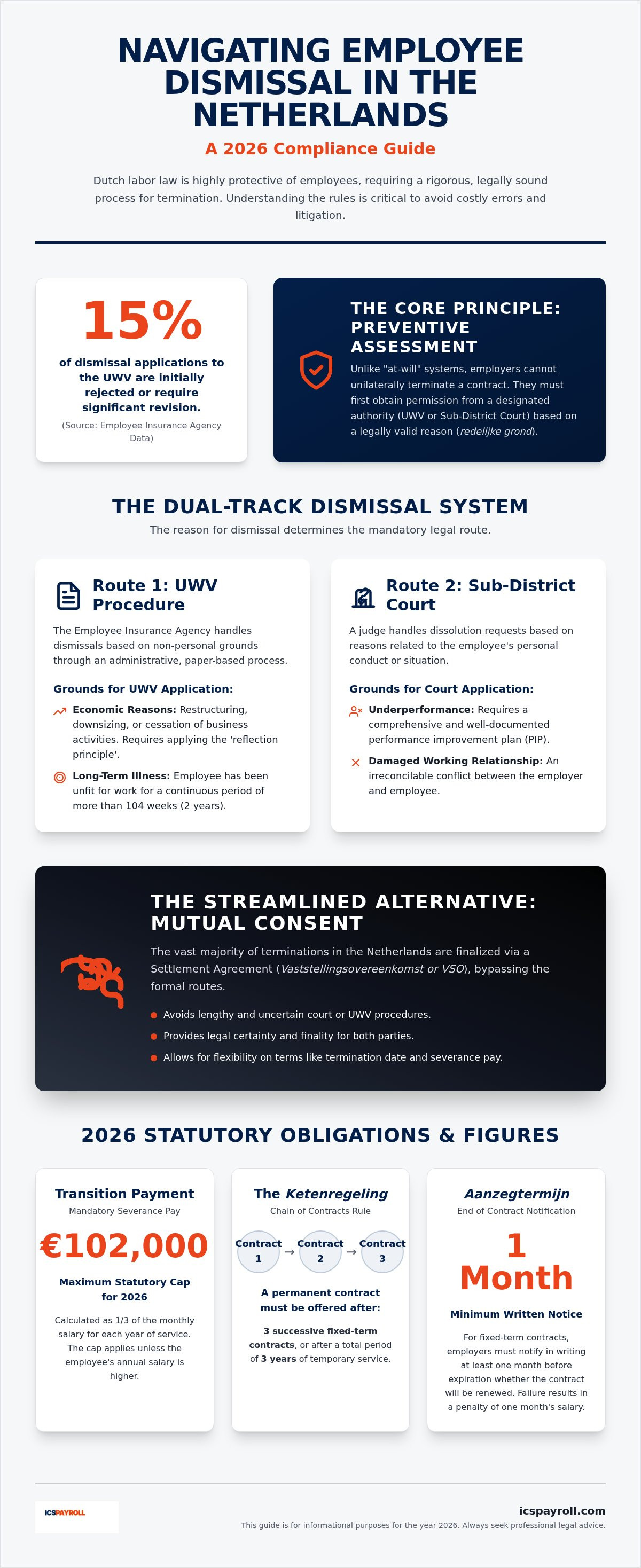
Approximately 15% of dismissal applications submitted to the Employee Insurance Agency (UWV) are rejected or require significant revision before they are approved. This high rejection rate reflects the rigorous standards of Dutch labor law and the risks inherent in the termination of employment contract netherlands. Many international employers find the protective nature of these regulations daunting, particularly when faced with the complexities of the dual-track dismissal system and the potential for high transition payment costs.
We recognize that maintaining compliance while managing workforce changes is a critical priority for your business. This 2026 guide provides a clear roadmap to navigate the legal requirements of offboarding staff. You will learn how to calculate transition payments accurately under the 2026 cap of €102,000 and identify the correct legal track for your specific situation. We provide the technical expertise needed to manage notice periods and settlement agreements, ensuring your business remains secure and free from the threat of litigation.
Key Takeaways
- Identify the specific legal grounds required for a compliant dismissal and understand the Dutch principle of preventive assessment.
- Navigate the dual-track system to determine whether the UWV or the Sub-District Court is the appropriate authority for your specific case.
- Streamline the termination of employment contract netherlands by utilizing a Settlement Agreement (VSO) to reach mutual consent and avoid court procedures.
- Calculate precise statutory transition payments for 2026, adhering to the 1/3 monthly salary rule and the EUR 102,000 maximum cap.
- Reduce administrative liability by leveraging an Employer of Record (EOR) to manage the complexities of the Ketenregeling and statutory notice periods.
Understanding the Dutch Dismissal System in 2026
Dutch employment law is built on a foundation of significant employee protection. Unlike "at will" employment systems found in other regions, the termination of employment contract netherlands requires a rigorous legal justification known as a redelijke grond (reasonable ground). Employers don't have the unilateral power to end a relationship without cause. Instead, they must navigate a system designed to prevent arbitrary dismissals. Preventive dismissal assessment is the requirement for either UWV or court approval before notice is given.
In 2026, the regulatory landscape has become even more complex due to the strict enforcement of the Wet DBA. This legislation focuses on the distinction between genuine freelancers and employees. If the authorities determine a worker is a "false self-employed" individual, that person automatically gains the full protection of Dutch labor law. This makes it impossible to terminate their services without following formal dismissal procedures. International companies must be certain of their workers' status to avoid unforeseen legal obligations and penalties from the Dutch Tax and Customs Administration.
The Role of Preventive Assessment
The preventive assessment system acts as a mandatory gatekeeper. Before an employer can issue a notice of termination, they must obtain permission from a designated authority. The specific route depends on the reason for the dismissal. Economic redundancies and long term illness cases (exceeding 104 weeks) go through the Employee Insurance Agency (UWV). Personal grounds, such as underperformance or a damaged working relationship, require a dissolution request via the Sub-district court. You can find detailed descriptions of these dismissal procedures on official government portals.
There are very few exceptions to this rule. Permission isn't required if the dismissal occurs during a valid probation period or in cases of summary dismissal for an urgent cause like theft. However, summary dismissal is high risk. If the court finds the reason wasn't "urgent" enough, the dismissal is voidable. The employee has exactly two months to challenge the termination and claim their job back or seek compensation.
Contract Types and the Ketenregeling
Compliance begins with understanding the specific contract in place. Fixed term contracts naturally expire on a set date, but they still carry administrative duties. Employers must provide a written aanzegtermijn (notification) at least one month before the contract ends. Failure to do so can result in a penalty payment equal to one month's salary. It's a small detail that often catches international firms off guard.
The Ketenregeling regulates how many temporary contracts you can offer. Under the current chain of contracts rule, an employee must be offered a permanent contract after three successive fixed term agreements or after three years of service. Permanent contracts provide the highest level of security. They don't have an end date and require a full legal dossier to terminate. ICSPayroll helps businesses manage these timelines by arranging employment through licensed partners, ensuring that the termination of employment contract netherlands always aligns with these statutory limits.
The Two Legal Routes to Dismissal: UWV and Sub-District Court
The Netherlands employs a rigid "dual-track" system where the specific reason for termination dictates the legal path an employer must follow. Choosing the incorrect track is a common mistake that leads to significant delays and unnecessary legal costs. Each authority has its own set of evidentiary requirements and procedural timelines. A successful termination of employment contract netherlands depends on identifying the correct redelijke grond (reasonable ground) before any formal steps are taken. Failure to align the reason with the correct track often results in the immediate rejection of the dismissal application.
Route 1: The UWV Procedure (Economic and Long-term Illness)
The Employee Insurance Agency (UWV) is the administrative body responsible for dismissals based on commercial or economic necessity. This includes restructuring, declining revenue, or the cessation of specific business activities. Employers must prove that the redundancy is inevitable and that they have applied the reflection principle (afspiegelingsbeginsel) to determine which specific roles are affected. Additionally, the UWV handles cases where an employee has reached the 24 month limit of continuous sick leave. This administrative process is generally paper-based and typically takes between 8 and 12 weeks to conclude. Detailed guidance on these procedural requirements is available via official government resources.
Route 2: The Sub-District Court (Personal and Performance Grounds)
If the dismissal is based on personal grounds, such as frequent absenteeism, culpable conduct, or poor performance, the employer must submit a dissolution request to the Sub-district court (kantonrechter). This route is also required for cases involving a damaged working relationship where collaboration is no longer possible. Performance-based dismissal is particularly challenging; judges require documented proof of a formal improvement plan (verbetertraject). You must show that the employee was given sufficient time and resources to improve their results. While the court route can be faster than the UWV, it usually involves higher costs due to the requirement for professional legal representation and the potential for "fair compensation" claims if the employer is found to be seriously culpable.
Regardless of the chosen route, the burden of proof rests entirely on the employer. You must maintain a comprehensive personnel file, a practice known as dossieropbouw, to justify the decision. This file must demonstrate that you have met all your Statutory Obligations: Notice Periods and Transition Payments. For international firms, maintaining this level of administrative precision can be a heavy burden. Utilizing a professional service for Dutch payroll administration ensures that your employment records are compliant and ready for legal scrutiny should a termination become necessary.
Termination by Mutual Consent: The Settlement Agreement (VSO)
Dismissal by mutual consent (wederzijds goedvinden) is the most efficient and frequently used method for the termination of employment contract netherlands. This approach allows both parties to bypass the formal UWV or court procedures by reaching a private agreement. It offers a level of control and speed that formal tracks cannot provide, often resolving sensitive situations within a matter of days. The terms of this arrangement are documented in a formal Settlement Agreement, known in Dutch as a vaststellingsovereenkomst or VSO.
Essential Elements of a Settlement Agreement
A properly drafted VSO is a legal necessity for risk mitigation. It must be structured to protect the employee's eligibility for Dutch unemployment benefits (WW-uitkering). If the agreement is poorly worded, the Employee Insurance Agency (UWV) may view the termination as voluntary, which would disqualify the employee from receiving support. According to Official Dutch Dismissal Guidance, these details are vital for a legally sound exit that satisfies the UWV benefit requirements.
To ensure compliance, the agreement should include these specific components:
- The document must explicitly state that the initiative for the termination came from the employer.
- It must confirm that there is no "urgent cause" (dringende reden) for dismissal, such as gross misconduct.
- The agreement should account for the statutory notice period, ensuring the end date is calculated correctly.
- It must include a final settlement covering outstanding holiday days, the 8% holiday allowance, and any pro-rata bonuses.
The Statutory Reflection Period
The Dutch legal system provides a mandatory protection for all employees signing a VSO. This is known as the statutory reflection period. Employees have a legal right to rescind their consent within 14 days of signing the agreement without providing any reason. This "cooling-off" period ensures that the employee has not been pressured into a decision and has had time to seek legal advice. This reflection period is a mandatory consumer-style protection for all Dutch employees.
Employers have a specific administrative duty regarding this timeline. You must mention the 14-day reflection period in writing within the agreement itself. If you fail to include this specific mention, the reflection period is automatically extended to 21 days. Managing these agreements requires technical precision to avoid unexpected reversals. ICSPayroll, through its licensed partners, ensures that every VSO follows current 2026 standards, removing the administrative burden from your internal teams while securing the legal standing of the business.
Statutory Obligations: Notice Periods and Transition Payments in 2026
The financial consequences of a termination of employment contract netherlands are strictly regulated by statutory requirements. Employers must provide a transition payment (transitievergoeding) for almost all dismissals. This obligation begins on the first day of employment, meaning payments are due even if a contract is ended during a probation period. For 2026, the payment is calculated as one-third of a gross monthly salary for each full year of service. Pro-rata calculations apply for any remaining months or days of the employment duration.
The maximum statutory transition payment for 2026 is capped at EUR 102,000. If an employee’s gross annual salary exceeds this amount, the cap is instead set at one full gross annual salary. These funds are intended to assist the employee in transitioning to new employment or funding additional training. For a detailed breakdown of how these payments interact with social security premiums, refer to our Dutch Payroll Administration: The 2026 Complete Reference Guide.
Calculating the Statutory Notice Period
Notice periods are not discretionary; they are tied directly to the employee's length of service. Employers must adhere to the following tiers unless a longer period is specified in the written contract:
- Less than 5 years of service: 1 month notice
- 5 to 10 years of service: 2 months notice
- 10 to 15 years of service: 3 months notice
- 15 or more years of service: 4 months notice
A critical administrative rule is that the notice period must always conclude on the final day of a calendar month. If you provide notice on the 15th of June, the notice period only begins to count from the 1st of July. Failure to respect these statutory timelines can result in an indemnity payment. You would be required to pay the employee an amount equal to the gross salary they would have earned during the remaining period. This is an avoidable cost that requires careful calendar management.
The Final Settlement (Eindafrekening)
Processing the final settlement, or eindafrekening, is the final step in the administrative process. This payment must be completed within one month of the contract end date. It includes the accrued holiday allowance, which is 8% of the gross salary earned since the last payout. You must also compensate the employee for any unused vacation days at their current daily rate. Pro-rata bonuses or 13th-month payments must be included to avoid post-termination claims.
If the departing employee benefits from the 30% ruling, specific technical precision is required. You must ensure the final payslip reflects the 2026 standard salary threshold of EUR 48,013. The tax-free allowance must be applied correctly to the final working days to remain compliant with the Dutch Tax and Customs Administration. Errors in this final calculation can trigger audits or lead to the loss of the ruling status for the employee's future roles.
Ensure your final calculations and offboarding processes are legally sound by leveraging our expert Dutch payroll administration services.
Mitigating Termination Risks Through an Employer of Record (EOR)
Hiring through an EOR partner allows international companies to delegate the legal complexities of the termination of employment contract netherlands. ICSPayroll’s licensed partners act as the legal employer, ensuring every dismissal adheres strictly to the rules of redelijke grond (reasonable ground). This arrangement provides a protective barrier between your foreign entity and the intricate Dutch labor court system. Managing offboarding via a local expert significantly reduces the risk of "unfair dismissal" (kennelijk onredelijk ontslag) claims, which can be both costly and damaging to your corporate reputation.
The financial structure of an EOR service offers unique advantages for cost management. The "payroll factor" pricing model utilized by our partners already incorporates the monthly accrual for statutory transition payments. This provides your business with absolute budget certainty. You won't face sudden, unbudgeted expenses when an employment relationship ends, as the 2026 transition payment obligations are pre-funded within your regular service invoices. It's a stabilizing force for businesses entering the Dutch market for the first time.
Compliant Offboarding via Licensed Partners
EOR partners manage the entire UWV or court application process on behalf of your organization. They handle the technical communication with Dutch authorities and ensure all procedural deadlines are met with precision. Compliance doesn't start at the point of dismissal; it begins on the first day of employment. Our partners provide the necessary employee handbook and structured HR administration to ensure your dossieropbouw is compliant from the outset.
The digital infrastructure provided by a local partner is equally critical. The online employee portal maintains a clear, timestamped audit trail of every signed contract, monthly payslip, and holiday balance. This data is essential for calculating a precise final settlement. Having a centralized record prevents disputes over unused leave or holiday allowances, ensuring the final payout is accurate and legally defensible.
Why a Local Partner Outperforms Global Platforms
Global PEO platforms often lack the deep, localized nuance required to navigate Dutch-specific 2026 reforms. They may struggle with the complexities of the recent non-compete clause changes or the stricter enforcement of Wet DBA regarding contract classification. Local partners provide direct access to Dutch payroll experts who understand exactly how the 30% ruling impacts severance packages and final tax filings. They ensure the standard 2026 salary threshold of €48,013 is respected in all final calculations.
Choosing a partner with deep roots in the Netherlands ensures your business isn't treated as a generic entry in a global database. You receive support tailored to the specific regulatory environment of the Dutch market. For a detailed comparison of these service models, read our guide on PEO Services in the Netherlands: The 2026 Guide to Compliant Hiring. This specialized expertise is the most effective way to secure your workforce operations against the volatility of local labor laws.
Secure Your Dutch Workforce Strategy for 2026
Managing the termination of employment contract netherlands requires a meticulous approach to both the dual-track legal system and statutory financial obligations. Success depends on choosing the correct path between the UWV and the Sub-district court while maintaining a legally sound personnel file. By prioritizing the 2026 transition payment standards and respecting mandatory notice periods, your business can avoid costly litigation and administrative penalties.
We provide the stability your business needs to thrive in a complex regulatory environment. Hire and offboard with confidence in the Netherlands via ICSPayroll. Our solutions, arranged through licensed partners, utilize a consolidated monthly invoice that already accounts for transition allowance accruals. We offer expert management of Dutch sickness risks for up to two years and provide expedited support for HSM and 30% ruling compliance. You can build and manage a compliant global team with absolute peace of mind.
Frequently Asked Questions
What is the 2026 transition payment cap in the Netherlands?
The statutory transition payment cap for 2026 is EUR 102,000 gross. If an employee's annual gross salary exceeds this amount, the maximum payment is instead capped at the equivalent of one gross annual salary. This payment is mandatory for all employees from their first day of service. It applies to terminations via the UWV, the Sub-district court, or when a fixed term contract is not renewed by the employer.
Can I fire an employee in the Netherlands for poor performance immediately?
Immediate dismissal for poor performance is not permitted under Dutch law. Employers must first build a comprehensive personnel file that documents the underperformance over time. You are required to provide a formal performance improvement plan (PIP) and allow the employee a reasonable period to improve their results. If performance remains insufficient, you must apply to the Sub-district court for a dissolution of the contract to ensure the termination of employment contract netherlands is legally valid.
How long is the reflection period for a Dutch settlement agreement?
The statutory reflection period is 14 days from the date the employee signs the settlement agreement (VSO). During this time, the employee can withdraw their consent without providing any reason. Employers must explicitly mention this right in the written agreement. If this written notice is missing, the reflection period automatically extends to 21 days. This consumer style protection is a mandatory requirement for all valid mutual consent terminations in the Netherlands.
Do I need to pay a transition allowance if the employee resigns?
Employers are generally not required to pay a transition allowance if the employee terminates the contract voluntarily. However, an exception exists if the resignation is the direct result of a seriously culpable act or omission by the employer. In most standard resignation scenarios, the statutory obligation to pay the transitievergoeding does not apply. You should still ensure the final settlement correctly accounts for accrued holiday pay and unused vacation days according to the final payslip.
What happens if I do not have a valid reason for dismissal in the Netherlands?
If you lack a valid legal ground (redelijke grond), the UWV or Sub-district court will reject your dismissal application. If you proceed with an invalid termination, the employee can challenge it in court within two months. This often leads to the dismissal being reversed or the employer being ordered to pay a "fair compensation" (billijke vergoeding). This additional penalty has no statutory limit and is awarded in cases of serious employer culpability.
Is summary dismissal (instant dismissal) allowed for non-performance?
Summary dismissal (ontslag op staande voet) is strictly reserved for urgent causes and is not a valid tool for managing non-performance. Urgent causes include serious offenses such as theft, fraud, or physical violence in the workplace. Using summary dismissal for performance issues is high risk and usually results in the court voiding the termination. In such cases, the employer remains liable for back pay and significant legal damages for failing to follow due process.
How does the 30% ruling affect the final settlement payment?
The 30% ruling impacts the final settlement by allowing a portion of the payment to be delivered as a tax free allowance, provided the 2026 salary threshold of EUR 48,013 is met. You must ensure the final payslip correctly calculates the pro-rata application of this ruling for the final month of service. Errors in this calculation can lead to the withdrawal of the ruling by the Tax and Customs Administration, affecting the employee's future tax status.
Can a fixed-term contract be terminated before the end date?
A fixed term contract can only be terminated early if both parties have included an interim termination clause in the written agreement. Without this clause, neither the employer nor the employee can end the contract before the specified end date unless they reach mutual consent via a VSO. If you terminate early without a clause or consent, you may be liable to pay the employee for the entire remaining duration of the contract.

Article by
Joost Hubregtse
Joost Hubregtse is Director of ICS Staffing & Payroll B.V., the wholly owned subsidiary of Intercompany Solutions behind ICS Payroll. He is responsible for Employer of Record and Dutch payroll services: employment contracts, wage tax and social security filings, holiday allowance, pension, sick leave and CAO compliance, with onboarding possible within 48 hours.
Frequently Asked Questions
The statutory transition payment cap for 2026 is EUR 102,000 gross. If an employee's annual gross salary exceeds this amount, the maximum payment is instead capped at the equivalent of one gross annual salary. This payment is mandatory for all employees from their first day of service. It applies to terminations via the UWV, the Sub-district court, or when a fixed term contract is not renewed by the employer.
Immediate dismissal for poor performance is not permitted under Dutch law. Employers must first build a comprehensive personnel file that documents the underperformance over time. You are required to provide a formal performance improvement plan (PIP) and allow the employee a reasonable period to improve their results. If performance remains insufficient, you must apply to the Sub-district court for a dissolution of the contract to ensure the termination of employment contract netherlands is legally valid.
The statutory reflection period is 14 days from the date the employee signs the settlement agreement (VSO). During this time, the employee can withdraw their consent without providing any reason. Employers must explicitly mention this right in the written agreement. If this written notice is missing, the reflection period automatically extends to 21 days. This consumer style protection is a mandatory requirement for all valid mutual consent terminations in the Netherlands.
Employers are generally not required to pay a transition allowance if the employee terminates the contract voluntarily. However, an exception exists if the resignation is the direct result of a seriously culpable act or omission by the employer. In most standard resignation scenarios, the statutory obligation to pay the transitievergoeding does not apply. You should still ensure the final settlement correctly accounts for accrued holiday pay and unused vacation days according to the final payslip.
If you lack a valid legal ground (redelijke grond), the UWV or Sub-district court will reject your dismissal application. If you proceed with an invalid termination, the employee can challenge it in court within two months. This often leads to the dismissal being reversed or the employer being ordered to pay a "fair compensation" (billijke vergoeding). This additional penalty has no statutory limit and is awarded in cases of serious employer culpability.
Summary dismissal (ontslag op staande voet) is strictly reserved for urgent causes and is not a valid tool for managing non-performance. Urgent causes include serious offenses such as theft, fraud, or physical violence in the workplace. Using summary dismissal for performance issues is high risk and usually results in the court voiding the termination. In such cases, the employer remains liable for back pay and significant legal damages for failing to follow due process.
The 30% ruling impacts the final settlement by allowing a portion of the payment to be delivered as a tax free allowance, provided the 2026 salary threshold of EUR 48,013 is met. You must ensure the final payslip correctly calculates the pro-rata application of this ruling for the final month of service. Errors in this calculation can lead to the withdrawal of the ruling by the Tax and Customs Administration, affecting the employee's future tax status.
A fixed term contract can only be terminated early if both parties have included an interim termination clause in the written agreement. Without this clause, neither the employer nor the employee can end the contract before the specified end date unless they reach mutual consent via a VSO. If you terminate early without a clause or consent, you may be liable to pay the employee for the entire remaining duration of the contract.