
Chain regulation for temporary contracts and how many you can have
By Joost Hubregtse, Director, ICS Staffing & Payroll
All blog posts are reviewed and fact checked by our labour law lawyer Zishan Hussain and our director. Editorial standards
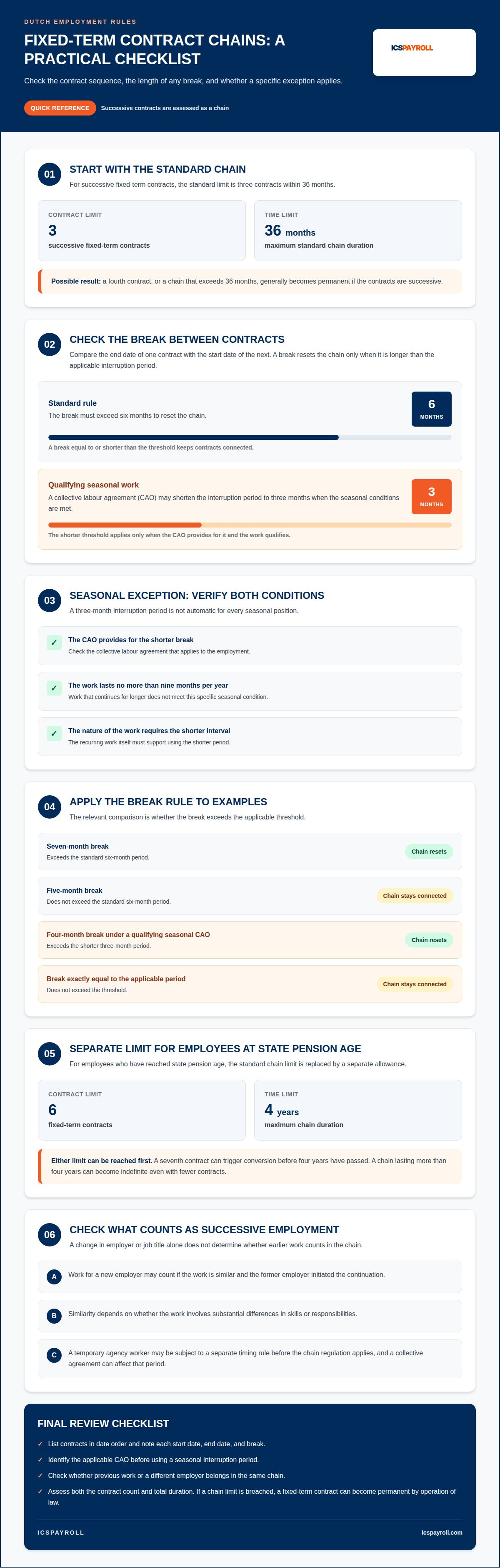
Under Article 7:668a of the Dutch Civil Code, the Dutch chain regulation for temporary contracts generally allows three consecutive fixed-term contracts within 36 months. A fourth contract, or a chain exceeding that period, generally becomes permanent if the contracts are successive.
The outcome can depend on breaks between contracts, applicable collective labour agreement provisions and the employee’s circumstances. Employees who have reached state pension age are subject to a separate limit.
This article explains how the rules work, when a break can reset the chain, and which exceptions may apply, including the separate rules for employees who have reached state pension age.
By Joost Hubregtse, Payroll Director. Joost Hubregtse is Payroll Director at ICSPayroll, the Dutch payroll and EOR specialist of Intercompany Solutions. A career payroll specialist and former Head of Payroll, he oversees wage tax filings, 30% ruling applications, and employment compliance for international employers.
Reviewed by Joost Hubregtse, Payroll Director, on 16 November 2026.
Key Takeaways
- A seasonal-work exception can shorten the break that resets the contract chain, but it depends on the applicable collective labour agreement and the nature and duration of the recurring work.
- Time worked for a previous employer may count toward the chain when a new employer continues similar work at the former employer’s initiative.
- Temporary agency workers follow a separate timing rule before the chain regulation applies, and a collective agreement can affect that period.
- Collective labour agreement provisions may change how the standard rules apply, so identify the agreement relevant to the employment before assessing the contract sequence.
- If the chain rule is breached, the fixed-term contract can become permanent by operation of law.
Can a short break between contracts prevent a permanent contract?
A break can reset a chain of temporary contracts, but the outcome depends on its length and whether a seasonal-work exception applies. The relevant interruption period determines whether earlier employment still counts.
Breaks Between Seasonal Contracts
For recurring seasonal work, a collective labour agreement (CAO) may shorten the standard interruption period from six months to three months. This exception applies when the work can be performed for no more than nine months per year and its nature requires the shorter interval. Employers planning seasonal roles and employees reviewing their contract history should check that both conditions are met.
A three-month gap does not automatically reset the chain for every seasonal position. The CAO must provide for the shorter interval, and the work must meet the seasonal conditions. For example, recurring work that lasts longer than nine months per year does not fit this specific exception. The statutory framework is set out in Article 7:668a of the Dutch Civil Code.
Breaking and Resetting the Chain
A break resets the chain only when it is longer than the applicable interruption period. Under the standard rule, it must exceed six months; under the qualifying seasonal exception, it must exceed three months. Once the chain resets, a later contract begins a new sequence for assessing successive employment. The length of the break matters, not a change to the contract title.
For example, a seven-month break exceeds the standard six-month period, while a five-month break does not. For qualifying seasonal work covered by a CAO, a four-month break exceeds the shorter period. A break exactly equal to the applicable period does not exceed it, so the contracts remain connected for chain-rule purposes.
The Interruption Period
The interruption period is the longest interval that may separate successive contracts while they remain part of the same chain. The standard period is six months. For eligible recurring seasonal work, a CAO may set it at three months if the work lasts no more than nine months per year and its nature requires the shorter interval.
To assess a sequence, compare the end date of one contract with the start date of the next. Apply the relevant threshold: six months under the standard rule, or three months under a qualifying seasonal CAO provision. For example, a five-month break keeps contracts connected under the standard rule, but exceeds the shorter seasonal interval.
As an employee of state pension age, how long can I be given fixed-term contracts?
In the Netherlands, an employee who has reached state pension age may receive up to six fixed-term contracts over a maximum period of four years. Under Article 7:668a of the Dutch Civil Code, a chain exceeding either limit becomes indefinite automatically. The number of contracts and the total period are separate limits, so the relevant one may be reached first.
A business transfer or role change does not necessarily start a new chain. Work for a new employer may count as successive employment if the work is similar and the former employer initiated the continuation. Similarity depends on whether the work involves substantial differences in skills or responsibilities. A different role or employer name alone does not determine whether earlier employment counts.
If an employer appears to breach the rule, list the contracts in date order and keep copies of each agreement. Raise the issue in writing, identify the limit you believe has been exceeded, and ask the employer to confirm your employment status. This correspondence and contract timeline can help clarify the sequence under the statutory rule.
For employees who have reached state pension age, the standard chain limit is replaced by a separate allowance of six contracts over four years. Both limits matter. A seventh contract can trigger automatic conversion before four years have passed, while a chain lasting more than four years can become indefinite even if it contains fewer contracts. These limits apply to successive employment within the same chain, not simply to the latest agreement’s label.
For example, if an employee has already received six successive fixed-term contracts, another contract in the same chain can become permanent. The same outcome can follow if the chain lasts more than four years before a seventh agreement is issued. The contract may convert by operation of law even if its written terms still state an end date.
That conversion changes the employment relationship. The employer can no longer rely on the original end date as though the contract were still temporary. Permanent employment also carries stricter dismissal protection, and an employee may be entitled to severance pay in relevant circumstances.
For a discussion about continued employment, present the contract sequence and ask for written confirmation of the contract status and terms. Include the start and end dates and any breaks, since these details help show how the chain is calculated. If the employer disputes the sequence, the relevant question is whether the contracts count as successive under Article 7:668a, rather than what the parties called them.
Maximum number and total duration of fixed-term contracts
In the Netherlands, the standard chain allows three successive fixed-term contracts within 36 months. If a fourth contract follows, or the total duration exceeds 36 months, the contract generally becomes indefinite.
These are separate limits. A sequence can reach the contract limit before the time limit, or exceed the maximum duration while containing fewer contracts. Assess both when reviewing successive employment in the same chain.
Limits on Contract Numbers
The contract-number limit counts successive fixed-term agreements, not just renewals with the same title. A new agreement can therefore matter even if the employee stays in the same position and the contract wording changes. This distinction helps employers and employees identify when another temporary agreement crosses the statutory limit.
For example, if an employee has completed three successive contracts, a fourth in the same chain triggers the standard rule. A collective labour agreement (CAO) may allow a different limit in specific circumstances, including a chain of up to six contracts within four years. The applicable CAO and its conditions determine whether this exception applies.
Combined Duration of the Contract Chain
The maximum combined duration under the standard rule is 36 months. Add the duration of successive contracts in the chain, rather than treating each agreement’s end date as a separate allowance. A chain that passes this limit can become indefinite even if it contains fewer than four contracts.
A CAO may extend the maximum chain duration to 48 months where Dutch law permits. The exception changes the duration limit, so the relevant sector agreement can affect how long temporary employment may continue. A CAO’s extension does not mean every employer or position automatically qualifies.
Keep the contract count and elapsed duration as separate checks. For instance, two long contracts could reach the 36-month duration limit before a fourth agreement is issued. Conversely, several shorter agreements could reach the contract limit while the total period remains below 36 months. Either limit can determine when the employment becomes indefinite.
Some statutory exceptions concern a particular contract sequence. For example, a contract lasting longer than 24 months followed by an extension of no more than three months is identified as an exception to the chain rule. This narrow provision should not be treated as a general extension of every contract or chain.
Before issuing or accepting another fixed-term agreement, list each contract in order and calculate the chain’s total duration. Then identify the applicable CAO and any exception relevant to the sector or employment arrangement. This distinguishes the standard limit from a lawful collective-agreement variation and clarifies whether the next contract remains temporary or becomes indefinite.
Immediate application and transitional rules
The Dutch chain-rule changes took effect immediately on 1 January 2020. They also applied to employment contracts that began before that date and ended on or after it. An existing sequence could therefore be assessed under the updated rules, rather than only contracts signed after the change.
Collective labour agreement (CAO) provisions that deviated from the previous law in favour of the employee continued to prevail over changes introduced by the Balanced Labour Market Act. For an employment relationship spanning 1 January 2020, the relevant CAO terms could therefore affect which rule applied. The earlier agreement’s more favourable provision was not automatically displaced.
Workers under 18 have a specific exception. The chain rule does not apply while an employee under 18 works less than 12 hours a week. When that employee turns 18, the current contract becomes the first contract in the chain. The age and weekly working hours determine when the ordinary counting starts.
For example, a 17-year-old working fewer than 12 hours weekly falls within the exception. At age 18, the current agreement counts as contract one, rather than disappearing from the sequence. This makes the birthday and contract status relevant dates for assessing successive term contracts.
Temporary agency workers follow a separate initial period. Temporary agency workers may be subject to a separate initial period before the chain rule applies. A CAO may extend that period, but only up to 78 weeks. The applicable agency agreement therefore affects when successive contracts begin counting under the chain rule.
Track agency employment from the start of the assignment, including whether a CAO changes the initial period. After that period ends, subsequent temporary contracts can count toward the chain. A direct contract with the company where the employee worked through an agency may also count as the second contract in the chain, rather than as a new first agreement.
Different rules can apply to vocational training and certain school supply-teaching arrangements. Article 7:668a of the Dutch Civil Code sets out exceptions for vocational training in paragraph 10 and for workers under 18 with small working hours in paragraph 11. These exceptions mean that the standard chain calculation does not apply identically to every employment arrangement.
To assess a sequence spanning a rule change, identify each contract’s start and end dates, the employee’s age and weekly hours, and any applicable CAO. For agency employment, include the agency-work start date and the agreement governing the initial period. These details help establish which transitional or category-specific rule applies before you count successive contracts.
Dutch statutory chain rule for consecutive temporary contracts
The current Dutch chain rule generally limits employment to three consecutive fixed-term contracts within 36 months. A fourth contract, or a chain lasting longer than 36 months, becomes indefinite if the contracts are successive and the breaks between them are six months or less. The rule is set out in Article 7:668a of the Dutch Civil Code.
The current standard rule is three contracts and 36 months, with qualifying breaks of six months or less keeping contracts connected. No proposed change should be treated as current law unless it has been enacted and taken effect.
Count the contracts and calculate their combined duration separately. Either limit can trigger conversion. For example, if three successive agreements have already been issued, a fourth may become indefinite even before the 36-month period ends. Conversely, fewer contracts can still exceed the duration limit.
The six-month interval determines whether a later employment contract continues the chain. A break longer than six months generally starts a new chain. A collective labour agreement (CAO) may provide a shorter, three-month interval for recurring seasonal work if it can be performed for no more than nine months per year and its nature requires the shorter period.
Some arrangements have specific exceptions. Dutch law excludes vocational training from the chain rule under Article 7:668a, paragraph 10. It also excludes certain employees under 18 who work fewer than 12 hours a week. A current contract becomes the first contract in the chain when that employee turns 18.
Temporary agency employment follows a distinct starting period. The chain clause does not apply during the first 52 weeks of agency work. A CAO may extend that period to a maximum of 78 weeks. If an agency worker then enters direct employment with the company where they worked, the direct contract can count as the second contract in the chain.
Work for a new employer can also count as successive employment in some circumstances. The work must be similar, without substantial differences in skills or responsibilities, and the former employer must have initiated the continuation. A different employer name alone does not determine whether earlier employment counts.
When assessing an employment sequence, list every agreement in date order, note each break, and identify any applicable CAO or statutory exception. Then compare the contract count and combined duration with the standard limits. If either limit is exceeded, the contract may become indefinite by operation of law, rather than remaining temporary just because the document states an end date.
For international employers applying these rules to Dutch hires, discuss Dutch employment compliance as part of the employment setup.
ICSPayroll
ICSPayroll helps international employers manage employment in the Netherlands when contract decisions need to align with local payroll and employment requirements. Its Employer of Record (EOR) and Dutch Payroll Administration services support companies hiring and paying employees in the Dutch market. ICSPayroll also manages 30% Ruling Applications for eligible international employees.
If you are planning temporary employment or reviewing a contract sequence, the right support depends on your hiring arrangement and payroll needs. An EOR can support employment in the Netherlands, while Dutch payroll administration is for companies managing their own employment arrangements. These services complement your understanding of the chain rule but do not replace assessing the applicable contract history and rules.
Contact ICSPayroll to discuss employment and payroll support for your Dutch team.
Build a consistent approach to Dutch hiring
Use the Dutch chain regulation (ketenregeling) for temporary contracts as part of workforce planning, not as a last-minute contract check. A consistent process for recording contract history, breaks, role changes and applicable agreements helps your team make informed decisions before extending employment. It also gives managers and payroll teams a shared basis for handling future hires.
For international employers, Dutch employment arrangements need to fit the company’s operating model and local requirements. Reviewing how contract decisions connect with payroll and workforce administration can clarify the next steps for your Dutch team. ICSPayroll supports employers with Dutch employment and payroll needs, including Employer of Record and payroll administration.
Contact ICSPayroll for support with your Dutch employment setup. A clear process can help your team move forward with confidence.
Frequently Asked Questions
How many temporary contracts can you have under the ketenregeling?
Under the standard Dutch rule, an employee can have three successive fixed-term contracts in a chain before a fourth generally becomes permanent. The chain also has a total duration limit of 36 months. Both limits matter: whichever is reached first can trigger conversion. When assessing a particular sequence, count contracts and calculate duration separately, then account for breaks and any applicable collective labour agreement.
Are there exceptions to the standard chain rule?
Yes. Exceptions include certain vocational training arrangements and employees under 18 who work fewer than 12 hours a week. A collective labour agreement may also change the rules in permitted circumstances, including the interval for qualifying recurring seasonal work. Temporary agency workers have a separate initial period before the chain rule applies. The relevant exception depends on the employee’s age, work arrangement, contract history and applicable agreement.
The chain rule explained: when do you get a permanent contract?
A fixed-term contract generally becomes permanent automatically when the chain reaches a fourth contract or exceeds 36 months, provided the contracts remain successive under the applicable interruption rule. For example, a contract can convert even if its written terms still give it an end date. The chain must be assessed using the employment history, the breaks between contracts and any exception that changes the ordinary calculation.
What are the consequences for employers if they violate the ketenregeling?
If a chain limit is exceeded, the contract may become indefinite by operation of law, even if the employer intended another temporary arrangement. The employee then has the protections associated with permanent employment, including stricter dismissal protection. Employers should assess contract history before issuing an extension, including work for a previous employer where it may count as successive employment. The contract label alone does not determine the legal outcome.
What happens if I do not work for the same employer for more than six months?
A break longer than six months generally resets the standard chain, so a later contract starts a new sequence. Measure the actual interval from the end of one contract to the start of the next. A shorter interruption may apply to qualifying seasonal work if a collective labour agreement provides for it. Because this exception has specific conditions, do not assume that a break automatically resets the chain.
What happens if an employer does not comply with the ketenregeling?
If an employee believes a contract has become permanent, they can explain their position to the employer in writing. Set out the contract sequence and dates, identify the limit that appears to have been exceeded, and ask the employer to confirm the employment status. Keep copies of contracts and correspondence. If the employer disputes the position, these records help establish the employment history needed to assess the chain.
What is the chain clause?
The chain clause is the Dutch legal rule that limits successive fixed-term employment contracts before permanent employment arises. It is set out in Article 7:668a of the Dutch Civil Code. The clause considers the number and combined duration of contracts, as well as breaks between them. A collective labour agreement or statutory exception can affect how the rule applies to a particular employment arrangement.
What is the Dutch chain regulation (ketenregeling) for fixed-term employment contracts?
The Netherlands’ chain regulation is the statutory framework for deciding when a sequence of fixed-term contracts becomes an indefinite employment relationship. The standard assessment considers whether contracts are successive, how many have been issued, their combined duration and the breaks between them. It also accounts for exceptions, such as specific agency-work or seasonal-work rules. Employers and employees should assess the complete employment history, not only the latest contract.

Article by
Joost Hubregtse
Joost Hubregtse is Director of ICS Staffing & Payroll B.V., the wholly owned subsidiary of Intercompany Solutions behind ICS Payroll. He is responsible for Employer of Record and Dutch payroll services: employment contracts, wage tax and social security filings, holiday allowance, pension, sick leave and CAO compliance, with onboarding possible within 48 hours.
Frequently Asked Questions
Under the standard Dutch rule, an employee can have three successive fixed-term contracts in a chain before a fourth generally becomes permanent. The chain also has a total duration limit of 36 months. Both limits matter: whichever is reached first can trigger conversion. When assessing a particular sequence, count contracts and calculate duration separately, then account for breaks and any applicable collective labour agreement.
Yes. Exceptions include certain vocational training arrangements and employees under 18 who work fewer than 12 hours a week. A collective labour agreement may also change the rules in permitted circumstances, including the interval for qualifying recurring seasonal work. Temporary agency workers have a separate initial period before the chain rule applies. The relevant exception depends on the employee’s age, work arrangement, contract history and applicable agreement.
A fixed-term contract generally becomes permanent automatically when the chain reaches a fourth contract or exceeds 36 months, provided the contracts remain successive under the applicable interruption rule. For example, a contract can convert even if its written terms still give it an end date. The chain must be assessed using the employment history, the breaks between contracts and any exception that changes the ordinary calculation.
If a chain limit is exceeded, the contract may become indefinite by operation of law, even if the employer intended another temporary arrangement. The employee then has the protections associated with permanent employment, including stricter dismissal protection. Employers should assess contract history before issuing an extension, including work for a previous employer where it may count as successive employment. The contract label alone does not determine the legal outcome.
A break longer than six months generally resets the standard chain, so a later contract starts a new sequence. Measure the actual interval from the end of one contract to the start of the next. A shorter interruption may apply to qualifying seasonal work if a collective labour agreement provides for it. Because this exception has specific conditions, do not assume that a break automatically resets the chain.
If an employee believes a contract has become permanent, they can explain their position to the employer in writing. Set out the contract sequence and dates, identify the limit that appears to have been exceeded, and ask the employer to confirm the employment status. Keep copies of contracts and correspondence. If the employer disputes the position, these records help establish the employment history needed to assess the chain.
The chain clause is the Dutch legal rule that limits successive fixed-term employment contracts before permanent employment arises. It is set out in Article 7:668a of the Dutch Civil Code. The clause considers the number and combined duration of contracts, as well as breaks between them. A collective labour agreement or statutory exception can affect how the rule applies to a particular employment arrangement.
The Netherlands’ chain regulation is the statutory framework for deciding when a sequence of fixed-term contracts becomes an indefinite employment relationship. The standard assessment considers whether contracts are successive, how many have been issued, their combined duration and the breaks between them. It also accounts for exceptions, such as specific agency-work or seasonal-work rules. Employers and employees should assess the complete employment history, not only the latest contract.