
WIA insurance for employee disability: who can be covered
By Joost Hubregtse, Director, ICS Staffing & Payroll
All blog posts are reviewed and fact checked by our labour law lawyer Zishan Hussain and our director. Editorial standards
Already receiving partial WIA benefits doesn’t automatically mean an employee can join supplemental disability insurance. WIA insurance for employee disability in the Netherlands has two distinct parts: statutory cover, which employees are automatically insured under, and optional insurance that may supplement a benefit.
It’s understandable to assume that a WIA benefit settles the question of cover. In practice, the employee’s incapacity assessment, remaining earning capacity and salary relative to the WIA limit all affect the benefit. Whether someone already receiving WIA can join an additional policy depends on that policy’s eligibility terms.
This guide explains who is covered, when WIA benefits may not be paid, and how partial incapacity, salary limits and employer self-insurance affect the situation. It also distinguishes the WGA, for partial or temporary full incapacity, from the IVA, for permanent full incapacity, so you can understand what statutory benefits provide and where supplementary cover may fit.
Key Takeaways
- Separate automatic statutory WIA cover from optional insurance that may supplement a benefit.
- Understand how the UWV’s assessment of incapacity and remaining earning capacity affects WGA or IVA eligibility.
- Learn why an employee may not receive WIA benefits after long-term illness, including the effect of reintegration efforts.
- Identify how the WIA wage limit can leave income above the cap outside statutory cover.
- See how continued work and an employer’s choice to self-insure for WGA can affect income and reintegration responsibilities.
Can I insure employees who are currently receiving partial WIA benefits?
Yes, employees receiving partial WIA benefits may be eligible for supplementary insurance, subject to the policy’s terms. WIA insurance for employee disability in the Netherlands can refer to statutory cover or optional cover, which are separate arrangements.
Dutch employers must continue sick pay at 70% for a maximum of 104 weeks under article 7:629 BW, as explained by the Government of the Netherlands. Employees are automatically insured under the statutory WIA scheme, while supplementary cover is voluntary. The UWV says employers may top up benefits, but aren’t required to do so.
After 104 weeks of illness, the UWV assesses an employee’s health, remaining capacity for work and potential earnings. WIA eligibility generally requires at least 35% incapacity for work, according to the UWV’s WIA information. The assessment determines the disability percentage and whether WGA or IVA may apply. A partial WIA award establishes statutory entitlement, but not automatic eligibility for another policy.
Cover for Employees With Partial WIA Benefits
Supplementary disability insurance may provide additional income protection for an employee already receiving partial WIA benefits. Whether the employee can join or make a claim depends on the policy’s eligibility and coverage terms. This distinction matters for HR: statutory compensation follows the UWV assessment, while voluntary insurance is governed by separate policy conditions. WIA insurance for employee disability in the Netherlands should therefore be considered in both its statutory and supplementary forms.
Disability Percentage and Benefit Amount
The UWV’s disability percentage reflects assessed loss of earning capacity and helps determine WIA eligibility and benefit type. WGA covers employees assessed as 35% to 80% incapacitated, as well as those temporarily fully incapacitated. The percentage matters because it affects the benefit calculation; former salary and current or new income also influence the amount. The assessment is not based on absence alone.
Effects of Salary and Work on Benefits
Returning to work can affect WGA income because the calculation considers remaining earning capacity and current or new salary. For eligible claimants, a WGA wage-related benefit is 70% of the difference between capped former salary and current or new salary. Continued work can change earnings and benefit amounts, so the employee’s work activity and assessed capacity both matter.
After a WGA wage-related benefit, the employee may receive a wage supplement or follow-up benefit. The transition occurs after at least 3 months and no more than 24 months. Employees using less than 50% of their remaining earning capacity receive a follow-up benefit, with the percentage depending on the assessed incapacity band.
WIA benefits and employer sick pay apply at different stages. Pension arrangements and other insurance are separate matters, each governed by its own terms. If the UWV denies a benefit or calculates it incorrectly, the employee can challenge the decision through the UWV’s objection process, as explained in the decision and its guidance. Keep any insurer claim separate because it follows the policy conditions.
When is WIA not paid after 2 years of illness?
After long-term illness, a WIA benefit isn’t automatic. The UWV’s WIA assessment considers the employee’s remaining capacity and potential earnings. An employee may qualify for WGA when illness has lasted at least 2 years and they can earn 65% or less of their former pay. If the assessed loss falls below the WIA threshold, statutory benefits may not be payable.
The assessment distinguishes partial or temporary full incapacity from permanent full incapacity. WGA applies to employees assessed as 35% to 80% incapacitated, and may also cover temporary full incapacity. IVA applies to employees assessed as at least 80% incapacitated, with little or no prospect of long-term recovery. An employee who can earn 20% or less of their former wage, with a condition unlikely to change, may qualify for IVA.
When the UWV finds an employee can earn more than 65% of their former pay, the employee may fall outside WGA eligibility. The relevant comparison concerns earning capacity, not simply the employee’s current working hours or job title. A person can remain unable to perform their previous role yet have sufficient assessed capacity for other suitable work. That assessment determines whether the statutory threshold is met.
There is also an employer-related reason a WIA decision may not follow the expected timetable. During the first 2 years of illness, the employer must continue paying wages and support the employee’s return to work. The Government of the Netherlands explains the sick-pay obligation, while the UWV reviews reintegration efforts as part of the WIA process. If it finds the employer’s efforts inadequate, it may require continued wage payment for a longer period, delaying the transition to a WIA assessment.
That distinction matters for HR. A delayed WIA decision following a reintegration shortfall doesn’t mean the employee has been found ineligible. It means the employer remains responsible for wages while addressing the UWV’s finding. If the employee doesn’t meet the incapacity threshold, however, WIA benefits may not be awarded. The employee’s capacity and likely earnings from suitable work remain central to the decision.
For example, an employee assessed below 35% incapacity may not qualify for WGA, even after 2 years of illness. An employee assessed at 80% or more may be considered for IVA only when the condition is also expected to be lasting. A WGA benefit and an IVA benefit therefore serve different work-and-income situations, with recovery prospects affecting the classification.
HR should keep the reintegration record separate from the UWV assessment. The first documents steps taken to support a return to work; the second evaluates the employee’s capacity and potential earnings. If the UWV requires continued wage payment, the employer’s responsibilities continue while the finding is addressed. If the assessment instead finds the employee below the eligibility threshold, they may not receive WIA benefits.
Coverage above the WIA wage limit
The WIA wage limit caps the salary used to calculate statutory benefits. The maximum annual income covered under the Dutch WIA was €75,864 in 2025, according to the UWV’s WIA information. If an employee’s salary exceeds that ceiling, the part above it isn’t included in the statutory calculation.
This difference can create a WIA wage gap: statutory benefits may not replace income earned above the limit. A WGA gap may also arise when total income falls below 70% of insured annual wage after the wage-related benefit changes. Supplementary disability insurance can help address a shortfall, depending on the policy. The UWV says employers may top up benefits, but aren’t required to do so.
How cover above the limit works
WIA excess insurance is intended to insure salary above the statutory wage limit. Available coverage percentages can be 70%, 75%, or 80% of that excess salary, subject to the policy’s terms. This cover doesn’t raise the statutory ceiling or alter the UWV’s disability assessment. It provides a separate layer of protection for income excluded from the statutory WIA calculation.
For example, an employee earning above the 2025 limit of €75,864 has an excess-salary portion above that amount. The chosen policy percentage determines how much of that portion is insured. The employee’s benefit still depends on the disability assessment and policy conditions, so supplementary cover should be distinguished from statutory WIA entitlement.
How the WGA gap differs
WGA gap insurance addresses a different shortfall. It may supplement income where the employee’s WGA benefit and earnings fall below the relevant level. A WGA wage-related benefit is calculated as 70% of the difference between capped former salary and current or new salary, according to the UWV’s WIA guidance. The employee’s income and remaining earning capacity affect the gap.
After the wage-related period, income can change again. Employees using less than 50% of their remaining earning capacity receive a WGA follow-up benefit. A supplementary policy may address some resulting income loss, but its coverage depends on its terms and the employee’s situation.
The applicable wage ceiling can change over time. Before estimating compensation, HR should distinguish the employee’s insured salary, the relevant WIA limit, the disability percentage and any supplementary cover. These factors help explain why employees with similar previous salaries can have different outcomes.
WIA excess insurance may continue until a fixed retirement age or the actual state pension age, depending on the policy. The Government of the Netherlands explains the state pension age. This supplementary period is distinct from statutory WIA entitlement, and doesn’t mean every employee receives identical cover or benefits for the same duration.
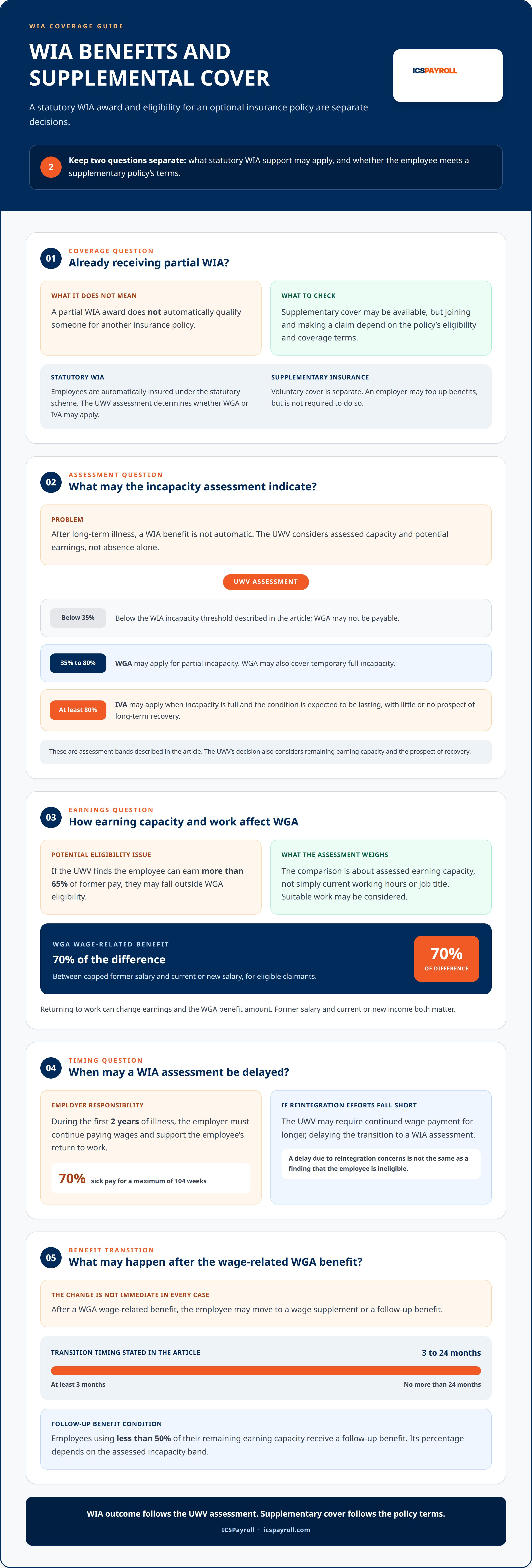
Partial and full incapacity thresholds
After 2 years of illness, the UWV classifies an employee by the percentage of lost earning capacity. The WIA threshold generally begins at 35% incapacity for work. An employee assessed below 35% may therefore receive no statutory WIA benefit, even if illness still limits their previous job. The assessment focuses on what the employee can earn in suitable work, compared with their former salary.
The WGA scheme covers employees assessed as 35% to 80% incapacitated, and employees temporarily fully incapacitated. The IVA scheme covers permanent full incapacity assessed at 80% to 100%, where there is little or no prospect of long-term recovery. These categories distinguish partial or potentially temporary incapacity from severe, lasting incapacity. The disability percentage and recovery outlook determine which scheme may apply.
For an employee assessed at 35% to 80%, WGA eligibility depends on the difference between former income and assessed earning capacity. An employee who can earn 65% or less of their former salary may qualify after 2 years of illness. By contrast, an employee assessed below the 35% threshold may not qualify for statutory WIA benefits. The UWV’s assessment concerns earning ability, not simply hours absent from work.
At least 80% incapacity does not automatically mean IVA. If recovery remains possible, the employee may instead fall under WGA as temporarily fully incapacitated. IVA requires permanent incapacity and little or no recovery prospect. For eligible permanent cases, IVA benefits are 75% of daily salary, subject to a maximum, until state pension age. The applicable salary cap means the benefit may not replace all previous income.
There is a separate protection for some employees below the statutory WIA threshold. WIA Compensation Insurance can pay compensation when an employee is assessed as at least 15% but less than 35% disabled after 2 years. This is supplementary cover, not statutory WGA or IVA entitlement. Its relevance depends on whether the employer has arranged that insurance and on the employee’s policy eligibility.
For HR, the practical distinction is between three assessed ranges: below 35%, 35% to 80%, and 80% to 100%. The first may fall outside statutory WIA; the second generally points to WGA; the highest range may lead to WGA or IVA, depending on recovery prospects. An annual salary above the WIA wage limit can also affect benefit calculations, so the percentage alone does not establish the employee’s final income.
Consider two employees each unable to perform their former role after 2 years. If one is assessed at 30% incapacity, statutory WIA may not apply, though WIA Compensation Insurance may. If another is assessed at 85% with little prospect of recovery, IVA may be relevant. These examples show why HR should keep the incapacity percentage, earning capacity, salary limit, and recovery assessment distinct.
How does salary, working hours, or partial work affect WIA benefit entitlement?
When determining WIA entitlement, the UWV assesses earning capacity, not working hours alone. It compares what an employee can still earn in suitable work with their earnings before illness. The resulting wage loss helps establish the disability percentage. An employee who works fewer hours may still have substantial earning capacity, while someone working within reduced capacity may qualify for WIA compensation.
For WIA claimants with income loss between 35% and 80%, compensation can reach 70% of lost income when they continue working within their remaining capacity. The actual outcome depends on assessed capacity and earnings. Returning to work can therefore affect both the income calculation and the employee’s assessed position. HR should distinguish actual hours worked from the UWV’s assessment of what the employee could earn.
A WGA wage-related benefit is calculated at 70% of the difference between capped former salary and current or new salary. The former salary used in that calculation is subject to the WIA maximum. In 2025, the maximum annual income covered under the Dutch WIA was €75,864. Salary above that limit does not increase the statutory calculation.
Part-time work can change current earnings without changing the underlying disability percentage by the same amount. The UWV assessment considers the employee’s health, remaining capacity and potential earnings compared with their work before illness. For example, an employee may work reduced hours but still be assessed on the earning capacity available through suitable work, rather than on their part-time schedule alone.
The WGA payment can change after the salary-related period. A wage-related benefit transitions to a wage supplement or follow-up benefit after at least 3 months and no more than 24 months. The employee’s earnings and use of remaining capacity matter at this stage. If the employee uses less than 50% of that capacity, the follow-up benefit applies.
This transition can create a WGA gap when total income falls below 70% of insured annual wage. The gap depends on the employee’s benefit type, income from work, and remaining earning capacity. Two employees with the same previous salary can therefore have different income outcomes if their assessed capacity or current earnings differ.
For HR, keep the UWV assessment, current salary and working pattern distinct in absence and payroll records. A changed schedule is not, by itself, a new disability assessment. If an employee’s salary changes as they return to work, that income can affect the WGA calculation. Reviewing these factors together helps explain why partial work may increase earnings without immediately replacing the statutory benefit.
ICSPayroll
ICSPayroll supports international businesses employing people in the Netherlands, where payroll administration and employment responsibilities must align with Dutch requirements. Its Dutch Payroll Administration and Employer of Record (EOR) services help structure employment and payroll processes around an employee’s pay and work status. These services do not replace a WIA eligibility assessment or supplementary disability insurance, but they can support the management of Dutch employment arrangements.
If you’re hiring in the Netherlands or reviewing how employee payroll is administered, ICSPayroll can help you understand the employment and payroll setup involved. Contact ICSPayroll to discuss your Dutch employment and payroll requirements.
Make disability cover part of your HR planning
Use your understanding of WIA insurance for employee disability in the Netherlands to shape clear internal processes. Align absence management, payroll records and employee communication so responsibilities remain clear when someone’s work capacity changes. Keep statutory benefits distinct from supplementary insurance, and consider cover alongside your wider Dutch employment arrangements.
For international employers, employment structure and payroll administration can also affect how Dutch requirements are handled. ICSPayroll provides Employer of Record (EOR), Dutch Payroll Administration and 30% Ruling Application services. These offerings support employment and payroll administration, while WIA eligibility and insurance terms remain governed by their applicable rules.
To discuss your Dutch employment and payroll setup, contact ICSPayroll about WIA insurance. Clear processes help your team make informed decisions and support employees with confidence.
Frequently Asked Questions
How does the WIA work?
The WIA is the Netherlands’ Work and Income (Capacity for Work) Act. Employees are automatically insured under the statutory scheme, but receiving a benefit requires an assessment after long-term illness. The UWV evaluates health, remaining earning capacity and income potential to determine eligibility and benefit type. For example, the assessment may distinguish a partial-capacity situation from permanent, full incapacity, which can lead to different WIA schemes.
Is the employer’s contribution included?
Employers pay premiums for employee insurance schemes, including statutory employee insurance. This statutory financing is separate from any optional policy an employer arranges to supplement WIA benefits. For supplementary cover, the policy documents and the employer’s insurance arrangement determine the premium and how it is handled. Do not assume that a statutory premium automatically provides additional cover for income above the WIA wage limit.
What does supplemental WIA insurance cover?
Supplemental WIA insurance can address income gaps that statutory benefits leave, including a WGA gap or salary above the WIA wage limit. The exact protection depends on the policy’s insured salary, selected coverage and duration. For instance, excess insurance may insure 70%, 75% or 80% of salary above the statutory limit. It supplements, rather than changes, the UWV’s decision on incapacity or WIA eligibility.
What is a WIA benefit?
A WIA benefit provides income support to an employee whose illness or disability reduces their capacity to earn. The UWV’s assessment determines whether the employee qualifies and which scheme applies. The WGA covers partial incapacity and temporary full incapacity; the IVA is for permanent full incapacity with little or no prospect of long-term recovery. The benefit amount depends on the assessment and relevant salary limits.
What is WIA in the Netherlands and when does employee disability coverage begin?
WIA stands for the Work and Income (Capacity for Work) Act, the Dutch statutory disability scheme for employees. Employees are automatically insured, but a WIA benefit is not paid simply because an illness begins. The benefit assessment follows long-term sickness, and the UWV considers the employee’s condition and earning capacity. This differs from employer sick pay, which applies during the earlier period of illness.
What are the eligibility requirements for WIA benefits after two years of sickness?
After 104 weeks of illness, eligibility generally requires at least 35% incapacity for work. The UWV compares the employee’s remaining earning capacity with their previous earnings. WGA may apply when an employee can earn 65% or less of former pay; IVA may apply when incapacity is at least 80%, permanent, and recovery prospects are limited. The assessment, rather than absence alone, determines entitlement.
How are WIA benefits calculated, including the WGA and IVA benefit rates and maximum amounts?
WGA wage-related benefits are 70% of the difference between capped former salary and current or new salary. IVA benefits are 75% of daily salary, subject to a maximum. The statutory WIA maximum annual income covered was €75,864 in 2025. These figures do not establish a personal payment: the UWV’s disability assessment, salary history and income from work affect the calculation.
How do Dutch WIA supplementary insurance premiums and costs compare for employers and employees?
There is no single cost comparison that applies to every employer and employee. Employers pay premiums for statutory employee insurance schemes, while supplementary cover is a separate insurance arrangement. Its cost and how payment is allocated depend on the cover chosen and the policy terms. Compare the salary insured, the percentage covered and how long benefits can continue, rather than treating statutory premiums as the price of supplementary protection.

Article by
Joost Hubregtse
Joost Hubregtse is Director of ICS Staffing & Payroll B.V., the wholly owned subsidiary of Intercompany Solutions behind ICS Payroll. He is responsible for Employer of Record and Dutch payroll services: employment contracts, wage tax and social security filings, holiday allowance, pension, sick leave and CAO compliance, with onboarding possible within 48 hours.
Frequently Asked Questions
The WIA is the Netherlands’ Work and Income (Capacity for Work) Act. Employees are automatically insured under the statutory scheme, but receiving a benefit requires an assessment after long-term illness. The UWV evaluates health, remaining earning capacity and income potential to determine eligibility and benefit type. For example, the assessment may distinguish a partial-capacity situation from permanent, full incapacity, which can lead to different WIA schemes.
Employers pay premiums for employee insurance schemes, including statutory employee insurance. This statutory financing is separate from any optional policy an employer arranges to supplement WIA benefits. For supplementary cover, the policy documents and the employer’s insurance arrangement determine the premium and how it is handled. Do not assume that a statutory premium automatically provides additional cover for income above the WIA wage limit.
Supplemental WIA insurance can address income gaps that statutory benefits leave, including a WGA gap or salary above the WIA wage limit. The exact protection depends on the policy’s insured salary, selected coverage and duration. For instance, excess insurance may insure 70%, 75% or 80% of salary above the statutory limit. It supplements, rather than changes, the UWV’s decision on incapacity or WIA eligibility.
A WIA benefit provides income support to an employee whose illness or disability reduces their capacity to earn. The UWV’s assessment determines whether the employee qualifies and which scheme applies. The WGA covers partial incapacity and temporary full incapacity; the IVA is for permanent full incapacity with little or no prospect of long-term recovery. The benefit amount depends on the assessment and relevant salary limits.
WIA stands for the Work and Income (Capacity for Work) Act, the Dutch statutory disability scheme for employees. Employees are automatically insured, but a WIA benefit is not paid simply because an illness begins. The benefit assessment follows long-term sickness, and the UWV considers the employee’s condition and earning capacity. This differs from employer sick pay, which applies during the earlier period of illness.
After 104 weeks of illness, eligibility generally requires at least 35% incapacity for work. The UWV compares the employee’s remaining earning capacity with their previous earnings. WGA may apply when an employee can earn 65% or less of former pay; IVA may apply when incapacity is at least 80%, permanent, and recovery prospects are limited. The assessment, rather than absence alone, determines entitlement.
WGA wage-related benefits are 70% of the difference between capped former salary and current or new salary. IVA benefits are 75% of daily salary, subject to a maximum. The statutory WIA maximum annual income covered was €75,864 in 2025. These figures do not establish a personal payment: the UWV’s disability assessment, salary history and income from work affect the calculation.
There is no single cost comparison that applies to every employer and employee. Employers pay premiums for statutory employee insurance schemes, while supplementary cover is a separate insurance arrangement. Its cost and how payment is allocated depend on the cover chosen and the policy terms. Compare the salary insured, the percentage covered and how long benefits can continue, rather than treating statutory premiums as the price of supplementary protection.