
How to Explain an EOR’s Role to a New Hire
By Joost Hubregtse, Director, ICS Staffing & Payroll
All blog posts are reviewed and fact checked by our labour law lawyer Zishan Hussain and our director. Editorial standards
A new hire should never have to guess who employs them. If you’re working out how to explain an EOR to your new hire, start with the key point: in the Netherlands, the EOR is their legal employer, while they do their day-to-day work for your company.
Employees reasonably want clarity about their contract, pay and workplace responsibilities. Explain that the EOR manages formal employment administration, including the employment contract, payroll, tax requirements and social security. Your company directs the employee’s work and welcomes them into the team.
This arrangement lets a company hire in the Netherlands without setting up a local employing entity. The employee still needs a clear explanation of who handles each part of the relationship, where to direct employment questions and how their work connects to your organisation. This article explains the EOR’s responsibilities, how the arrangement works in practice, and why companies use an EOR for cross-border hiring. A clear conversation at the start sets expectations and helps the new hire begin with confidence.
Key Takeaways
- Explain that the EOR is the employee’s legal employer in the Netherlands, while your company directs their day-to-day work.
- Clarify which employment matters the EOR manages, including payroll and employment administration, so the new hire knows where to turn for support.
- Set clear expectations about the division of responsibilities between the EOR and your company throughout the employment relationship.
- Consider an EOR when you need to hire in the Netherlands without establishing a local employing entity, while weighing the arrangement’s limits for your business.
- Use a consistent explanation to help new hires understand how their employment works across borders and how their role fits into your team.
What is an employer of record (EOR)?
An employer of record, or EOR, is the legal employer of a worker hired in the Netherlands. The arrangement is generally treated as a payroll agreement under Article 7:692 of the Dutch Civil Code. The EOR employs the person and seconds them to your company, which directs their day-to-day work.
For international hiring, this separates formal employment administration from the employee’s daily role on your team. It can let a company hire in the Netherlands without establishing a local entity.
The EOR’s Employment Role
The EOR employs the new hire and seconds them to your company to perform their role. Your company organises their work, sets priorities and supports team collaboration. For example, an employee based in the Netherlands can join your product team’s meetings while the EOR manages the formal employment relationship.
This distinction gives the employee two clear points of contact. The EOR is the legal employer for employment administration, while your company manages the work itself. Explain both roles during onboarding: who issues employment documents, and who assigns projects or gives role-specific direction. That clarity helps a new hire understand how their position fits within your organisation.
Payroll and Employment Administration
Payroll and employment administration cover the recurring records and processes that support the EOR employment relationship. In the Netherlands, this can include calculating and processing pay, preparing payslips, and administering relevant employment information. The EOR also handles tax requirements and deductions connected with payroll, following the Dutch payroll tax rules described by Business.gov.nl.
A payslip is a practical example: the EOR manages payroll administration, while your company provides role-related information that affects the employee’s work. The EOR also gives the employee a formal contact for payroll matters. Explain where payroll questions should go, separately from conversations about deadlines, performance or team priorities.
Contracts, Taxes, and Contributions
The EOR’s employment administration can include the employment contract, tax requirements and deductions, social security and pension. These are separate from your company’s operational decisions, such as the employee’s projects or working relationships with colleagues. During onboarding, explain which organisation handles each area, so the employee knows where to direct a contract question versus a task-related question.
In the Netherlands, the employee’s contract and payroll administration sit within the EOR relationship, while their day-to-day work supports your business. For example, a new hire might discuss a payslip or pension with the EOR, then talk with their manager about a product launch. A concise explanation makes the arrangement understandable without suggesting the EOR controls company culture. Your team still shapes collaboration, communication and the employee’s experience at work.
What the EOR handles: payroll, taxes, benefits and compliance
In the Netherlands, an EOR coordinates payroll administration and employment-related processes for the employees it employs. Its responsibilities differ from the client company’s strategic and day-to-day management of the employee’s work.
Payroll, Salary, and Taxes
An EOR manages salary processing, payroll records, payslips and related payroll tax administration for an employee it employs. Under this arrangement, the EOR handles payroll tax as the employer, rather than the client company using a local entity of its own. This distinction helps the new hire understand who administers their pay and who manages their work.
The key difference from direct hiring is who employs the person: under direct hiring, a Dutch company is the employer; under an EOR arrangement, the EOR is the legal employer. The EOR manages payroll taxes and social security administration associated with the employment. The client company supplies work-related information needed for accurate administration, while the EOR handles employment and payroll processes.
Benefits and Statutory Contributions
Benefits and statutory contributions are managed through the employee’s Dutch employment arrangement. This can include social security administration and relevant pension arrangements, alongside payroll processing. An EOR arrangement in the Netherlands typically qualifies as a payroll agreement under Article 7:692 of the Dutch Civil Code. That legal relationship helps define the EOR’s formal role in administering employment.
Equal treatment also matters. Article 8a of the Dutch Waadi entitles payroll employees to the same employment conditions as employees hired directly by the host company. For example, a candidate should receive applicable employment conditions comparable to those offered to directly hired employees in equivalent roles. This gives the employee a clearer basis for understanding how their conditions relate to the host company.
Holidays, Sick Leave, and Pensions
Holiday allowance, leave records, sick-leave administration, and pension arrangements are employment matters handled within the EOR relationship. As of July 2026, Dutch employers must pay holiday allowance of at least 8% of an employee’s gross annual salary, according to the Government of the Netherlands. This helps the employee understand that holiday allowance is separate from ordinary salary administration.
In the Netherlands, full-time employees are entitled to at least 20 days of statutory annual leave, while part-time employees receive at least four times their weekly working hours. For example, a part-time schedule of three days weekly carries a statutory leave entitlement calculated from those weekly hours. The EOR administers relevant employment records, while the employee coordinates planned time off with the client company’s team.
Client and EOR Responsibilities
The EOR manages formal employment administration, including payroll, employment records, and related tax and social security processes. The client company directs the employee’s work, sets priorities and integrates them into its teams. This division answers a practical onboarding question: payroll or pension administration goes to the EOR, while project deadlines and team responsibilities go to the manager.
For compliance, the EOR administers the employment relationship, and the client company provides accurate information about the employee’s role and working arrangements. The employee should know both points of contact from the start. For example, the manager addresses the operational impact of a change in working arrangements, and the EOR handles any resulting employment administration.
Benefits and limitations of using an EOR
An EOR can make hiring in the Netherlands more manageable by handling employment administration and local payroll processes. Its value depends on the company’s hiring plans, internal capacity and need for local employment expertise.
Where an EOR Adds Value
For a company testing demand in the Netherlands, an EOR can make it possible to hire before building local employment infrastructure. The company can bring a Dutch-based software specialist into its team while the EOR manages the employment administration. This reduces the administrative work the company needs to organise internally.
An EOR can also support international hiring across several countries. Managing payroll and compliance across multiple countries without a centralised solution can be difficult. A company with employees in the Netherlands and other markets may use EOR services to coordinate employment processes through local arrangements. This can help its internal team focus on talent planning and business priorities.
Local employment expertise is another practical benefit. Dutch regulations and employment law shape contracts, payroll, leave and other employment processes. An EOR familiar with the Dutch system can manage these administrative requirements while the client company focuses on role expectations and the employee’s contribution. For example, a manager can set a product launch schedule without also processing Dutch payroll.
What an EOR Does Not Replace
An EOR does not take over the client company’s strategic management of an employee. The client still needs to define the role, set priorities, provide feedback and build the employee’s connection to the team. A Dutch-based analyst may receive employment administration through an EOR, but the client must still explain reporting lines and project goals.
An EOR does not automatically suit every hiring plan. A company building a substantial, long-term Dutch operation may prefer to assess whether a local entity better fits its structure and direct employment plans. Consider expected headcount, the duration of the hiring need, management capacity and how closely the company wants to control local employment arrangements. An EOR is an employment route, not a substitute for that strategic decision.
Service scope matters too. EOR providers differ in the countries and employment processes they cover, so a Netherlands arrangement applies to Dutch employment. A company hiring in the Netherlands and another country needs to account for each country’s separate regulations and administration. One Dutch EOR arrangement does not cover requirements in every market.
Making the Trade-Off Clear
Explain the practical division to a new hire: the EOR manages the formal employment relationship, while the client company directs work and supports team integration. This framing avoids presenting the arrangement as either a barrier or a promise that every employment decision sits with one organisation.
For the business, weigh the administrative capacity gained against the responsibilities retained. A clear division of work, defined escalation points and explicit country scope make the model easier to manage. These details help determine whether an EOR suits a particular Dutch hiring plan.
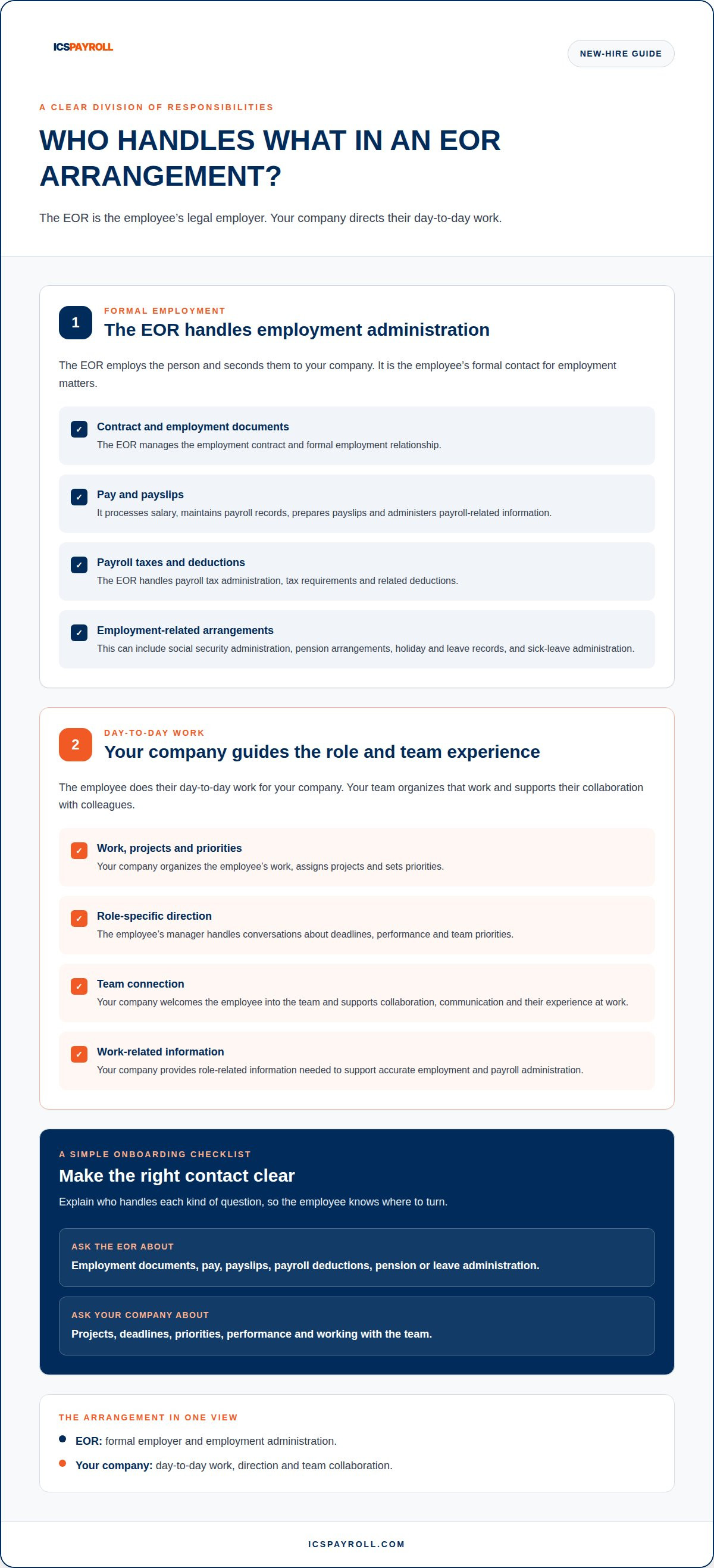
How the EOR relationship works day to day
The arrangement works through two connected channels: the EOR handles formal employment administration, and the client company manages the employee’s work. A new hire should know which channel to use for each issue from their first day.
Work and Team Communication
For a project deadline, the employee speaks with their manager at the client company. The manager sets priorities, shares feedback and explains how the employee’s work supports the team. The EOR does not replace these everyday management conversations. A clear reporting line helps the employee take part in company culture while understanding the separate employment relationship.
For example, a Dutch-based designer may discuss a campaign brief with colleagues and raise workload concerns with their manager. They can direct questions about their contract or payslip to the EOR. Explaining this distinction during onboarding separates routine work discussions from employment administration and gives the employee a practical route for each question.
Employment Administration in Practice
Administrative requests should go to the organisation responsible for the subject. A payslip query, a change to personal details or a question about employment records concerns the EOR’s administration. A request to change a project deadline concerns the client company’s work planning. This helps employees avoid sending the same request through both channels.
Time off is a useful example of coordination. The employee discusses team coverage and planned dates with their manager, then follows the applicable process to record the absence. The manager considers project needs; the EOR maintains relevant employment administration. Clear communication between both organisations helps keep the employee’s schedule and records aligned.
Handling Changes and Questions
A change can affect both work and employment records. If an employee’s role or working arrangements change, the client company communicates the operational details, while the EOR handles any related employment administration. For instance, a manager may explain new responsibilities, then share the relevant information through the agreed process so employment records stay accurate.
Social security questions belong in the employment-administration channel, while concerns about team collaboration belong with the manager. If a question touches both areas, the employee can start with the relevant contact and ask them to coordinate. This keeps responsibilities clear without making the employee act as a go-between.
Keeping the Relationship Clear as Teams Grow
As a company expands, it may add employees in the Netherlands while its internal teams continue to manage their daily work. A consistent onboarding explanation helps each new hire understand the EOR’s role, their manager’s role and the route for common requests. The same distinction supports a smooth working relationship as responsibilities or team structures change.
When companies use an EOR to hire across borders
Companies use an EOR when they need to employ someone in the Netherlands but do not have a local employing entity. The arrangement can also bridge the period before a company establishes its own presence.
Hiring Before Establishing a Local Entity
A business may identify a Dutch candidate before deciding whether to build a lasting local operation. An EOR provides an employment arrangement while the company assesses its plans and the employee starts contributing to the team. This separates the immediate hiring need from the longer process of setting up a local entity.
Establishing a subsidiary can take 2-6 months. An EOR implementation may take a few weeks, making the difference relevant when the business needs to onboard talent sooner. These timelines describe different arrangements, not a guarantee for every hiring situation. For example, a company with a new Dutch customer project might need a local specialist before its entity setup is complete.
Bridging a Transition to a Local Presence
An EOR can also serve as an interim arrangement while a company builds its own presence in the Netherlands. The employee can begin working with the client company under the EOR employment relationship. Once the local entity is in place, the employee may transfer to it, supporting continuity during the company’s expansion.
Explain any transition clearly to the employee: who employs them now, what changes when the company’s own entity is ready, and how their role continues. For example, a software engineer may keep working with the same product team while the employing arrangement changes. Distinguish continuity in the role from changes to formal employment administration.
Hiring for a Defined Need
Some cross-border hiring needs are tied to a specific business plan, such as entering the Dutch market or supporting a regional project. An EOR allows a company to establish an employment relationship in the Netherlands without making entity setup the first step. The company still defines the role, reporting lines and expected contribution.
Before choosing the arrangement, consider whether the hiring need is exploratory, transitional or part of a permanent local operation. A company planning one specialist hire may have different structural needs from a business building a larger Dutch team. This distinction helps determine whether an interim employment model or direct employment through a local entity better supports the company’s plans.
Explaining the Cross-Border Arrangement
Explain the country-specific employment relationship alongside the role itself. Tell the new hire which organisation is the legal employer, who manages daily priorities and where employment questions should go. A Dutch employee joining an international team should not have to infer these responsibilities from colleagues or payroll messages.
This explanation also helps managers coordinate across borders. The client company handles team integration and work direction, while the EOR manages formal employment administration. Clear ownership gives the employee a practical route for questions and helps the company maintain consistent onboarding as its international team grows.
ICSPayroll
ICSPayroll helps companies hiring in the Netherlands manage employment and local payroll administration through its Employer of Record (EOR) service. This is a practical option when you need to employ someone locally without a Dutch entity, or want professional support with Dutch payroll processes.
The team can also manage a 30% Ruling Application for eligible international employees. These services help clarify the division between formal employment administration and your company’s day-to-day management, so you can explain the arrangement accurately to a new hire. The right support depends on your hiring structure and the Dutch employment tasks you need handled.
For help with hiring and employment administration in the Netherlands, contact ICSPayroll.
Make the First Conversation Count
A new hire’s first explanation of the employment arrangement can shape how confidently they approach their role. Make it part of onboarding, not a formality. Explain who to approach for work decisions and employment questions, then give the employee room to raise anything that remains unclear.
Knowing how to explain EOR to your new hire means making the arrangement clear without overwhelming them with administration. Keep the conversation relevant to their immediate experience, and reinforce the key points when questions arise. Consistency helps the employee focus on joining the team and contributing to the work.
If you’re planning a hire in the Netherlands, ICSPayroll can discuss how its EOR support fits your employment needs. Contact ICSPayroll to discuss EOR and take a clear next step toward welcoming your new hire.
Frequently Asked Questions
What does an EOR actually do?
An EOR provides the formal employment framework for a hire in the Netherlands. It is responsible for employment records and payroll administration. During onboarding, explain how to direct a specific request: identify the right employment contact and provide the document or pay period involved. This makes it easier to resolve individual issues without confusing them with work-related discussions.
What is an EOR and when should you use one?
An EOR is a legal employer arrangement that can help a company hire in the Netherlands without first establishing its own Dutch entity. It may suit a company entering the country, hiring a Dutch-based specialist or assessing a new market before making a longer-term structural decision. For example, a business planning a pilot project can consider whether it needs an employee locally before investing in a permanent operating structure.
When is an EOR necessary?
An EOR is not required for every Dutch hire. It is relevant when a company wants to employ someone locally without using its own Dutch entity. A company that already has a Dutch employing entity may instead arrange employment directly. The deciding question is which employing structure fits the company’s plans, not whether every international hire must use an EOR.
How can an EOR provider explain an Employer of Record to your new hire in simple terms?
Explain it in plain language: “Your employment paperwork is managed through the EOR, and your manager at the company guides your work.” Then give the employee a short contact map, such as the role or name for employment queries and the person responsible for team priorities. A concrete example, such as where to send a payroll question, makes the explanation easy to apply.
Who is the legal employer under an EOR arrangement, and who manages day-to-day work?
The legal employer is the entity named in the employment arrangement, while the client company generally directs the employee’s work. The legal employer depends on the hiring route. For some international hires, immigration sponsorship is arranged via our licensed partner. During onboarding, explain which entity appears in the employee’s documents and who handles work planning, so the employee has clear points of reference.
What should a new hire know about their EOR employment contract and payslip?
A new hire should read the contract for the named employer, role, agreed salary and any stated employment conditions. On a payslip, they can review the pay period and listed salary and deductions. If an item is unclear, they can identify the relevant document and entry when raising a query. This gives the payroll contact a specific issue to investigate, rather than a general request to explain the whole payslip.
What Dutch employment rights and benefits apply to employees hired through an EOR?
Employees hired through an EOR are covered by applicable Dutch employment rules. For example, Article 7:629 of the Dutch Civil Code governs sick pay. The Government of the Netherlands’ guidance on continued wage payment during illness explains the employer’s sick-pay obligations. Employees can use their contract and employment contact to understand how relevant conditions apply to them.
What are the risks or drawbacks of EOR employment for a new hire?
One potential challenge is a change in the employment arrangement if the company later establishes its own Dutch entity. The employee may need new or updated employment documentation, so explain the change clearly and in advance. Another practical risk is uncertainty about whom to approach. A written contact guide can reduce confusion by identifying the right channel for contract, payroll and role-related questions.

Article by
Joost Hubregtse
Joost Hubregtse is Director of ICS Staffing & Payroll B.V., the wholly owned subsidiary of Intercompany Solutions behind ICS Payroll. He is responsible for Employer of Record and Dutch payroll services: employment contracts, wage tax and social security filings, holiday allowance, pension, sick leave and CAO compliance, with onboarding possible within 48 hours.
Frequently Asked Questions
An EOR provides the formal employment framework for a hire in the Netherlands. It is responsible for employment records and payroll administration. During onboarding, explain how to direct a specific request: identify the right employment contact and provide the document or pay period involved. This makes it easier to resolve individual issues without confusing them with work-related discussions.
An EOR is a legal employer arrangement that can help a company hire in the Netherlands without first establishing its own Dutch entity. It may suit a company entering the country, hiring a Dutch-based specialist or assessing a new market before making a longer-term structural decision. For example, a business planning a pilot project can consider whether it needs an employee locally before investing in a permanent operating structure.
An EOR is not required for every Dutch hire. It is relevant when a company wants to employ someone locally without using its own Dutch entity. A company that already has a Dutch employing entity may instead arrange employment directly. The deciding question is which employing structure fits the company’s plans, not whether every international hire must use an EOR.
Explain it in plain language: “Your employment paperwork is managed through the EOR, and your manager at the company guides your work.” Then give the employee a short contact map, such as the role or name for employment queries and the person responsible for team priorities. A concrete example, such as where to send a payroll question, makes the explanation easy to apply.
The legal employer is the entity named in the employment arrangement, while the client company generally directs the employee’s work. The legal employer depends on the hiring route. For some international hires, immigration sponsorship is arranged via our licensed partner. During onboarding, explain which entity appears in the employee’s documents and who handles work planning, so the employee has clear points of reference.
A new hire should read the contract for the named employer, role, agreed salary and any stated employment conditions. On a payslip, they can review the pay period and listed salary and deductions. If an item is unclear, they can identify the relevant document and entry when raising a query. This gives the payroll contact a specific issue to investigate, rather than a general request to explain the whole payslip.
Employees hired through an EOR are covered by applicable Dutch employment rules. For example, Article 7:629 of the Dutch Civil Code governs sick pay. The Government of the Netherlands’ guidance on continued wage payment during illness explains the employer’s sick-pay obligations. Employees can use their contract and employment contact to understand how relevant conditions apply to them.
One potential challenge is a change in the employment arrangement if the company later establishes its own Dutch entity. The employee may need new or updated employment documentation, so explain the change clearly and in advance. Another practical risk is uncertainty about whom to approach. A written contact guide can reduce confusion by identifying the right channel for contract, payroll and role-related questions.