
What Is a CAO in the Netherlands and How Does It Affect Your Pay?
By Joost Hubregtse, Director, ICS Staffing & Payroll
All blog posts are reviewed and fact checked by our labour law lawyer Zishan Hussain and our director. Editorial standards
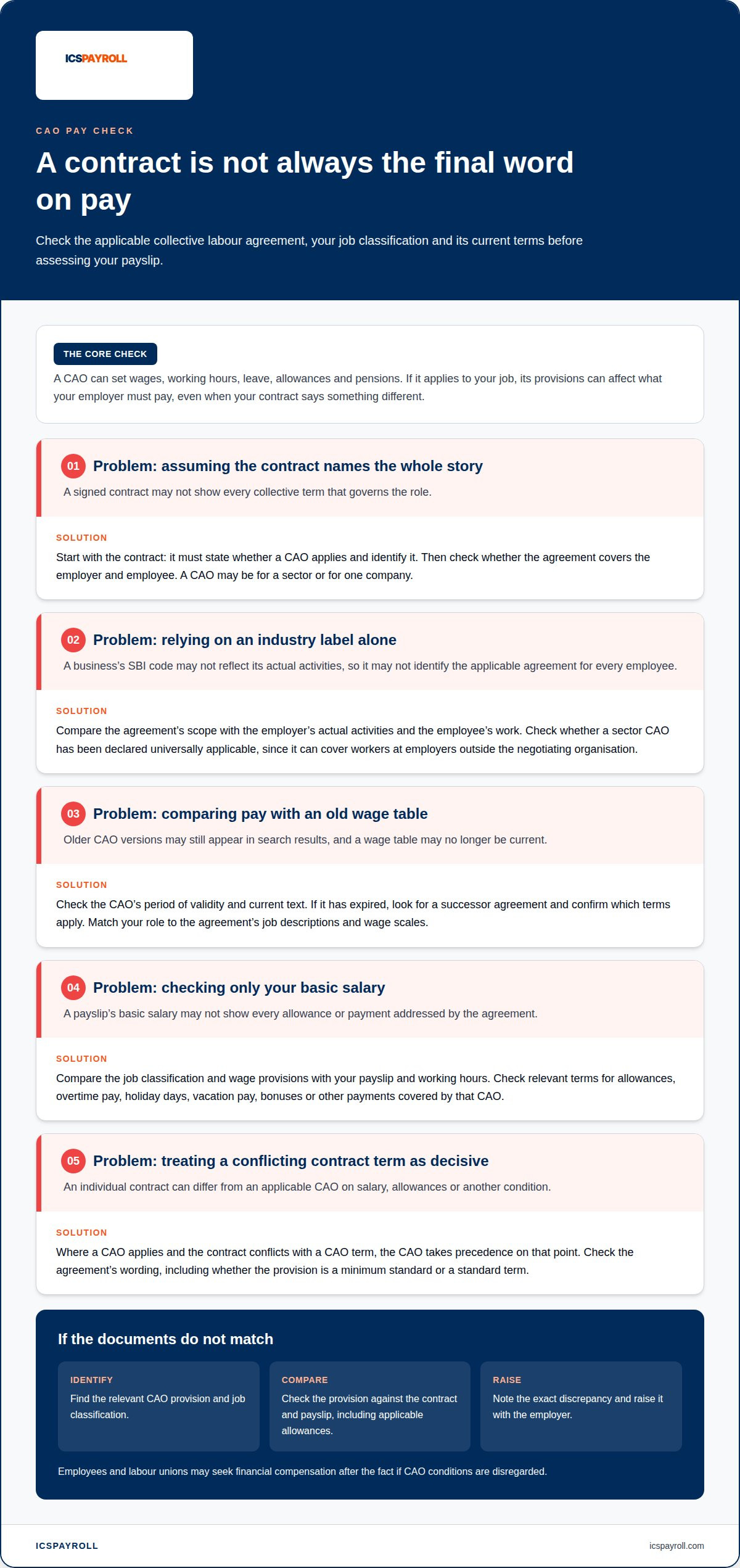
Your employment contract is not always the final word on your pay. To understand what a CAO in the Netherlands is, start with its purpose: a collective labour agreement negotiated by employers or employers’ organisations and employees or trade unions. It can set terms such as wages, working hours, leave, allowances and pensions. If a CAO applies to your job, its provisions can affect what your employer must pay, even if your contract says something different.
That is why a payslip can be hard to assess by looking at gross pay alone. Identify the applicable CAO, match your role to its job description and wage table, and account for the agreement’s current terms and your working hours. This guide explains what a CAO covers, when it applies, how it relates to your employment contract and Dutch law, and how to compare your pay with the relevant wage arrangements. You’ll have a clearer basis for understanding whether your payslip reflects the conditions that govern your employment.
Key Takeaways
- Identify whether a sectoral or company agreement applies to your role before assessing your pay.
- Use the CAO’s job descriptions and wage arrangements to compare your position with your payslip.
- Check how the agreement interacts with your employment contract, especially where their terms differ.
- When no CAO is compulsory, employment terms can be agreed individually, but general Dutch employment rules still apply.
- Understand the role of Dutch Payroll Administration and Employer of Record services when managing employment and payroll compliance.
What is a CAO (collective labour agreement)?
A CAO is a collective agreement negotiated between employers or employers’ organisations and employees or their organisations, such as trade unions. In the Netherlands, it can set employment conditions for a sector or a single company, including wage arrangements that affect an employee’s pay. The Government of the Netherlands explains how collective agreements are made and apply.
Sectoral and Company Agreements
A sectoral CAO covers employers and employees in a particular industry, while a company CAO applies within one company. Employers can negotiate sectoral terms with trade unions directly or through an employers’ organisation. If a sector CAO is declared universally applicable, it covers all workers in that sector, including at employers outside the negotiating organisation, according to the Government of the Netherlands. This distinction helps explain why two employees with similar jobs may have different agreements.
CAO negotiations bring representatives of employers and employees together to agree on terms. For example, an employers’ organisation may negotiate with a trade union on behalf of participating employers. An individual company can also negotiate with a union, sometimes alongside other employers, to establish a company or sector agreement. Before considering its own CAO, a company should establish whether a sector agreement already applies to its activities.
Matters Covered by a CAO
A CAO sets agreed employment conditions, which may include wages, working hours, holiday days, allowances, overtime pay, notice periods and pensions. Its wage table can link job descriptions to salary scales, helping employees assess how the agreement relates to their role and pay. Provisions differ between agreements, so the wording of the relevant CAO matters.
Some agreements also cover breaks, probation periods, vacation pay, bonuses, internship pay or trainee allowances. A CAO may set minimum rates for self-employed professionals, as well as rules on public holidays or commuting-cost reimbursement. These details matter because a payslip’s basic salary may not show every allowance or payment covered by the agreement. Check the relevant provisions alongside the job classification and pay details.
Finding the Applicable CAO
To identify the CAO that may apply to a job, start with the agreement named in the employment contract, then compare its scope with the employer’s actual activities and the employee’s work. A business’s SBI code may not reflect its actual activities, so it may not identify the applicable agreement for every employee. Check the agreement’s coverage and current text, as older versions may still appear in search results.
A CAO sets its own period of validity, so its text shows when it expires. After expiry, look for a successor agreement and confirm which terms apply to the employment relationship. Do not assume an old wage table is still current. If the employer appears not to follow an applicable CAO, identify the relevant provision, compare it with the contract and payslip, and raise the discrepancy with the employer. Employees and labour unions may seek financial compensation after the fact if CAO conditions are disregarded.
Relationship between a CAO and an employment contract
A CAO and an individual employment contract work together to define employment conditions in the Netherlands. The contract records the terms agreed between employer and employee, while an applicable CAO adds collective terms for the covered workplace or sector. According to the Government of the Netherlands, the contract must state whether a CAO applies and identify it. This gives employees a starting point for understanding which agreement governs their employment.
Where a CAO applies, its provisions cover employees within its scope. According to the Government of the Netherlands, if an employment contract conflicts with a CAO term, the CAO takes precedence on that point. For example, a contract may describe a salary or allowance arrangement that differs from the applicable CAO. Compare the wording and relevant wage provisions rather than treating the signed contract as the only source of employment terms.
An employer that is not required to follow a CAO may still choose to adopt an existing agreement and include it in employees’ contracts. The contract then shows which collective terms the parties have chosen to use. Employers should identify the selected agreement clearly and apply its relevant provisions consistently. Employees can refer to its job descriptions, wage arrangements and allowances to understand how those terms relate to their role.
Employers and trade unions negotiate CAOs, either directly or through employers’ organisations representing participating businesses. The negotiations establish shared employment conditions. When an agreement applies, an individual contract operates within its framework; signing a different term does not, by itself, displace the CAO. The outcome depends on the agreement’s scope and wording, including whether a provision sets a minimum standard or a standard term.
Some CAOs also set minimum rates for self-employed professionals. These differ from employee salary scales because they relate to a different working arrangement. A self-employed professional should locate the relevant CAO provision and distinguish its rate from employee wages, allowances and benefits. Do not automatically treat an employee wage table as the rate for every kind of work addressed by the agreement.
For a practical comparison, identify the CAO named in the contract, locate the relevant clause, then compare it with the contract and payslip. Include base pay and any applicable allowances. If the documents differ, note the exact provision and discrepancy, then raise it with the employer. This helps distinguish a conflict from a difference caused by job classification or a specific CAO condition.
Definition and purpose of a CAO
A collective labour agreement, known in the Netherlands as a CAO, is an agreement between employers or employers’ organisations and employees or their organisations, such as trade unions. It sets shared employment conditions for a defined group of workers. Its purpose is to provide a common framework for matters such as wages, working hours, holiday arrangements and pensions, rather than leaving every term to individual negotiation.
Coverage depends on the agreement’s scope and the employer’s connection to it. A company CAO applies within the company covered by that agreement. A sector CAO concerns employers and workers in a particular industry. Employers may negotiate directly with trade unions or participate through an employers’ organisation that has concluded an agreement with a union.
Which employees and employers are covered by a CAO? Employers and employees fall within its scope when the agreement applies to their company or sector. A sector CAO may apply to employers and workers across the sector, including those outside the negotiating employers’ organisation.
A CAO has a practical purpose as well as a collective one. Shared wage tables and job descriptions can give an overview of pay arrangements for different roles. For example, a worker can use the job classification in the agreement to locate the relevant wage scale, then review applicable allowances and working-time provisions. This connects general negotiated terms with the conditions for a specific job.
A CAO can cover terms beyond base pay, including overtime compensation, breaks, probation and notice periods, vacation pay and pension arrangements. Some agreements include internship pay, trainee allowances or minimum rates for self-employed professionals. The exact subjects depend on the agreement, so its scope and clauses determine which arrangements apply to a particular employer or worker.
To understand a CAO’s reach, distinguish the negotiating parties from the group it covers. Employers and trade unions may negotiate a sector agreement, with an employers’ organisation representing participating businesses. Universal application can extend a sector agreement beyond those participants. By contrast, a company agreement sets collective terms for the company it covers.
The agreement’s text provides the clearest overview of its purpose and coverage. Read its scope provisions alongside the employer’s activities and the employee’s role. A business’s SBI code may not reflect its actual activities, so the code alone may not identify the applicable CAO for every employee. The agreement’s job descriptions and provisions provide a more direct basis for understanding how its collective terms relate to the work.
Arrangements when no CAO is compulsory
If an employer is not required to follow a CAO, the employer and employee can agree on employment terms individually. General Dutch employment rules still apply, including the Minimum Wage Act and the Working Hours Act. For example, an employment contract can set a salary and working schedule, but those terms must comply with the rules governing minimum pay and working hours. The absence of a collective agreement does not permit statutory requirements to be ignored.
Individual arrangements can cover matters a CAO might otherwise address, such as pay, working hours, leave, allowances and overtime. The contract should describe the agreed terms clearly enough for both parties to understand how they work. A salary clause, for instance, sets out the agreed pay, while a schedule clause describes the working pattern. Company regulations may also explain internal arrangements, such as how employees submit leave requests.
An employer can choose to follow an existing CAO even when it is not required to do so. It may incorporate the agreement into employees’ contracts, making the selected collective terms relevant to their employment. The employer should identify which provisions it adopts and how they fit with individual terms. A business does not need to assume that membership in an employers’ organisation is the only way to use a CAO.
Before relying on individual agreements, distinguish “no CAO is compulsory” from “no CAO applies.” A sector agreement may cover an employer, including through universal application, and an employer may also be bound through an employers’ organisation. Employment agencies have their own CAO, so the agency relationship can affect which agreement to consider. The employer’s actual activities and connection to an agreement matter more than assumptions based only on its organisation type.
Start a practical review with the employment contract and any company regulations. List the agreed terms for pay, working hours, leave and allowances, then consider whether an applicable CAO adds or changes conditions. For example, if a contract describes a working schedule but says nothing about overtime, review the other employment documents and relevant rules before treating that silence as an agreed arrangement. This overview helps employees and employers identify what they have agreed and which general rules still apply.
How CAO terms relate to Dutch law
A CAO operates within Dutch employment law, not outside it. The Dutch Civil Code sets rules for employment contracts in Book 7, starting at Article 610, while other laws establish protections such as the minimum wage. A CAO can add employment conditions, but it cannot reduce protections required by law. This legal baseline matters when comparing a CAO wage scale or holiday provision with an employee’s contract.
The distinction between a minimum CAO and a standard CAO affects how terms can be applied. Under a minimum CAO, an employer may depart from a provision if the change benefits employees. A standard CAO does not allow such departures. For example, a more favourable arrangement may be possible under a minimum agreement, while a standard agreement’s terms must be followed as written.
Pay must also meet statutory minimum wage requirements. A CAO can set wage arrangements for a sector or job category, but it cannot set pay below the national minimum wage. When reviewing a wage table, compare the employee’s job classification and working hours with the applicable scale, then consider the statutory minimum. The agreement may provide a higher rate or additional allowances, but it cannot remove that minimum protection.
Leave illustrates how statutory rights and collective terms work together. The statutory minimum vacation entitlement after one year is four times the number of days an employee works weekly. For a five-day workweek, that means 20 days. A CAO may provide a more favourable arrangement, including additional vacation days or different vacation-pay terms. The relevant agreement determines whether extra benefits apply to the employee.
Other workplace conditions can also depend on the CAO. Whether employees have a day off on a public holiday depends on the CAO or employment-contract terms. A CAO may also set arrangements for working hours, pensions, overtime, breaks and allowances. These provisions operate alongside legal protections against discrimination, bullying, sexual intimidation and aggression, which continue to apply even if the agreement does not mention them.
For a focused review, separate each issue into three parts: the statutory rule, the applicable CAO provision and the individual contract term. Compare pay, working hours, leave or pension provisions, and note any differences. If an employer disregards applicable CAO conditions, employees and labour unions may seek financial compensation after the fact. This comparison helps show whether a difference reflects a lawful, more favourable arrangement or a potential failure to apply the agreement.
ICSPayroll
ICSPayroll helps international employers manage Dutch employment and payroll requirements, including payroll where CAO terms affect staff pay. Its Dutch Payroll Administration supports compliance for companies with a Dutch entity. Employer of Record (EOR) services enable companies to employ staff in the Netherlands without setting up a local entity. The right option depends on your hiring arrangement and payroll needs.
For employers reviewing a CAO, accurate payroll administration helps apply the relevant employment terms to pay calculations. ICSPayroll also manages 30% Ruling Applications for eligible international employees, a separate tax process from CAO coverage. Contact ICSPayroll to discuss your Dutch employment or payroll requirements.
Make CAO awareness part of ongoing employment planning
Understanding what a CAO in the Netherlands means for pay is most useful when it informs decisions beyond a single payslip. Build the relevant agreement into routine employment planning, including onboarding, role changes and payroll updates. When responsibilities or work arrangements change, review whether the information used to administer pay still reflects the employee’s situation.
This forward-looking approach helps employers keep employment records and payroll processes aligned as their organisation develops. It also gives employees a clearer basis for asking how their terms are applied. Treat CAO awareness as an ongoing part of workforce administration, not a one-time document review.
If you need support with Dutch employment or payroll administration, contact ICSPayroll to discuss your requirements. A clear process can help you move ahead with greater confidence.
Frequently Asked Questions
Is a CAO mandatory?
No, not every employer is automatically required to have or follow a CAO. An employer must follow an agreement it concluded with trade unions, one concluded by its employers’ organisation, or a sector agreement declared universally applicable. If none applies, the employer and employee can agree on individual terms, subject to general Dutch employment rules. For example, a contract can set pay and working arrangements, but cannot remove statutory protections.
What is a CAO?
A CAO is a collective agreement that sets employment conditions for a defined group of workers. Employers or employers’ organisations negotiate it with employees or their organisations, such as trade unions. For employees, its practical value is that it can provide shared terms for a job category, rather than leaving every condition to separate individual negotiation. The agreement’s scope determines which employers and workers it covers.
What does CAO stand for in the Netherlands?
CAO is the abbreviation used in the Netherlands for a collective labour agreement. The initials are commonly retained in English, even though the words are translated. The term refers to a negotiated agreement on employment conditions, not an individual employment contract or a government-set wage table. For instance, a sector agreement may contain job classifications and wage scales for roles it covers.
What is a collective labour agreement (CAO) in the Netherlands?
A Dutch collective labour agreement is a negotiated set of employment terms that applies to employers and employees within its defined scope. It may cover a sector or an individual company. To understand how it affects a particular role, check the agreement’s coverage provisions, the employer’s activities and the employee’s job classification. A company’s SBI code alone may not establish which agreement applies if it does not reflect the company’s actual activities.
Who negotiates a CAO in the Netherlands?
Employers or employers’ organisations negotiate CAOs with employees’ organisations, commonly trade unions. An employers’ organisation can represent participating businesses in sector negotiations, while an individual employer may negotiate directly with a union. The parties agree on terms for the group covered by the agreement. Employees can then use the CAO’s scope and job classifications to understand whether its negotiated provisions relate to their employment.
What terms and conditions does a Dutch CAO typically set?
A Dutch CAO can set terms for wages, working hours, holidays, allowances, overtime, notice periods and pensions. Some agreements also cover breaks, vacation pay, internships or trainee allowances. Provisions vary, so do not assume that a wage scale in one agreement matches another sector’s arrangements. For a specific role, compare its job classification with the agreement’s wage table and read the related allowance and working-time clauses.
Can a CAO provide better or different terms than Dutch employment law?
Yes. A CAO can provide terms that are more favourable to employees, but it cannot reduce statutory protections such as the minimum wage. Whether an employer can vary a CAO provision also depends on its type: a minimum CAO can allow a more beneficial arrangement, while a standard CAO does not permit departures. For example, an improved employee benefit may be possible under a minimum agreement, subject to its wording.
What is the difference between a company CAO and an industry-wide CAO?
A company CAO sets collective terms for the company it covers; an industry-wide CAO sets terms for employers and workers in a sector. The industry agreement may extend beyond the negotiating organisations if declared universally applicable. A company considering its own agreement should first establish whether a sector CAO already covers its activities. For employees, the distinction helps identify which agreement’s scope and job classifications to review.

Article by
Joost Hubregtse
Joost Hubregtse is Director of ICS Staffing & Payroll B.V., the wholly owned subsidiary of Intercompany Solutions behind ICS Payroll. He is responsible for Employer of Record and Dutch payroll services: employment contracts, wage tax and social security filings, holiday allowance, pension, sick leave and CAO compliance, with onboarding possible within 48 hours.
Frequently Asked Questions
No, not every employer is automatically required to have or follow a CAO. An employer must follow an agreement it concluded with trade unions, one concluded by its employers’ organisation, or a sector agreement declared universally applicable. If none applies, the employer and employee can agree on individual terms, subject to general Dutch employment rules. For example, a contract can set pay and working arrangements, but cannot remove statutory protections.
A CAO is a collective agreement that sets employment conditions for a defined group of workers. Employers or employers’ organisations negotiate it with employees or their organisations, such as trade unions. For employees, its practical value is that it can provide shared terms for a job category, rather than leaving every condition to separate individual negotiation. The agreement’s scope determines which employers and workers it covers.
CAO is the abbreviation used in the Netherlands for a collective labour agreement. The initials are commonly retained in English, even though the words are translated. The term refers to a negotiated agreement on employment conditions, not an individual employment contract or a government-set wage table. For instance, a sector agreement may contain job classifications and wage scales for roles it covers.
A Dutch collective labour agreement is a negotiated set of employment terms that applies to employers and employees within its defined scope. It may cover a sector or an individual company. To understand how it affects a particular role, check the agreement’s coverage provisions, the employer’s activities and the employee’s job classification. A company’s SBI code alone may not establish which agreement applies if it does not reflect the company’s actual activities.
Employers or employers’ organisations negotiate CAOs with employees’ organisations, commonly trade unions. An employers’ organisation can represent participating businesses in sector negotiations, while an individual employer may negotiate directly with a union. The parties agree on terms for the group covered by the agreement. Employees can then use the CAO’s scope and job classifications to understand whether its negotiated provisions relate to their employment.
A Dutch CAO can set terms for wages, working hours, holidays, allowances, overtime, notice periods and pensions. Some agreements also cover breaks, vacation pay, internships or trainee allowances. Provisions vary, so do not assume that a wage scale in one agreement matches another sector’s arrangements. For a specific role, compare its job classification with the agreement’s wage table and read the related allowance and working-time clauses.
Yes. A CAO can provide terms that are more favourable to employees, but it cannot reduce statutory protections such as the minimum wage. Whether an employer can vary a CAO provision also depends on its type: a minimum CAO can allow a more beneficial arrangement, while a standard CAO does not permit departures. For example, an improved employee benefit may be possible under a minimum agreement, subject to its wording.
A company CAO sets collective terms for the company it covers; an industry-wide CAO sets terms for employers and workers in a sector. The industry agreement may extend beyond the negotiating organisations if declared universally applicable. A company considering its own agreement should first establish whether a sector CAO already covers its activities. For employees, the distinction helps identify which agreement’s scope and job classifications to review.