
Notice Periods Under Dutch Labor Law: Rules for Ending Employment
By Joost Hubregtse, Director, ICS Staffing & Payroll
All blog posts are reviewed and fact checked by our labour law lawyer Zishan Hussain and our director. Editorial standards
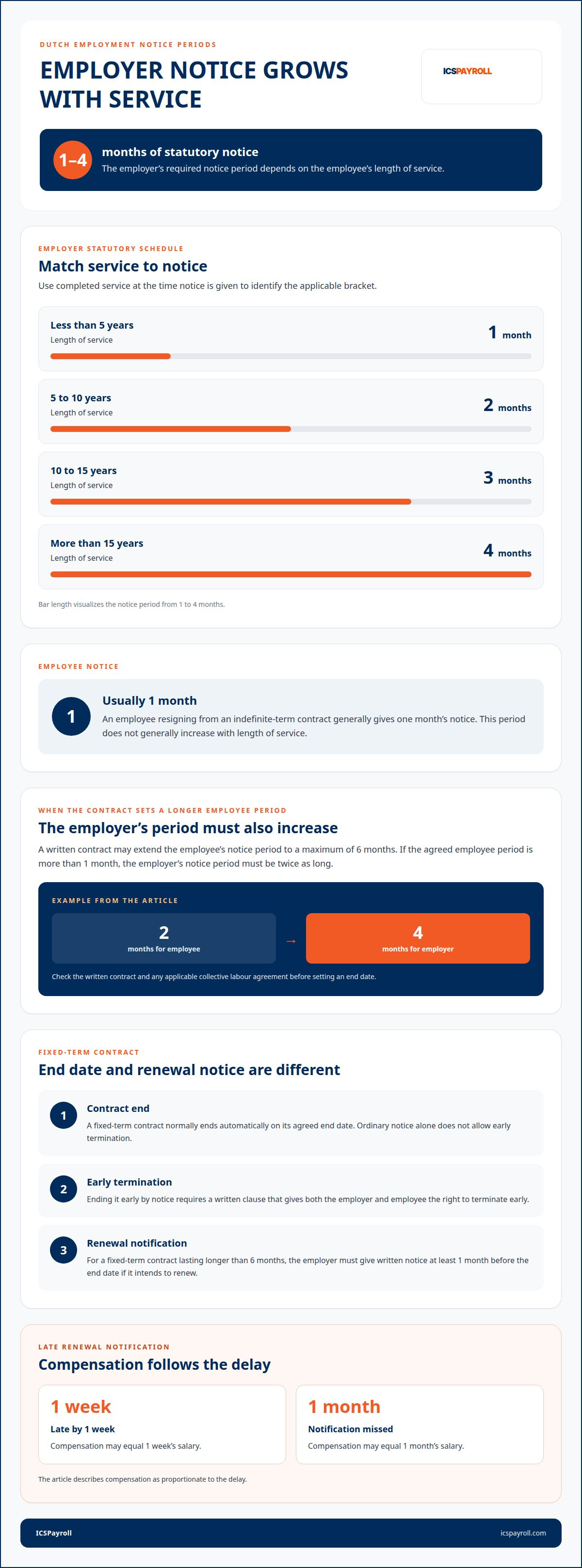
For employers, the notice period under Dutch labor law is one month for employees with less than five years’ service, two months for five to ten years, three months for ten to fifteen years, and four months for more than fifteen years, according to the Government of the Netherlands. An employee resigning from an indefinite-term contract generally gives one month’s notice.
A fixed end date or a clause in the contract may seem to settle the matter, but the rules also depend on whether the contract is permanent or fixed-term, whether early termination was agreed in writing, and whether an exception applies.
This guide explains how to calculate notice periods, when a fixed-term contract can end early, and what compensation may be due if notice is late or insufficient. It also covers the end-of-month rule and key exceptions, so employers and employees can understand the steps and consequences before ending employment.
Key Takeaways
- Match the employer’s statutory notice period to the employee’s length of service. For more than fifteen years of service, it is four months, according to the Government of the Netherlands.
- A fixed-term contract normally ends on its agreed end date. Ending it earlier by notice requires a written agreement allowing both parties to do so.
- Giving notice too late can create a compensation obligation tied to the wages for the notice period that was not observed.
- Notice generally takes effect at the end of a calendar month, so the timing of the notice can affect the employee’s final working date.
- Some situations, including summary dismissal and the probation period, follow different notice rules.
What is (statutory) notice period?
A Dutch employer’s statutory notice period depends on the employee’s length of service, ranging from one to four months. An employee resigning from an indefinite-term contract generally gives one month’s notice.
Employer Notice by Length of Service
The statutory employer notice period is the minimum time between giving notice and the end of employment, and it increases with length of service. The required period is one month for less than five years, two months for five to ten years, and three months for ten to fifteen years. This schedule helps employers plan an end date and employees understand how much notice applies.
For longer service, according to the Government of the Netherlands’ notice-period guidance, an employer’s statutory notice period is four months when the employee has worked longer than fifteen years. For example, an employee with twelve years of service falls into the three-month bracket. The applicable period is based on completed service at the time notice is given, so an employer should use the employment record to identify the correct bracket.
Longer Contractual Notice Periods
A written employment contract can set a longer employee notice period, but that also increases the employer’s corresponding obligation. If the employee’s agreed notice period exceeds one month, the employer’s period must be twice as long. For example, a two-month employee notice period requires the employer to give at least four months’ notice.
The employee’s notice period may be extended in writing to a maximum of six months. If it exceeds one month, the employer cannot keep its statutory period unchanged. Review the contract alongside the statutory service-based schedule before communicating an end date. A collective labour agreement may also affect the applicable terms, so check which agreement governs the employment.
For a fixed-term contract lasting longer than six months, the employer must notify the employee in writing at least one month before the end date if it intends to renew. This notification concerns continuation, not early termination. Late notification can mean compensation proportionate to the delay: one week late means one week’s salary. Missing the notification entirely can mean compensation of one month’s salary.
Employee Notice and Length of Service
An employee’s statutory notice period generally does not increase with length of service: an employee resigning from an indefinite-term contract usually gives one month. The employer’s notice period, by contrast, increases with length of service. This distinction matters when calculating each party’s obligations, especially if the contract sets a different employee notice period.
The employment contract may explicitly set a shorter or longer employee notice period. If the agreed period exceeds one month, the employer must give twice that period. For instance, a two-month employee notice period means at least four months for the employer. Check the written terms before setting a final employment date. Mutual agreement alone does not override statutory requirements.
Can a Fixed-Term Contract Be Terminated Early?
A fixed-term contract normally ends automatically on its agreed termination date. Whether it can end sooner depends on the written agreement, the applicable collective labour agreement, and the termination route. The notice period under Dutch labor law does not, by itself, allow either party to end every fixed-term contract early.
Notice Requirements for Fixed-Term Contracts
A fixed-term contract expires on its agreed end date without notice. This distinction matters because an employer cannot treat it like an indefinite-term agreement and end it early through ordinary notice without a valid basis.
For a fixed-term contract lasting longer than six months, the employer must notify the employee in writing at least one month before its end date if it intends to renew. This notification duty, known as the aanzegplicht, is set out in Article 7:668 of the Dutch Civil Code. If notice arrives late, compensation is proportionate to the delay. A delay of one week means one week’s salary; failure to provide the required notification may mean one month’s salary.
Changing a notice period depends on the contract and any collective labour agreement, or cao. The parties may extend a notice period in writing, but shortening it is not permitted unless the cao specifically allows it. An individual agreement cannot shorten the employer’s statutory notice period. Check the applicable agreement before communicating a proposed termination date.
Early Termination Clauses
An early termination clause is a written provision allowing both parties to end a fixed-term contract before its agreed end date by giving notice. Under Article 7:667(3) of the Dutch Civil Code, this right must be agreed in writing for both parties. Without that clause, ordinary notice does not provide a route to early termination.
The clause should give both the employer and employee the right to terminate early. A clause granting that right to only one party does not meet this requirement. Before relying on one, confirm that it covers both parties and identify the applicable notice period. Consider the notice period under Dutch labor law alongside the clause: the clause does not change the original end date unless early termination takes effect under its terms.
Temporary agency contracts can have additional rules. The agency-work provisions in Article 7:691 of the Dutch Civil Code address the agency clause. While that clause applies, an agency worker may end the contract immediately during the first 26 weeks of work. For recruitment agency work, the notice period is five days for employment lasting from 12 to 26 weeks, 10 days from 26 to 52 weeks, and 14 days from 52 to 78 weeks. No notice period is required for employment lasting from zero to 12 weeks.
For a fixed-term Phase B agency contract with an early termination clause, the employee generally gives one month’s notice. An agency clause and an early termination clause are distinct, so identify which provision applies before processing a resignation or dismissal. A contract ending on its agreed date follows a different route from early termination.
Compensation for insufficient notice
Ending employment before the required notice period expires can create an obligation to pay compensation for wages. Dutch employment law also provides a separate payment when an employer gives late or missing notice about continuing a qualifying fixed-term contract. These payments address different failures, so identify which obligation was missed before calculating what may be owed.
Under Article 7:672(11) of the Dutch Civil Code, a party that gives notice for an earlier end date than allowed owes compensation equal to the wages for the remaining notice period. If an employee is entitled to another month of notice but employment ends immediately, compensation corresponds to that remaining period’s wages. The same principle applies whether the employer or employee gives insufficient notice. The calculation should use the notice period that applied and the wages attributable to the unserved portion.
For a qualifying fixed-term contract, the employer’s renewal notification must arrive in writing at least one month before the end date. Late notification can trigger compensation proportionate to the delay: one week late means one week’s salary. If the employer gives no required notification, compensation may equal one month’s salary. This payment is distinct from compensation for shortening a notice period. Notification compensation is not due in cases of bankruptcy, deferral, or application of the debt restructuring scheme for natural persons.
These amounts are not automatically interchangeable with a settlement payment. An employer and employee may agree on an end date in a settlement agreement, potentially changing the date that would otherwise follow from notice. Under Article 7:670b of the Dutch Civil Code, a Dutch employee can cancel a signed settlement agreement in writing within 14 days without giving a reason. If the agreement omits the reflection period, the period extends to 21 days.
A transition payment is a separate statutory entitlement, not payment for a shortened notice period. It accrues from the first day of employment, including during probation, and is calculated at one-third of monthly salary per calendar year of employment. Under Article 7:673 of the Dutch Civil Code, the 2026 maximum is €102,000 gross, or one year’s salary if that is higher. The amount depends on salary and length of service.
Fair compensation is distinct from both notice compensation and the transition payment. It is not automatically added to every dismissal payment. Summary dismissal also differs from ordinary notice-based termination because it can take effect immediately. Keep the notice calculation, any fixed-term notification payment, and any transition payment separate in the final payroll and settlement records. This clarifies which payment relates to a notice shortfall, a late notification, or the end of employment.
Notice taking effect at the end of a calendar month
Under Dutch employment law, notice generally takes effect at the end of a calendar month. Article 7:672(1) allows another day if the parties agreed it in writing or it follows from custom. This rule affects the termination date, not the length of the statutory notice period. Employers should calculate both before confirming an employee’s final day.
For an employee resigning from a permanent contract, the notice period starts on the first day of the month after notice. If the employee gives notice on 12 March and has a one-month period, the period starts on 1 April. Applying the month-end rule, employment ends on 30 April. The notice date alone does not mean the month runs from 12 March to 12 April.
For an employer, the notice period begins the day after the employee is told about dismissal or redundancy and ends on the employee’s last day. The end-of-month rule still affects the termination date. For example, notice given during March must be calculated using the applicable period and month-end rule. The letter should state the intended end date clearly, rather than only naming a number of months.
Use this sequence to calculate an ordinary notice date:
- Identify whether the employee or employer is giving notice.
- Confirm the statutory or contractual notice period that applies.
- Record the date notice is communicated, then apply the relevant start rule.
- Set the end date at month-end unless a different day applies in writing or through custom.
For example, an employee who resigns on 12 March with a one-month notice period starts that period on 1 April. The resulting end date is 30 April. By contrast, if a written agreement sets another termination day, that agreed date may apply instead. The written contract and any applicable collective agreement can help establish the terms governing notice, which may differ according to the applicable arrangements.
Keep the notice letter, delivery date, applicable agreement, and calculated final date together in the employment record. This documents why a particular end date was chosen if the employee later queries the final salary period. A month-end date can also affect handover planning and final administration, so use the same date in the dismissal letter and payroll records.
The month-end rule applies to notice-based termination. Summary dismissal is different: it takes effect immediately and does not run through an ordinary notice period. Treating an immediate dismissal like a month-end termination confuses two separate routes. Record the stated basis and effective date accurately, as these determine whether ordinary notice calculations apply.
Exceptions to notice periods
Several situations in the Netherlands change how ordinary notice rules apply. The main distinctions concern immediate dismissal, probation, UWV procedures, illness, on-call work, and agreed termination dates.
Summary dismissal for gross misconduct takes effect immediately, so no notice period is required. This differs from ordinary dismissal, which follows the applicable notice rules. The employer does not wait until month-end for employment to end. Clearly record the reason and effective date.
Probation is another exception: either party may end employment without notice during the valid trial period. The permitted probation period depends on the contract type and duration. For example, the Fact Sheet 2026 allows a maximum of one month for fixed-term contracts lasting six to 24 months, and two months for indefinite contracts. No probation period is allowed for a contract lasting six months or less.
After the UWV gives permission to dismiss, the employer’s notice period is shortened by the duration of the UWV procedure. At least one month must still remain. Account for the procedure when calculating the final date, then apply the relevant notice rules. Permission does not remove the minimum remaining period.
Illness creates a separate limit on termination. The dismissal ban generally applies during the first two years of an employee’s illness, and an employer generally cannot terminate by notice for illness lasting less than 104 weeks. This restriction concerns dismissal during illness; it does not itself set a replacement notice period. Keep the illness timeline distinct from the notice calculation.
For a zero-hours or on-call contract, the notice period is the short period that also applies to calling the employee in for work. The end-of-calendar-month rule does not apply under Article 7:672(5). An employer should therefore use the applicable call-in period, rather than calculating an ordinary month-end termination date.
Some circumstances may allow an employee to end employment without following the ordinary notice period. Separately, an employer and employee may agree on an employment end date through a settlement agreement. That date can differ from the one that would otherwise result from the statutory notice period. Clearly record the agreed date and the basis for ending employment.
A collective labour agreement may shorten the employer’s statutory notice period, while an individual contract cannot. This makes the applicable collective terms important when determining the required period. The contract, any collective agreement, the dismissal route, and the reason for termination each affect which rule applies.
ICSPayroll: Dutch Payroll Administration
ICSPayroll supports employers with Dutch payroll administration during employment changes, including an employee’s final payroll period. Accurate processing depends on applying the correct end date and accounting for any compensation due when notice requirements are not met.
For companies hiring employees in the Netherlands, ICSPayroll also provides Employer of Record (EOR) services. This can be relevant when a business needs an employment solution alongside local payroll administration. International employers may also use the 30% Ruling Application service for eligible employees.
Contact ICSPayroll to discuss Dutch payroll administration or an Employer of Record arrangement for your Netherlands workforce.
Build a Clearer Employment Process
Employment changes are easier to manage when notice decisions are part of a consistent HR process. Keeping contract terms, communications, and the agreed end date on record helps teams coordinate payroll and handovers with fewer administrative gaps. It also gives managers a reliable basis for handling future changes.
Understanding notice periods under Dutch labor law is one part of responsible employment management. International employers can also consider how Dutch payroll administration or an Employer of Record arrangement fits their workforce, while eligible employees may benefit from a 30% Ruling Application.
For support aligned with your Dutch workforce, contact ICSPayroll. A well-organized process gives your team a practical foundation for each employment transition.
Frequently Asked Questions
How do you resign correctly?
Give your employer clear written notice and state your intended resignation date. This creates a record of what you communicated and when. For an indefinite-term contract, an employee generally gives one month’s notice, starting on the first day of the following month. Before sending notice, compare your employment contract with any applicable collective labour agreement, as written terms may affect your notice period.
On which date does the contract end?
The end date depends on the contract type, the notice period, and when the notice takes effect. A fixed-term contract generally ends on its agreed date. For a permanent contract, notice ordinarily takes effect at month-end, unless another day applies under a written agreement or established custom. For example, a resignation given in March with a one-month period can result in an end date at the end of April.
What should you check as an employee?
Review the employment contract and applicable collective labour agreement for the notice period, any early-termination clause, and the method for giving notice. For a fixed-term contract, check whether both parties have a written right to end it early. Also confirm final payroll arrangements: untaken holiday entitlement and accrued holiday allowance must be paid when employment ends.
When Can an Employee Resign Without Notice?
An employee may resign with immediate effect because of a contract breach and, in that situation, does not have to give notice. This differs from an ordinary resignation, which follows the applicable notice terms. State clearly in the communication that the resignation is immediate and identify the contract breach, so the reason and effective date are documented.
What is the statutory employee notice period in the Netherlands?
An employee resigning from an indefinite-term contract generally gives one month’s notice. Unlike the employer’s statutory period, this does not increase with length of service. The employment contract may set a different employee notice period in writing, subject to legal limits. Check whether a collective labour agreement also applies, as its provisions can affect the terms governing the employment relationship.
How do collective labor agreements (CAOs) affect Dutch notice periods?
A collective labour agreement, or CAO, can set notice terms that differ from an individual contract. It may permit a shorter notice period where the applicable rules allow it. The applicable notice period may depend on the terms governing the employment relationship. Check which CAO applies to the role and whether its notice provision covers the employee’s situation.
When must notice be given in the Netherlands, and how does the calendar-month rule work?
Give notice early enough to meet the applicable period and end date. For an employee resigning from a permanent contract, the period begins on the first day of the month after notice is given. Employment generally ends at month-end once the required period has run. A written agreement or established custom may provide for a different end date.
Can a Dutch employment contract set a different notice period, and what limits apply?
Yes. The employment contract may extend an employee’s notice period in writing, up to a maximum of six months. If the agreed period exceeds one month, the employer’s notice period must be twice as long. For example, a two-month employee notice period means the employer must give at least four months. An individual contract cannot shorten the employer’s statutory notice period.

Article by
Joost Hubregtse
Joost Hubregtse is Director of ICS Staffing & Payroll B.V., the wholly owned subsidiary of Intercompany Solutions behind ICS Payroll. He is responsible for Employer of Record and Dutch payroll services: employment contracts, wage tax and social security filings, holiday allowance, pension, sick leave and CAO compliance, with onboarding possible within 48 hours.
Frequently Asked Questions
Give your employer clear written notice and state your intended resignation date. This creates a record of what you communicated and when. For an indefinite-term contract, an employee generally gives one month’s notice, starting on the first day of the following month. Before sending notice, compare your employment contract with any applicable collective labour agreement, as written terms may affect your notice period.
The end date depends on the contract type, the notice period, and when the notice takes effect. A fixed-term contract generally ends on its agreed date. For a permanent contract, notice ordinarily takes effect at month-end, unless another day applies under a written agreement or established custom. For example, a resignation given in March with a one-month period can result in an end date at the end of April.
Review the employment contract and applicable collective labour agreement for the notice period, any early-termination clause, and the method for giving notice. For a fixed-term contract, check whether both parties have a written right to end it early. Also confirm final payroll arrangements: untaken holiday entitlement and accrued holiday allowance must be paid when employment ends.
An employee may resign with immediate effect because of a contract breach and, in that situation, does not have to give notice. This differs from an ordinary resignation, which follows the applicable notice terms. State clearly in the communication that the resignation is immediate and identify the contract breach, so the reason and effective date are documented.
An employee resigning from an indefinite-term contract generally gives one month’s notice. Unlike the employer’s statutory period, this does not increase with length of service. The employment contract may set a different employee notice period in writing, subject to legal limits. Check whether a collective labour agreement also applies, as its provisions can affect the terms governing the employment relationship.
A collective labour agreement, or CAO, can set notice terms that differ from an individual contract. It may permit a shorter notice period where the applicable rules allow it. The applicable notice period may depend on the terms governing the employment relationship. Check which CAO applies to the role and whether its notice provision covers the employee’s situation.
Give notice early enough to meet the applicable period and end date. For an employee resigning from a permanent contract, the period begins on the first day of the month after notice is given. Employment generally ends at month-end once the required period has run. A written agreement or established custom may provide for a different end date.
Yes. The employment contract may extend an employee’s notice period in writing, up to a maximum of six months. If the agreed period exceeds one month, the employer’s notice period must be twice as long. For example, a two-month employee notice period means the employer must give at least four months. An individual contract cannot shorten the employer’s statutory notice period.